

The rapid growth of unmanned aircraft systems (UAS) is reshaping the aviation landscape in ways few could have predicted a decade ago. Once considered a niche technology, drones have become indispensable tools across a broad range of industries, including public safety, critical infrastructure, utilities, construction, agriculture, transportation, security, cinematography, environmental research and emerging advanced air mobility (AAM) operations.
Thank you for reading this post, don't forget to follow and signup for notifications!
As drone adoption continues to accelerate, a new challenge is emerging: how to safely integrate an unprecedented number of unmanned aircraft into an already complex National Airspace System (NAS).
A new era in aviation
The scale of drone adoption is unlike anything previously experienced in aviation. According to Federal Aviation Administration (FAA) data, the United States has approximately 230,000 registered traditional aircraft, including commercial airliners, helicopters, business jets, agricultural aircraft and general aviation aircraft.
By comparison, nearly one million drones are currently registered nationwide.
The transformation is particularly evident within public safety. Historically, approximately 300 law enforcement, fire and emergency services aviation programs operated manned aircraft. Today, more than 10,000 public safety agencies utilize drone programs to support emergency response, search and rescue, disaster assessment, crime scene documentation and situational awareness.
Pilot certification trends further illustrate this shift. FAA statistics indicate there are roughly 900,000 certificated traditional pilots and nearly 500,000 certificated remote pilots. The growth rate of remote pilot certification continues to outpace that of traditional aviation, reflecting the increasing role drones play in both public and private sector operations.
Drone as First Responder changes the paradigm
One of the most significant developments in recent years has been the rapid emergence of Drone as a First Responder (DFR) programs.
Enabled by evolving FAA regulations and streamlined approval processes, DFR programs allow drones to launch immediately in response to emergency calls and provide real-time intelligence before first responders arrive on scene. These operations typically involve Beyond Visual Line of Sight (BVLOS) flights, enabling agencies to extend coverage and improve response times while reducing operational costs.
The expansion has been dramatic. Following FAA process improvements in 2025, approved DFR operations grew from approximately 50 approvals over six years to more than 1,000 approvals within six months. The FAA now approves roughly 125 new DFR operations each month.
Operational data from these programs has demonstrated an exceptionally low risk of collisions between drones and traditional aircraft, helping validate the safety case for expanded BVLOS operations.
| RELATED: The DFR decisions every chief faces before the first drone ever flies
The next airspace challenge
While much attention has focused on preventing conflicts between drones and manned aircraft, the next major challenge may be managing interactions between drones themselves.
Commercial drone delivery services continue to expand, approaching one million successful deliveries nationwide. At the same time, public safety agencies are deploying increasing numbers of DFR operations in urban, suburban and rural environments. Infrastructure inspections, utility operations, mapping missions and other commercial applications are adding even more aircraft to the airspace.
As these activities grow, many will occur within the same geographic areas and at similar altitudes.
The question is no longer whether drones can safely coexist with traditional aircraft. The emerging challenge is determining how thousands of unmanned aircraft conducting diverse missions can safely operate alongside one another while maintaining efficiency, reliability and public trust.
The importance of UAS Traffic Management
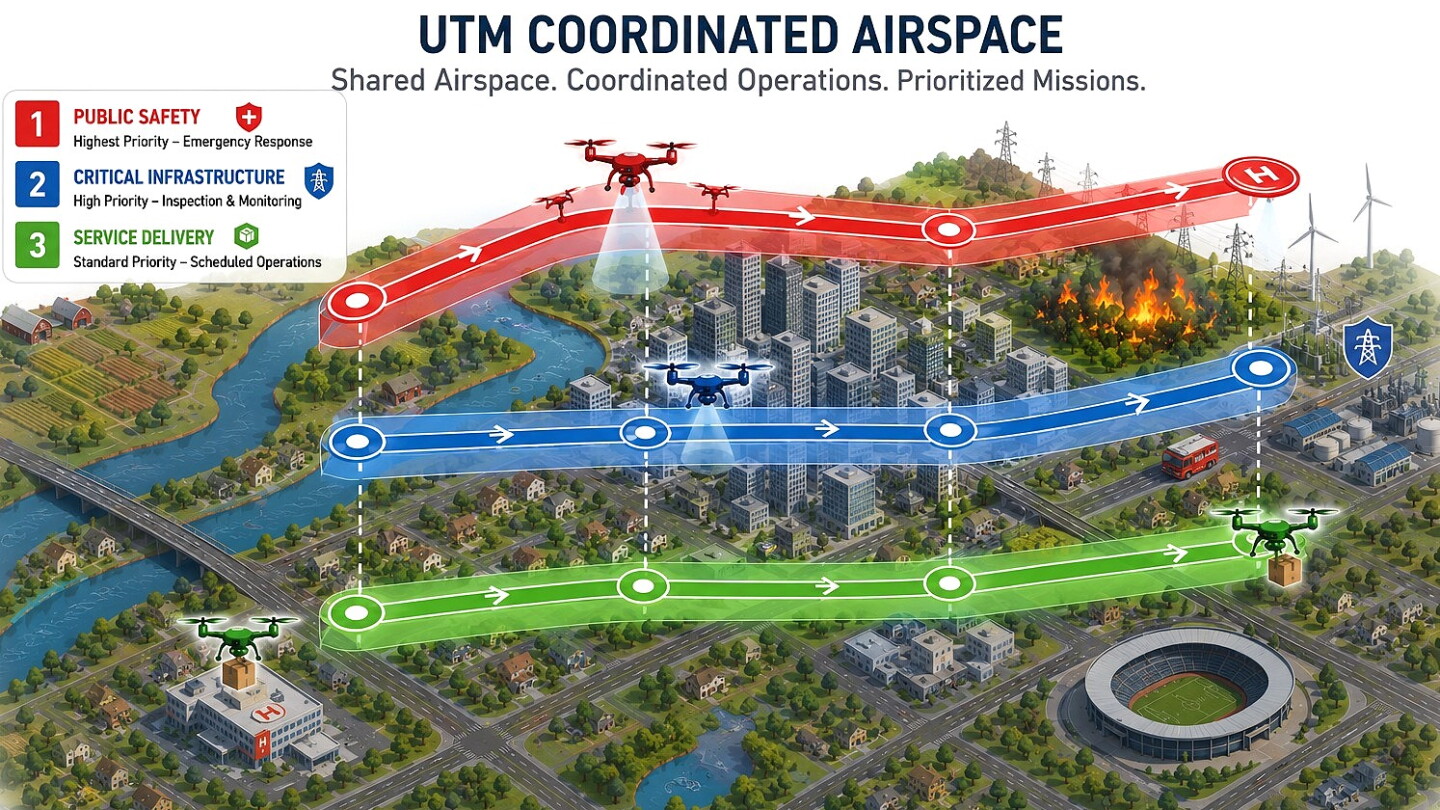
The long-term solution lies in the successful development and implementation of UAS Traffic Management (UTM).
UTM is envisioned as a digital ecosystem that enables aircraft operators, service suppliers, regulators and other stakeholders to share information, coordinate operations, manage conflicts and support safe integration at scale.
Although significant progress has been made, UTM remains in its developmental stages. Many of the governance structures, operational standards, interoperability requirements and sustainable business models necessary for widespread deployment are still being defined.
For public safety agencies, understanding how they will participate in future UTM environments is becoming increasingly important.
While there are questions that still need to be answered, we must not let them delay progress on UTM or its prioritization.
Preparing for Part 108
The FAA’s forthcoming Part 108 BVLOS rule is expected to further accelerate drone operations across virtually every sector.
By enabling routine BVLOS operations on a national scale, the rule is likely to increase the number of commercial, industrial and public safety aircraft sharing the NAS. While this expansion will unlock tremendous economic and operational benefits, it will also increase demands on airspace management systems.
The need for coordination, prioritization and scalable traffic management solutions will become more urgent as drone density continues to grow.
Building a strong safety foundation
Regardless of future regulatory developments, public safety organizations can take immediate steps to position themselves for success.
Programs should continue emphasizing aviation best practices, including:
- Remote pilot certification and qualification management
- Recurrent training and proficiency programs
- Crew Resource Management (CRM)
- Aircraft maintenance and airworthiness procedures
- Operational risk assessment processes
- Standard operating procedures and governance
- Comprehensive recordkeeping and documentation
Strong safety cultures not only reduce operational risk but also prepare agencies for integration into increasingly sophisticated airspace management environments.
Collaboration will drive success
The future of drone integration will depend on collaboration among regulators, public safety agencies, industry, UTM providers and commercial operators.
Public safety organizations and commercial service providers share a common objective: safe, reliable and scalable access to the airspace. Developing frameworks that enable operational deconfliction, mission prioritization and information sharing will be essential as drone operations continue to expand.
The transition from isolated drone operations to a fully integrated airspace ecosystem is already underway. The decisions made today regarding governance, interoperability and traffic management will shape the future of aviation for decades to come.
For public safety leaders, the time to engage in those discussions is now. DRONERESPONDERS has initiated a collaborative discussion with the Service Delivery Cohort, consisting of the largest service delivery companies, to develop an effective approach to airspace deconfliction and public safety prioritization.
| NEXT: On demand: What every agency needs to know as their DFR program evolves

