

[[{“value”:”
Thank you for reading this post, don't forget to follow and signup for notifications!
The following is based on reporting from African Lion 26, Tantan, Morocco. Interviews conducted with 1st Lt. Vincent Gasparri and General Dagvin R.M. Anderson, Commander, US Africa Command. Video below
We are not approaching a revolution in warfare. We are already inside it.
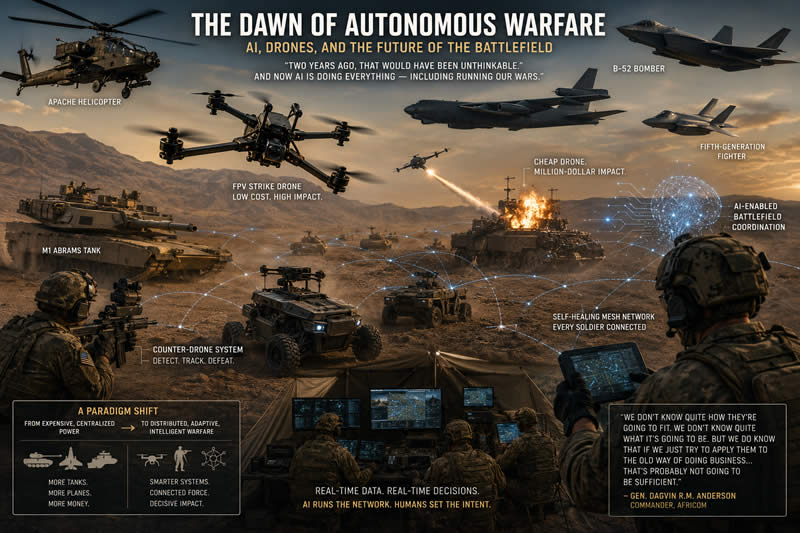
That was the unmistakable message from the deep Moroccan desert, where tens of thousands of troops from more than 40 nations gathered for African Lion 26 — one of the largest joint military exercises in the world. This year’s iteration looked nothing like its predecessors. Gone was the primary emphasis on conventional maneuver and firepower. In its place was something that would have seemed like science fiction just a decade ago: Apache helicopters, M1 Abrams tanks, B-52 bombers, fifth-generation fighters, and autonomous ground vehicles — all coordinated in real time by artificial intelligence. As one commander put it, watching the exercise unfold in the Moroccan heat: “Two years ago, that would have been unthinkable. And now AI is doing everything — including running our wars.”
That sentence should stop anyone cold. Not because it is alarmist, but because it is matter-of-fact.

For most of modern military history, battlefield dominance was a function of resources. The side with more tanks, more planes, more soldiers, and more money had the decisive advantage. Logistics and material concentration were treated as sacred. You protected your expensive, exquisite systems deep in the rear, away from the front, and projected power outward from that position of strength.
That calculus is now obsolete.
The Russia-Ukraine war demonstrated — brutally and repeatedly — that a cheap commercial drone, costing a few hundred dollars, could destroy a tank worth millions. Ukrainian operators adapted civilian FPV racing drones, added explosive payloads, and sent them screaming into Russian armor that had no effective countermeasure. The so-called “Trojan Horse” moment came when Ukrainian drones reached deep into Russian territory and struck $110 million bombers with weapons that cost a fraction of the price. Asymmetric warfare had found its ultimate expression: a small, precise, low-cost system delivering a strategic-level blow.
As 1st Lt. Vincent Gasparri — a West Point graduate in nuclear engineering and one of the architects of the US Army’s emerging drone capability — put it: “Resources and material resources used to be generally correlative to impact on the battlefield. Now we have very low-cost solutions that are both precise and effective. A small drone can cause a national or strategic impact. That is a paradigm shift.”
To understand the scale of what is being fielded, consider what Gasparri and his team have built in Vicenza, Italy — not at a DARPA lab, not at Lockheed Martin, but in the equivalent of a well-organized tent. They assemble attack FPV drones from commercial components, 3D printing custom mounts and modifications. They arm them with commercially available explosive delivery systems that interface cleanly with Army-supplied energetics. They build counter-drone systems using modified M4 rifles fitted with smart-tracking sights. They operate a self-healing mesh radio network — the MPU-5 — that allows every soldier in a formation, down to the platoon level, to access the internet in the field, networked through satellite terminals. And they have adapted a heavy-lift drone originally designed to deliver mail to the Italian Alps into a military resupply and munitions platform capable of carrying up to 200 pounds.
These are not prototype systems sitting in a lab awaiting approval. They were tested, fired, and flown during African Lion 26. Eleven FPV strike drones were launched against targets in a single exercise day. Counter-drone systems tracked and defeated incoming threats in real time. Autonomous ground vehicles — based on a Polaris Razor platform — navigated the exercise terrain without GPS and without operator commands. Given a destination, they found their own way there, carrying breaching explosives or a remote-controlled weapons turret. Soldiers learned to operate many of these systems in under ten minutes.
That last detail matters enormously. The barrier to entry is gone. The technology is accessible, intuitive, and already in the hands of 18-year-olds on their first operational deployment.
General Dagvin R.M. Anderson, commander of US Africa Command (AFRICOM), offered a frame of reference that cuts through the noise: we have been at this crossroads before.
At the dawn of the 20th century, the world had airplanes, submarines, machine guns, and radio communications. None of these were secrets. Everyone could see them coming. And yet, when the First World War erupted, no one fully grasped how these technologies would combine to transform warfare utterly. The stalemates of the Western Front — the trenches, the barbed wire, the catastrophic losses — reflected the failure of military thinking to keep pace with military technology. A generation later, the Germans synthesized the lesson into something new. They called it blitzkrieg. The French had built the Maginot Line — an engineering marvel designed around the previous war’s logic — and were bypassed completely, at a speed they could not mentally process or physically respond to.
Anderson’s point was direct: “These elements are coming together into a different type of warfare. We don’t know quite how they’re going to fit. We don’t know quite what it’s going to be. But we do know that if we just try to apply them to the old way of doing business — strong-point defense, build a wall to hold the border — that’s probably not going to be sufficient.”
The digital age is doing to warfare what the industrial age did to it a century ago. The difference is the speed. The uptake of AI across global society has been, as Anderson described it, remarkable for its absence of cultural lag. There was no transition period, no generational handoff, no slow adoption curve. Within a few years, AI went from a niche research concept to the operational backbone of military exercises involving 40 nations.


With autonomous weapons systems — ground vehicles carrying machine guns, drones programmed to fly into targets — comes a question that cannot be deferred: who is responsible when the machine acts?
The US military has drawn a firm line, at least for now. The doctrine is built around two positions: human in the loop (a human must authorize every individual action before it is taken) and human on the loop (a human monitors parameters and constraints, while the system executes within those boundaries automatically). What is explicitly off the table, according to Anderson, is human off the loop — a fully autonomous system that acts without any oversight whatsoever. As he described it, even a laser anti-drone defense system — turn it on and it will shoot down incoming threats automatically — still requires a human monitoring to ensure it isn’t targeting airliners or allied aircraft. You turn it on, but you don’t walk away.
That distinction matters, but it also raises harder questions downstream. When autonomous systems are sold or transferred to partner nations operating under different rules of engagement, or when adversaries develop and deploy systems with no equivalent ethical constraints, the human-on-the-loop model faces pressure it may not be designed to withstand. The military acknowledges this openly. The answer they give is not reassuring but it is honest: this is not a new problem. The United States has managed end-use agreements and rules of engagement with partner nations for decades across conventional weapons transfers. The technology is newer, the pace is faster, but the framework exists.
The deeper cultural challenge is the one General Anderson named plainly: most people’s only reference point for autonomous military robots is the Terminator. That cultural image — the machine that decides to kill and cannot be stopped — has colonized public imagination in a way that makes rational policy discussion genuinely difficult. The real answer, he argues, lies neither in utopian nor dystopian extremes. It lies in the space that society is currently unwilling to occupy: a difficult, honest, ongoing conversation about how these tools are employed, what constraints govern them, and who bears responsibility for what they do.
Looking two to three years out, the trajectory is clear even if the destination is not. Targeting — the process of identifying, selecting, and engaging threats — will need to be automated at a scale that no human staff can manage. The number of low-cost drones that can be generated and deployed simultaneously already outstrips traditional targeting workflows that once took days, then hours. Future battlefields will require processing thousands of potential targets in minutes, repeatedly, with the kind of precision that eliminates collateral damage. That is a job for large language models and advanced AI systems, not human analysts working from paper maps.
Individual autonomous systems — a drone, a ground vehicle, a sensor — are not the story. The story is the network. Each system becomes a node in a larger web of sensing, data-gathering, communication, and effects delivery. The AI doesn’t just fly the drone. It integrates everything, processes the data, formats it for human decision-makers, and enables directed action at a speed and scale that was previously impossible.
Add quantum computing to that picture and the implications become harder to comprehend. Quantum-protected AI systems — powerful, encrypted, effectively impenetrable — create both extraordinary military advantages and extraordinary risks. The nations that get there first will hold a decisive edge. The nations that do not will face systems they cannot crack, cannot counter, and may not even be able to detect.
The United States, China, Israel, Ukraine, Russia, and a cluster of sophisticated allies are all running in this race simultaneously.
The soldiers taping drones together in a tent in Morocco are not playing games. They are writing the opening chapter of a new kind of war — one that is already underway, already consequential, and still, by almost any measure, just getting started.
“}]]

