


By Glenn Norling
Thank you for reading this post, don't forget to follow and signup for notifications!
“Active shooter incidents are not single-agency problems. They are regional missions that demand unity across institutions, disciplines and leadership.” — Scott Hyderkhan
The field of active shooter and targeted violence prevention has evolved significantly over the past two decades, shaped by hard lessons, painful losses and the growing recognition that response alone is insufficient.
Despite this progress, the discipline remains fragmented, often divided by jurisdictional boundaries, professional silos and an overreliance on tactics divorced from leadership, culture and systems thinking.
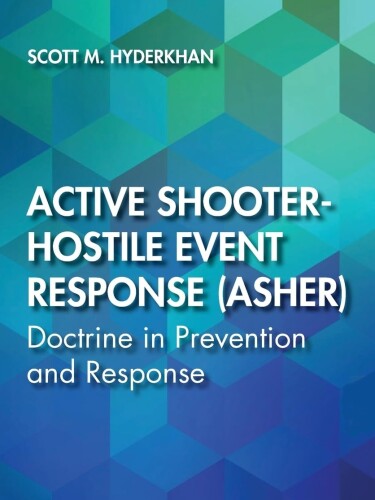
In “Active Shooter–Hostile Event Response (ASHER): Doctrine in Prevention and Response,” Scott Hyderkhan offers a timely and disciplined contribution that seeks to address these gaps through a comprehensive, doctrine-driven framework focused on prevention, preparedness, response and recovery as a unified mission.
Rather than presenting another tactical manual or compliance checklist, Hyderkhan frames active shooter incidents as inherently regional and shared challenges.
What makes ASHER stand apart
The ASHER 360 doctrine is constructed around four foundational pillars: Mission Command, Operational Doctrine, Tactical Doctrine and Training Management. Each is intentionally designed to reinforce the others. This structure reflects a mature understanding that preparedness is not achieved through isolated policies or periodic training, but through sustained alignment of leadership, planning, execution and evaluation across institutions.
One of the book’s strongest elements is its emphasis on leadership as the foundation of effective prevention and response. Hyderkhan draws heavily from Mission Command philosophy, emphasizing competence, mutual trust, shared understanding, commander’s intent, disciplined initiative and prudent risk acceptance.
He makes a persuasive case that organizational culture — how leaders communicate, delegate, train and hold teams accountable in daily operations — determines whether institutions are capable of adaptive, coordinated action under stress. This perspective will resonate with seasoned practitioners who have seen well-written plans fail because of cultural friction and unclear leadership expectations.
The book’s treatment of interoperability is similarly grounded in experience. Hyderkhan, who served as a U.S. Army Ranger before beginning a second career as a law enforcement tactician, does not assume agencies or institutions naturally collaborate effectively. He candidly acknowledges the friction caused by differing authorities, vocabularies, priorities and levels of preparedness.
ASHER advocates for standardized language, shared operational frameworks, regional planning cells and deliberate dissemination of plans across all echelons. The result is not a call for uniformity, but for compatibility — an important distinction that respects institutional differences while still demanding unity of effort.
Leadership and interoperability at the core
Another notable strength is the book’s refusal to narrowly define success as the rapid neutralization of a threat. ASHER devotes substantial attention to casualty care coordination, reunification operations, public information management, psychological recovery and the long process of returning affected communities to a functional sense of normalcy. These elements are treated as mission-essential tasks rather than secondary concerns.
In doing so, the book recognizes that the human consequences of violence extend far beyond the incident footprint and that failures in recovery and reunification can compound trauma long after the immediate danger has passed.
From a prevention standpoint, the book’s inclusion of behavioral, psychological, emotional and relational considerations adds meaningful depth. ASHER reinforces the importance of early identification of risk, shared awareness and multidisciplinary engagement. This approach aligns with contemporary prevention models that recognize targeted violence as a process rather than a spontaneous act.
By embedding these concepts within a broader operational doctrine, Hyderkhan avoids treating prevention as a standalone program and instead positions it as an integral component of organizational readiness.
The training management doctrine presented in ASHER is particularly valuable for administrators and organizational leaders responsible for preparedness who may lack a tactical background.
The use of mission-essential task identification, multi-echelon training and continuous evaluation provides a practical framework for building and sustaining capability over time. Training is framed not as a compliance exercise, but as a leadership responsibility and cultural investment.
This perspective reinforces the idea that readiness is not achieved through one-time drills, but through consistent, standards-based development of people and teams.
Preparedness beyond the tactical response
While the book’s depth is one of its greatest strengths, it also underscores the seriousness of its purpose. Readers looking for quick-reference guidance will instead find a richly developed doctrine that rewards thoughtful engagement.
For professionals who have spent years navigating complex incidents and multi-agency operations, the sections on command and control and operational planning are particularly valuable.
In the hands of experienced senior law enforcement leaders and community safety professionals, this work becomes less a manual and more a leadership tool capable of shaping how organizations prepare long before a crisis unfolds.
ASHER challenges leaders to take ownership of preparedness, invest in relationships before crises occur and accept that prevention and response require sustained effort and humility. In a field where oversimplification is dangerous, that seriousness is a virtue.
For professionals committed to preventing targeted violence, this book will feel both familiar and clarifying. It reinforces lessons learned through experience while providing a structured framework to apply those lessons more coherently.
For community leaders, educators, emergency managers and first responders, ASHER offers a shared language and disciplined foundation for collaboration. It encourages readers to think beyond organizational boundaries and view preparedness as a collective responsibility.
In a discipline where credibility is earned through service and results, Scott Hyderkhan’s work reflects a deep respect for the complexity of the problem and for the people tasked with addressing it. For those dedicated to the prevention mission, this book is a meaningful contribution to the ongoing effort to keep communities safe.
If we are serious about preventing the next tragedy rather than simply responding to it, this is the kind of work we should be studying.
Hyderkhan’s latest book was released in March 2026 and is available online through Amazon and Routledge’s Taylor & Francis Group.
About the author
Glenn Norling is a retired FBI Special Agent and now serves as Senior Principal and Managing Director for the Active Shooter Prevention Project, an active shooter prevention solution and education company dedicated to enacting the first national standard to prevent and survive an active shooter event.
Glenn is a certified FBI crisis manager, an FBI instructor and FBI adjunct faculty. During his 20-year career, he was a field investigator and supervisor, and a supervisor at the FBI’s Critical Incident Response Group in Quantico, Virginia. Glenn has trained over 50,000 people in active shooter awareness and preparation since 2013.
Prior to the FBI, Glenn served 10 years in the United States Air Force as an acquisition program manager, managing multimillion-dollar weapon systems and state-of-the-art modeling and simulation training systems, separating at the rank of Captain.
He is a co-author of “School Safety: A Practical and Tactical Resource Guide for Administrators,” published in January 2026 by Bloomsbury Academic Publishing.
Glenn holds a bachelor’s degree in physics and a master’s degree in organizational management. He is a proud Eagle Scout and Gunsite graduate.


