


[[“value”:”
Thank you for reading this post, don't forget to follow and signup for notifications!

Kat Ainsworth Stevens
If you spend much time shooting, you’ve likely heard the terms point of aim and point of impact. Maybe you’re wondering what those phrases mean and what effect they have on you as a shooter. Or perhaps you’re curious about how point of impact changes (or doesn’t change at all) when shooting suppressed.
We’re going to answer those questions and explain why maintaining awareness of point of impact is a good thing for all gun owners, whether you’re a hunter or tactical shooter.
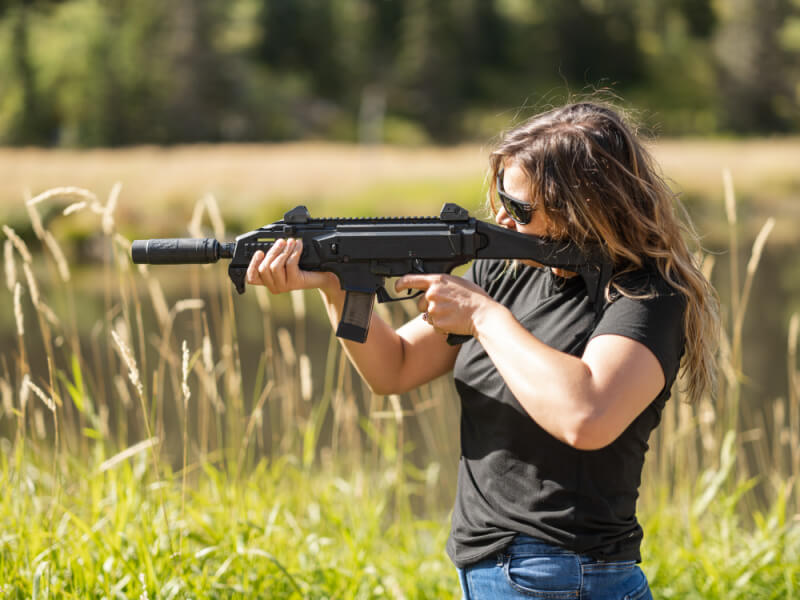
What is Point of Impact?
Point of impact refers to the location at which the bullet strikes the target. Your point of impact won’t always match point of aim, which is an important concept to familiarize yourself with to become a better shot.
This becomes clear when shooting at longer distances and learning about things like holdover. You’re not aiming precisely where you intend to hit, you’re aiming at the spot necessary for your shot to impact in the correct location based on various factors.
How Point of Impact Is Determined
Determining point of impact means considering various factors such as point of aim, distance, and wind. And for point of impact to be where you want it to be, your gun needs to be zeroed. More on that below.
Ballistics and trajectory come into play with point of impact. For example, if your gun is zeroed at 100 yards but you’re closer than that to the target, things change.
If you aim the gun the same way you would at longer distances, you might be surprised to find your shot impacts the target lower than you want. That’s because a close-range shot involves a bullet that hasn’t gone through its full trajectory, so when you’re close enough to the target, the bullet hasn’t risen like it will if you’re shooting at more distant targets.
Zeroing Your Optic
If you’re using optics, you’ll need to zero the scope so point of aim syncs with point of impact (just remember that you’re zeroing at a specific distance and any changes in distance affect POI and POA). An optic that isn’t zeroed can result in point of impact being all over the place, especially at longer distances.
It’s also important to remember you can’t swap an optic from gun to gun without zeroing it again. Accuracy requires a fresh zero with not only the firearm but also the ammunition being used.
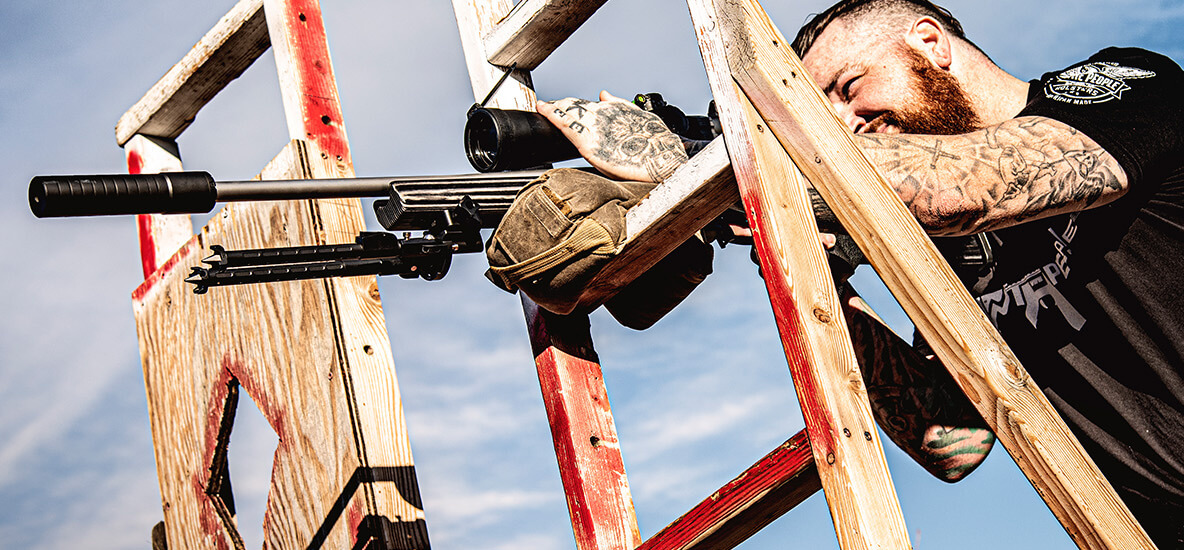
Sighting In Your Iron Sights
Using iron sights requires sighting in, a term that’s sometimes confused with zeroing. However, sighting in refers to iron sights, and zeroing applies to optics.
Sighting in helps you fine-tune point of aim and how it relates to point of impact. In the case of adjustable iron sights, it allows you to adjust elevation and/or windage as needed for more accurate hits on target.
Just like with zeroing an optic, keep in mind that the specific ammunition you’re using also changes things not only due to bullet weight but to the load itself.
Why Suppressors Don’t Change Point of Impact
Suppressors don’t affect point of impact in the way many people believe they do. In fact, if your suppressor is precisely aligned with your barrel (as it should be), you’re unlikely to notice any difference. Similarly, larger bore firearms tend not to experience a point of impact shift like smaller ones might. But is it the suppressor that affects it or something else entirely?
Yes, adding any weight and length to your gun’s barrel can shift point of impact, but it’s not the suppressor itself that literally changes point of impact. Once your gun is zeroed or sighted in with a suppressor, you’ll be right on target just like you are without a suppressor. However, the additional length and use of a muzzle device does alter the barrel harmonics of your firearm.
Bear with us, this is where it gets a bit pedantic. When you haven’t zeroed your gun and try to aim and shoot like you would without the suppressor, your results might not be quite the same. The harmonics changed, and you need to both zero the gun accordingly and get used to the difference in length and weight.
This is the same concept as the difference between running a rifle with a 16-inch barrel versus one with a 22-inch barrel. POI an POA won’t be identical.
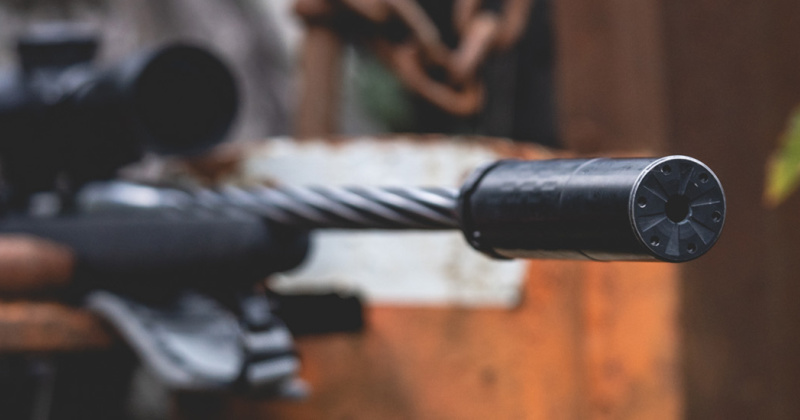
Happily, adding a suppressor and then zeroing your gun often results in greater accuracy than you experienced prior to the addition of the suppressor. This is thanks to a few things, including the way a suppressor can somewhat reduce felt recoil and muzzle rise.
What is Point of Impact Shift?
This refers to the shift in point of impact many shooters notice when adding a suppressor to their firearm. That shift might be real or perceived and certainly varies by gun, suppressor, and mounting system.
Lighter, thinner barrels generally see a point of impact shift. Similarly, heavier suppressors often cause a greater shift than lighter models. Point of impact might simply shift when the suppressor is new and the shooter has yet to properly zero their firearm. The latter problem often stems from the type of mounting system used or is caused by a suppressor walking itself loose on the barrel of the gun. These are signs to watch for to ensure the suppressor is securely attached to the barrel of the gun.
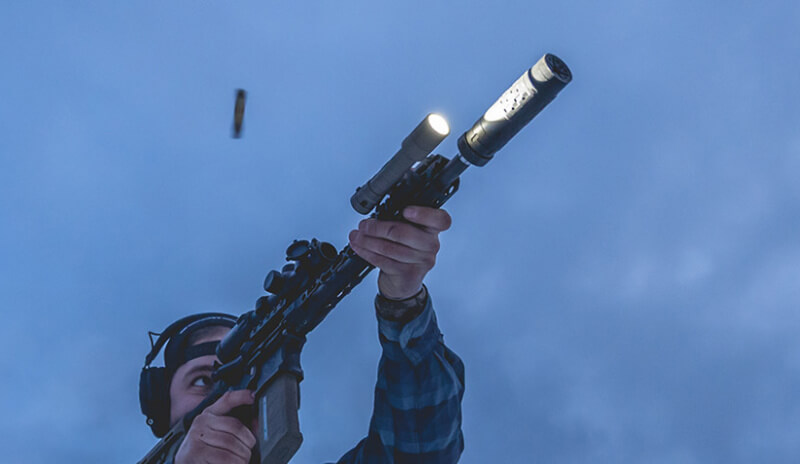
Guess what can cause point of impact shift that has nothing to do with the suppressor itself? Improperly threaded barrels. If the barrel threads aren’t executed with precision, the suppressor might not be able to mount precisely to the gun, resulting in a shift.
Shifts don’t necessarily have anything to do with the suppressor itself. A shooter can cause point of impact shift by failing to account for the extra weight and length while shooting.
There’s a difference between taking an offhand shot at a feral hog using an unsuppressed carbine, and making that shot with a 9-inch suppressor added to your setup. You’re likely not supporting that gun in the same way you were before adding a suppressor, and that’s ok as long as you’re aware of it and adjust accordingly.
When it comes right down to it, a suppressor on a zeroed firearm will usually deliver more precise results on target than the shooter was getting before adding the suppressor. Just another reason to add a suppressor to your favorite gun!
Kat Ainsworth Stevens
The post What Is Point of Impact, and What Determines It? appeared first on SilencerCo.
“]]

