

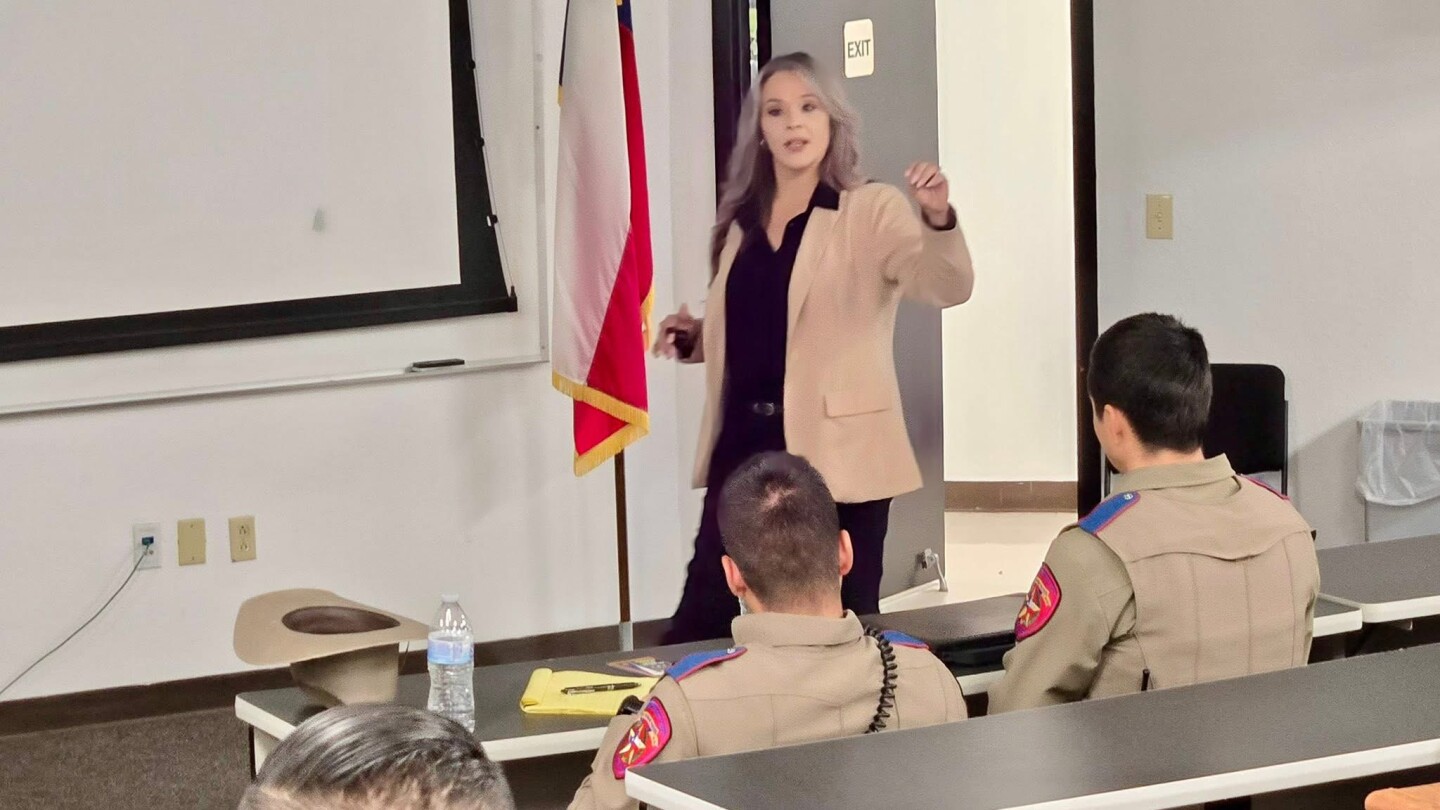
Katie Alexander has spent more than a decade talking to officers about traffic safety, but the conversation doesn’t stop at citations, crash data or enforcement campaigns.
Thank you for reading this post, don't forget to follow and signup for notifications!
For Alexander, a Texas law enforcement liaison and Below 100 core instructor, the work always comes back to the same question: How do we make sure officers get home at the end of the day?
“My job is to promote traffic safety,” Alexander said. “But the most important part of my job is making sure officers get home.”
| READ NEXT: What the lowest line-of-duty death total on record really means for policing
What do law enforcement liaisons do?
Law enforcement liaisons serve as a link between State Highway Safety Offices and local agencies, helping promote traffic safety initiatives, training and enforcement campaigns. The LEL program continues to have strong backing from NHTSA and the U.S. Department of Transportation.
Alexander said LELs have a unique opportunity to spread that message because they already have relationships with agencies across their states.
“I look at it as one of the smartest, best force multipliers in policing,” Alexander said. “You are tying them both together. They have access to everybody in their state.”
Alexander has nearly 25 years of law enforcement service and has spent almost 12 years as a Texas law enforcement liaison with the Texas Municipal Police Association under a Texas Department of Transportation grant. She is also an active law enforcement officer, holding dual commissions with agencies in the Houston area.
In her LEL role, Alexander works with agencies to identify crash problems in their communities, explain the data behind those trends and connect departments with funding for safety initiatives, including high-visibility enforcement campaigns such as Click It or Ticket.
“My job is to not only tell you what this grant is all about, but I can actually help you build it,” Alexander said.
But Alexander said the work cannot stop at encouraging more enforcement. If officers are going to be sent into traffic, she said, they need the training and reminders that keep them safe.
“In order to go out and push these guys to put themselves out there — what I consider to be in the line of fire — I’ve got to equip them with the knowledge it takes to go home at the end of the day to their families,” Alexander said.
For Alexander, that role is closely tied to Below 100, a national officer safety initiative focused on reducing preventable line-of-duty deaths and injuries. Below 100’s five tenets are simple: Wear your belt, wear your vest, watch your speed, WIN — What’s Important Now? — and remember that complacency kills.
Seatbelts, speed and the push to reduce preventable deaths
Traffic-related incidents remain one of the leading causes of line-of-duty deaths for law enforcement officers, though recent data shows signs of improvement.
According to the National Law Enforcement Officers Memorial Fund (NLEOMF), 34 officers died in traffic-related incidents in 2025, down 23% from 2024. Overall line-of-duty deaths also dropped to 111 nationwide — the lowest total in more than 80 years.
Alexander said programs like Below 100, combined with courageous conversations around officer wellness and safety culture, help agencies focus more attention on preventable deaths.
Alexander said one preventable behavior continues to stand out: officers not wearing seatbelts.
“If they would just put their seatbelts on,” Alexander said. “A lot of these crashes, they could have survived had they been wearing a seatbelt.”
She often hears familiar reasons from officers who resist buckling up: the seatbelt gets caught on gear, they believe they need to be able to exit their vehicle quickly, or they worry about being trapped after a crash. Alexander challenges those objections directly in training.
“Have you ever tried to practice taking your seatbelt off?” she said. “It does not take any longer to unbuckle before getting out.”
Alexander says officers must model the same behavior they enforce.
“If you’re going to go out and work Click It or Ticket, please wear your seatbelt,” Alexander said. “How do you go out and enforce when you’re not leading by example?”
The message, she said, is not about criticizing officers after a tragedy happens. It is about preventing the kinds of deaths that training and conversations may help avoid.
“Predictable is preventable,” Alexander said, referencing longtime Below 100 messaging from co-founder Gordon Graham.
Alexander said officers often approach her after training to share how the course changed their behavior. One officer told her he had never worn his seatbelt until taking Below 100. Later, after surviving a crash, he called Alexander and told her he would not have been able to make that call if he had not been buckled up.
Another officer emailed her after a class to say he wanted to show one of the course videos to his wife and daughter.
“He messaged me later on and said, ‘I shared it with not only my wife, but my daughter, and we were all in tears together,’” Alexander said.
That family connection is central to the message, she said.
All Texas law enforcement liaisons are instructors for Below 100 training. Alexander and fellow Texas LEL Trent Lozano are also core instructors, allowing them to teach both the four-hour Below 100 intensive course and the train-the-trainer course for instructors who want to bring the program back to their agencies.
Below 100 has also continued to grow through partnerships. In 2025, NLEOMF announced it would collaborate with NHTSA on Below 100 through their traffic safety partnership.
Alexander said NHTSA’s commitment goes beyond supporting the Law Enforcement Liaison program. The agency also backs the mission behind Below 100, particularly its focus on officer safety and reducing preventable traffic-related line-of-duty deaths.
Alexander said she has seen the model spread beyond Texas, with LEL programs in other states looking at how to connect traffic safety outreach with Below 100’s officer safety message.
“No matter what the law enforcement liaison’s role is, we still play a part, whether we’re teaching it or promoting it,” Alexander said. “We want to make sure that these guys make it home to their families at the end of the day.”
During Police Week, Alexander said the message is especially personal. Instead of taking a traditional vacation, she travels to Washington, D.C., each year to honor fallen officers.
“We have to honor the fallen by training the living,” Alexander said. “It’s not Monday morning quarterbacking. It’s saying, what can we learn? What can we do differently?”
For Alexander, the work keeps coming back to one outcome.
“We would love to get to zero,” Alexander said. “But we have to look at a realistic and feasible number, which is below 100.”
Resources from Below 100:
- Training courses
- Request a course
- Brochures and posters
Police1’s National Police Week coverage

