

[[{“value”:”
Thank you for reading this post, don't forget to follow and signup for notifications!
By Steve Tidwell
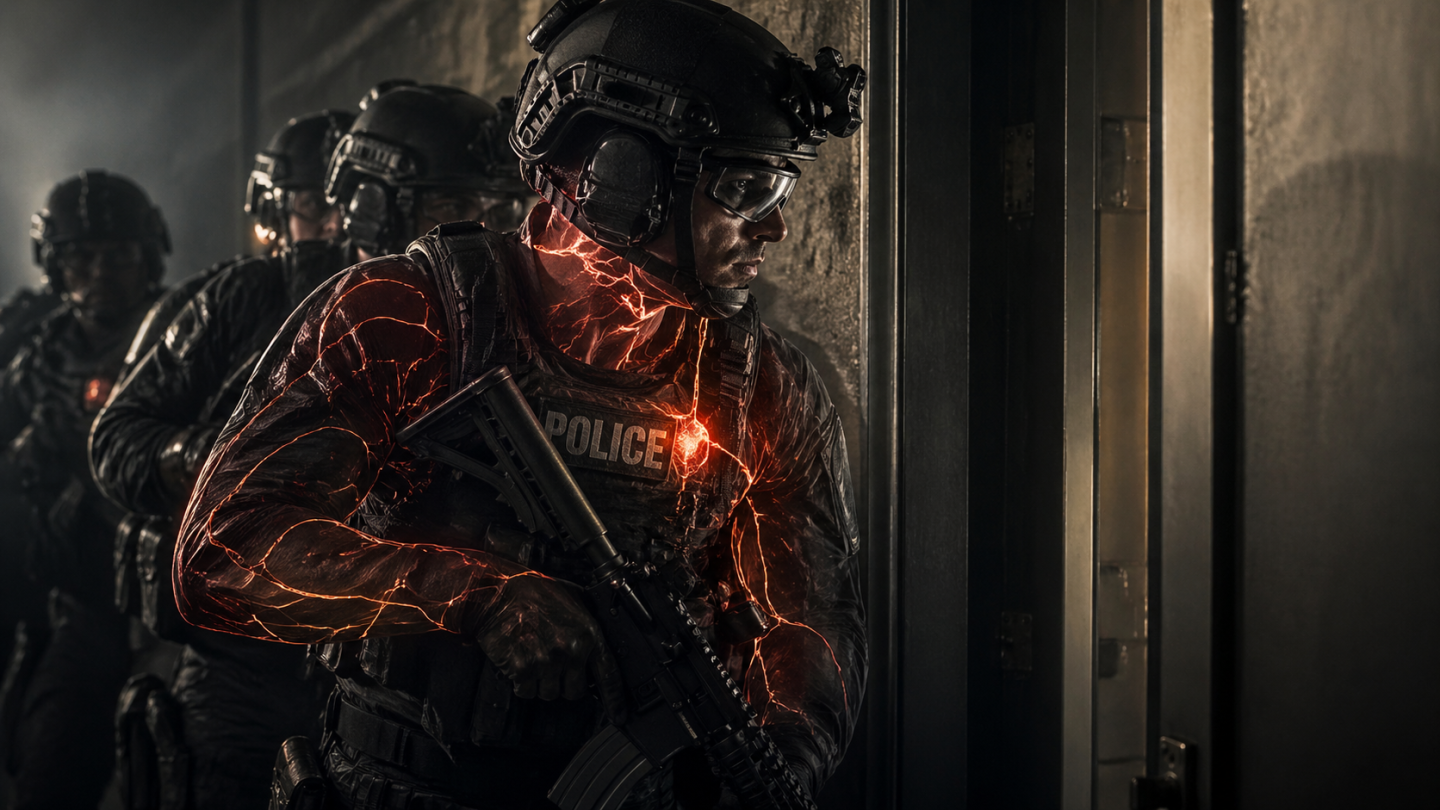
Every experienced warfighter and law enforcement officer knows the feeling. It arrives in the moments before a breach, a raid or a patrol in hostile territory. Hands tremble, the stomach turns and the heart hammers against the ribs. In locker rooms, we dismiss this sensation as “jitters” or hide it for fear of appearing weak. However, labeling this reaction as fear or anxiety is a fundamental error. Science offers a different explanation: this physical upheaval is not a sign of cowardice; it is the sound of the body’s engine revving to the redline before the clutch drops.
Understanding the difference between anxiety and biological mobilization is critical for effective leadership. When a leader sees a subordinate shaking before a high-risk warrant service, they might assume the officer is losing their nerve. In reality, that officer’s body is executing a complex survival sequence. The hypothalamus-pituitary-adrenal (HPA) axis is flooding the bloodstream with adrenaline and cortisol. [1] This chemical “dump” prepares the muscles for explosive movement, but it has a side effect. When this massive energy release hits a body that is still standing still, it causes vibration. The officer is not afraid; they are idling at maximum RPM.
This article examines the transition from this uncomfortable anticipation to the absolute focus of combat. By understanding this cycle, leaders will stop viewing pre-combat stress as a liability and start treating it as a confirmed indicator that the team is biologically primed to win.

Image/Steve Tidwell
The physiology of the wait: Why the body shakes
To understand why we feel “off” before a high-risk event, we must look under the hood of the central nervous system. When the brain identifies a threat, it ignores your rank or training and cares only about survival. It engages the sympathetic nervous system (SNS), the body’s turbocharger.

Image/Steve Tidwell
The process begins with a chemical flood. The adrenal glands release a massive cocktail of hormones, primarily epinephrine (adrenaline), norepinephrine and cortisol. [1] The heart rate spikes to pump oxygen-rich blood into large muscle groups. The liver dumps glucose for immediate fuel. The body is violently agreeing to participate in extreme physical exertion, even if you are currently standing perfectly still in a stack.
This chemical dump creates physical symptoms often mistaken for nervousness:
- Trembling: The “shakes” are the result of muscles priming for action. They vibrate with potential energy that has nowhere to go.
- Nausea: Blood is diverted from the stomach to the muscles, causing the sensation of “butterflies.”
- Cold hands: Through vasoconstriction, the body constricts blood vessels in the extremities to push blood toward vital organs and minimize potential bleed-out in case of an injury. [2]
The discomfort of the pre-action phase arises from a mismatch between the body’s state and the environment. You have a distinct biological problem: your engine is redlining at 7,000 RPM, but the clutch is still disengaged. Evolution intended for us to run or fight immediately, not wait. The “jitters” are merely the side effects of a system fully mobilized but waiting for the green light.
The mind’s radar: The competence of fear
While the body revs its engine, the mind engages in its own intense preparation. In the minutes before an operation, operators often find their minds racing, replaying the plan or visualizing worst-case scenarios. Psychologists refer to this as cognitive appraisal. [3]

Image/Steve Tidwell
The brain runs a high-speed comparison between the threat and your resources. The anxiety of the wait is the brain’s way of “wargaming” the future to identify gaps in the plan.
There is a common adage in the tactical community: “If you are not scared, you do not understand the danger you are in.” Psychologically, this is accurate. If an operator feels nothing before a high-risk event, it often indicates a failure of the appraisal system or complacency. A lack of physiological arousal suggests that the brain has failed to recognize the environment’s lethality. Therefore, the “jitters” are not a sign of weakness; they are a confirmed indicator that your situational awareness is intact. You are stressed because you take the threat seriously.
The sensory betrayal: When your senses lie
One of the most disorienting aspects of high-stress encounters is the realization that your own brain is actively censoring reality. When the HPA axis fully engages, the brain decides that processing 100% of environmental data is too slow. To speed up reaction times, it begins shedding “non-essential” input.

Image/Steve Tidwell
- Tunnel vision (perceptual narrowing): Under extreme stress, the peripheral field collapses, often reducing vision to a small circle. This is evolution’s way of ensuring you do not miss the immediate danger.
The operational cost: You see the weapon in the suspect’s hand with clarity, but you are physically blind to the second suspect flanking you. You lose situational awareness because your brain has effectively turned off the cameras on the sides of your head. - Auditory exclusion: Just as the brain zooms in visually, it tunes out audio.
The experience: You might see the slide of your weapon cycle and the brass eject, but you do not hear the gunshot. Conversely, you might not hear your team leader screaming “Cease fire!” right next to your ear. - Tachypsychia (time distortion): This is the “Matrix” effect. Operators frequently report that a three-second gunfight felt like five minutes.
The reality: Your eyes are not seeing faster; your memory is writing data at a higher density. Because the amygdala marks every millisecond as “important,” retention is incredibly detailed. When replayed later, that density makes the event feel longer than it was.
The clutch drop: Entering the zone
The most jarring part of the pre-combat experience is how quickly the feeling ends. The moment the first round is fired, or the breach charge detonates, the nausea and shaking vanish instantly. This shift is the result of cognitive bandwidth.

Image/Steve Tidwell
The human brain has finite processing power. During the “wait,” the brain has spare capacity to process emotions and physical discomfort. However, when the fight begins, the tactical situation demands 100% of your cognitive attention. The brain instantly reallocates all energy to survival tasks. There is no mental space left for anxiety.
Psychologist Mihaly Csikszentmihalyi calls this the “flow state.” [4] The engine that was revving in neutral has finally dropped the clutch. The energy that was causing you to shake is now being used to move. The adrenaline that made you nauseous is now fueling your speed and suppressing pain.
Minimizing the dump: Training for control
We cannot stop the biological dump, nor do we want to, as we need that energy to survive. However, we can control its magnitude so it does not overwhelm us.
- Tactical breathing (the physiological brake): Breathing is the only physical function that bridges the sympathetic (gas pedal) and parasympathetic (brake) nervous systems.
The application: Box breathing (4-count in, hold, out, hold). By forcing a rhythmic breath, you trick the brain into thinking, “We are breathing calmly, so we must not be in immediate danger.” This keeps arousal levels in the optimal range for performance, preventing the panic-induced degradation of skill described by Yerkes and Dodson (1908). [5] - Mental rehearsal (the “pre-live”): The brain struggles to distinguish between a vividly imagined event and a real one.
The application: Close your eyes and visualize the breach and your specific reaction. When the event actually happens, the brain experiences a sense of déjà vu, reducing the “novelty” of the shock, a primary driver of the freeze response. - Reality-based training (inoculation): Shooting paper on a flat range teaches marksmanship; it does not teach combat. To minimize the “jitters,” training must replicate the physiological state of the fight.
The method: We must train in environments that spike the heart rate. This exposure builds what Ursin and Eriksen define as “coping,” a positive expectancy that the individual can handle the stressor, which dramatically reduces the physiological cost of the event. [6]
Leading through the jitters
Understanding the biology of readiness is useless if it does not change how we lead. Leaders must change their approach to managing this energy rather than suppressing it.
- Normalize the sensation: The most damaging aspect of pre-combat stress is the secondary anxiety it creates (e.g., “I am shaking, so I must be weak”). Leaders must brief their teams on the “biology of the dump.” Explicitly tell them: “You will shake. You will feel sick. This is not fear. This is your body diverting blood to make you stronger and faster. It is a biological advantage.”
- Bias for action: Action cures the anxiety of the wait. The longer a team sits fully kitted without moving, the more time the brain has to catastrophize. The leader serves as the clutch. When you see the team vibrating with potential energy, initiate movement. Even small tasks, checking gear or brief rehearsals, burn off excess catecholamines and force the brain to switch from emotional processing to task execution.
Conclusion
The trembling, nausea and hyper-vigilance experienced before combat are not defects. They are the calculated products of millions of years of evolution designed to keep us alive. The HPA axis fuels the tank; the cognitive appraisal system scans the radar; and the eventual transition to action focuses the laser.
We do not need to “fix” the pre-fight jitters. We need to understand them. When an operator recognizes that the shaking in their hands is just the engine idling at redline, they stop fighting their own biology. They can accept the discomfort, wait for the signal and trust that when the clutch finally drops, the stress will vanish, and they will be ready to win.
References
1. Sapolsky RM. Why zebras do not get ulcers. 3rd ed. Henry Holt and Company; 2004.
2. Grossman D. On killing: The psychological cost of learning to kill in war and society. Little, Brown and Company; 1995.
3. Lazarus RS, Folkman S. Stress, appraisal, and coping. Springer Publishing Company; 1984.
4. Csikszentmihalyi M. Beyond boredom and anxiety. Jossey-Bass; 1975.
5. Yerkes RM, Dodson JD. The relation of the strength of stimulus to the rapidity of habit formation. J Comp Neurol Psychol. 1908;18(5):459–482.
6. Ursin H, Eriksen HR. The cognitive activation theory of stress. Psychoneuroendocrinology. 2004;29(5):567–592.
About the author

Steve Tidwell is a decorated global security leader with over 39 years of experience, beginning his career on the front lines as a U.S. Army infantry soldier, law enforcement investigator and emergency response team leader. He currently serves in global security services within the aerospace and defense industry, following a career protecting principals ranging from U.S. presidents to pontiffs. Steve holds a Master of Science in organizational psychology and a Bachelor of Science in business management and leadership, integrating tactical expertise with a nuanced understanding of human dynamics under stress.
“}]]

