

[[{“value”:”
Thank you for reading this post, don't forget to follow and signup for notifications!
Anyone who spends time learning long-range shooting eventually runs into the same debate: MOA or MIL?
The conversation appears everywhere — at rifle ranges, hunting camps, competitive shooting events, and online forums dedicated to precision shooting. Ask a group of experienced shooters which system is better and you’ll likely hear strong opinions on both sides.
Some argue MOA offers finer control. Others insist MIL is faster and easier to use.
But beneath the debate lies a simple truth.
MOA and MIL are not competing technologies. They are two different ways of measuring the same thing: angular adjustments in a rifle scope.
Both systems help shooters compensate for bullet drop and wind drift. Both can produce extremely accurate results. And both have been used successfully by military marksmen, competitive shooters, and hunters for decades.
Understanding how they work — and when each system shines — removes much of the confusion for shooters entering the world of long-range marksmanship.
At short distances, rifles appear relatively forgiving. A shooter aiming at a target 50 or 100 yards away rarely needs to worry about ballistic drop or complex environmental factors.
As distance increases, however, physics takes over.
Bullets immediately begin falling due to gravity after leaving the barrel. Wind pushes projectiles off course. Air density, temperature, and altitude all affect trajectory.
At 1,000 yards, a typical rifle bullet may drop more than 25 feet compared to its initial trajectory.
Without adjusting the rifle scope to compensate for this drop, hitting distant targets becomes nearly impossible.
Scope adjustment systems solve this problem by allowing shooters to change the angle between the rifle and the target. Small angular changes at the scope translate into significant movement downrange.
This is where MOA and MIL come into play.
Many beginners assume scope adjustments move impacts directly in inches or centimeters.
In reality, scopes measure angles, not distance.
When a shooter turns an elevation turret, the optic changes the viewing angle slightly. Because the angle extends outward toward the target, the correction increases proportionally with distance.
Think of a flashlight beam shining on a wall.
Move the flashlight slightly and the beam shifts inches across a nearby wall. Shine it across a football field and that same movement may shift several feet.
Scopes behave exactly the same way.
Both MOA and MIL describe how much that angle changes.
The difference lies only in the units used to measure the adjustment.

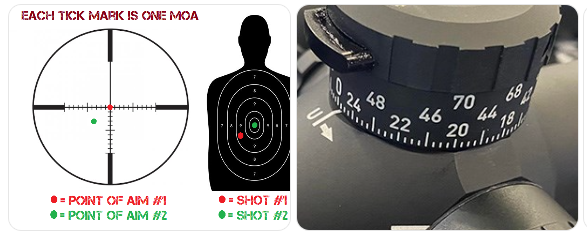
MOA stands for Minute of Angle, a measurement derived from geometry.
One MOA represents one-sixtieth of a degree.
While this sounds technical, shooters rarely think about degrees while shooting. Instead, they rely on a practical rule that simplifies MOA use:
1 MOA equals approximately 1 inch at 100 yards.
Technically, the measurement equals 1.047 inches. In real-world shooting, the difference is small enough that most shooters round it off.
The adjustment grows with distance.
Typical MOA scaling:
| Distance | 1 MOA Adjustment |
|---|---|
| 100 yards | ~1 inch |
| 200 yards | ~2 inches |
| 500 yards | ~5 inches |
| 1,000 yards | ~10 inches |
Most MOA scopes adjust in ¼ MOA increments, meaning four clicks move the point of impact about one inch at 100 yards.
Because many American shooters think naturally in inches and yards, MOA feels intuitive. If a shot lands several inches low, estimating the correction requires little mental conversion.
This familiarity explains why MOA dominated the American optics market for decades.

MIL, short for milliradian, measures angular adjustments differently.
A radian divides a circle into units based on radius length. A milliradian represents one-thousandth of that measurement.
Fortunately, shooters rarely need to understand the math behind it.
Instead, they rely on a practical rule similar to MOA.
1 MIL equals approximately 3.6 inches at 100 yards.
Scaling outward:
| Distance | 1 MIL Adjustment |
|---|---|
| 100 yards | 3.6 inches |
| 500 yards | 18 inches |
| 1,000 yards | 36 inches |
Most MIL scopes adjust in 0.1 MIL increments, meaning ten clicks equal one full MIL.
The decimal structure makes corrections simple. Shooters observe where a shot lands relative to the reticle and dial exactly what they see.
For example:
Impact observed: 0.4 MIL low
Correction required: dial 0.4 MIL up (four clicks)
No inch conversion required.
Because both systems measure the same angular changes, they can be converted easily.
Approximate conversion values:
- 1 MIL ≈ 3.438 MOA
- 1 MOA ≈ 0.29 MIL
Practical example:
A correction of 10 inches at 500 yards equals roughly 2 MOA or 0.6 MIL.
However, experienced shooters rarely convert between systems in the field. They simply use whichever measurement their scope employs.
A common misconception suggests that one measurement system provides superior accuracy.
It doesn’t.
Both MOA and MIL allow extremely precise adjustments when used with quality optics.
Accuracy depends on several factors:
- Rifle consistency
- Ammunition quality
- Ballistic data
- Environmental conditions
- Shooter fundamentals
The measurement system printed on a turret does not determine group size.
Many professional marksmen have achieved extraordinary precision using both systems.
Over the past two decades, MIL systems have gained popularity, especially in competitive shooting disciplines.
Several factors contributed to this shift.
MIL uses decimal increments, which many shooters find easier to understand than fractional adjustments.
Example:
0.3 MIL = three clicks.
Precision shooting often involves teamwork between a shooter and spotter.
A spotter might call corrections like this:
“Impact point two left, point three low.”
The shooter instantly understands the correction.
MIL reticles allow shooters to measure distance or corrections directly using reticle markings.
This eliminates the need to estimate inches.
Despite MIL’s growth in competitive shooting, MOA remains extremely popular among hunters.
Several reasons explain this.
Hunters frequently describe impacts using inches rather than angular measurements.
Sight-in corrections at 100 yards translate directly into inches.
Example:
2 inches low → dial roughly 2 MOA.
Many classic hunting scopes have historically used MOA systems.
For shooters already comfortable with MOA equipment, switching systems provides little practical advantage.
One critical concept applies regardless of measurement system.
Reticles and turrets should use the same unit of measurement.
Older scopes sometimes combined MIL reticles with MOA turrets. This forced shooters to convert measurements constantly.
Example:
Impact observed: 0.5 MIL low
Turret adjustment required: convert to MOA.
Modern optics avoid this complication.
Best practice:
- MIL reticle → MIL turret
- MOA reticle → MOA turret
Consistency eliminates confusion during fast shooting situations.
To understand how shooters use these systems, consider a real-world example.
A shooter engages a steel target at 800 yards.
The bullet strikes low.
A MOA shooter may estimate:
“About eight inches low.”
That translates into roughly 1 MOA correction.
A MIL shooter instead observes reticle spacing:
“Point three low.”
The correction becomes 0.3 MIL (three clicks).
Both approaches achieve the same result.
They simply reflect different ways of describing the adjustment.
Wind represents one of the greatest challenges in long-range shooting.
Unlike bullet drop, which remains consistent, wind constantly changes direction and strength.
Many experienced shooters prefer to dial elevation but hold wind corrections using the reticle.
MIL reticles often simplify this process.
A shooter might hold 0.5 MIL into the wind without adjusting the turret.
If wind conditions change, the hold can be adjusted instantly.

MOA shooters accomplish the same process using MOA reticle markings.
New long-range shooters sometimes focus too heavily on measurement systems rather than fundamentals.
Common mistakes include:
Consistency matters more than chasing trends.
Using mismatched reticles and turrets introduces unnecessary complexity.
Accurate DOPE (Data on Previous Engagements) matters more than turret markings.
Choosing between MOA and MIL often comes down to personal preference.
Shooters who naturally think in inches may feel comfortable with MOA.
Those entering competitive shooting environments may prefer MIL due to its decimal structure and widespread use in modern training.
Either system can support exceptional precision when used consistently.
Industry trends suggest MIL systems will continue gaining popularity, especially among competitive shooters and training programs.
Ballistic calculators, spotting communication, and modern optics design often default to MIL measurements.
However, MOA remains deeply rooted in hunting culture and traditional American shooting sports.
Both systems will likely coexist indefinitely.
At the end of the day, targets don’t care how adjustments are measured.
Wind doesn’t care whether shooters think in inches or decimals.
Gravity works the same regardless of measurement system.
MOA and MIL simply represent different languages used to describe the same corrections.
A disciplined shooter using either system can achieve remarkable precision.
The key lies not in the numbers printed on a turret, but in understanding how to apply them when distance, wind, and pressure challenge every shot.
“}]]

