

[[{“value”:”
Thank you for reading this post, don't forget to follow and signup for notifications!
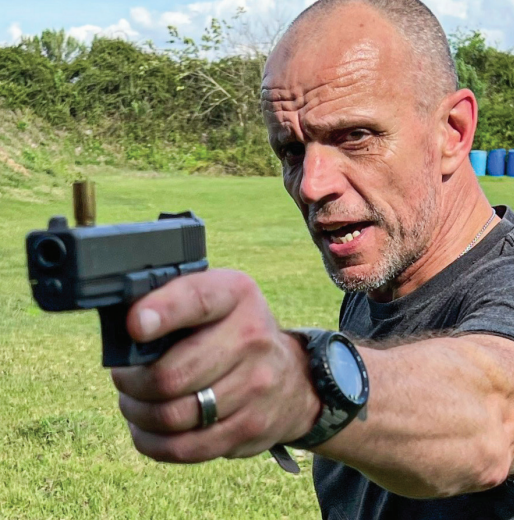
High praise for Sonny Puzikas, Who’s gone from Spetsnaz
Operator to International Self-Defense Instructor.
Story and Photos by Paul Pawela
When you hear the name Sonny Puzikas, you’re not just talking about another self-defense/firearms instructor; you’re talking about a man whose life has been shaped by violence and discipline. Saulius “Sonny” Puzikas was born in 1969 in Lithuania. He began training in martial arts at age 6, studying kyokushinkai, judo and boxing. Puzikas served in the Soviet Spetsnaz, the elite special forces unit renowned for its brutal training and unconventional combat tactics, before immigrating to the United States in the 1990s, following Lithuania’s independence from the USSR. His background in elite military units shaped his philosophy:
combat is not about rigid drills but about surviving chaos.

By the late 1990s, Puzikas was studying under Vladimir Vasiliev, a Russian martial arts instructor based in Toronto, Canada, whose instruction shaped much of his later teaching. His instruction has also been shaped by many teachers of Southeast Asian
combative methods, such as kuntao, silat and Filipino arts. After immigrating to the US, Puzikas carved out a niche as a trainer specializing in systema, a Russian martial art that integrates combat conditioning, firearms handling and psychological resilience. His seminars often blur the line between martial arts and military science, teaching students not only how to fight but also how to think in violent environments. Puzikas has often argued that traditional shooting schools fail to prepare civilians for the chaotic reality of armed conflict, where moral, legal and psychological factors weigh as heavily as technical skill.

His military background gave him firsthand experience in unconventional warfare, close-quarters combat and survival tactics.
Unlike many firearms instructors who focus solely on marksmanship, Puzikas emphasizes a systemic understanding of violence, what he calls the “why” behind the “what.” His work even reached pop culture: He consulted with video game developer Treyarch on the Call of Duty: Black Ops series and motion-captured Spetsnaz maneuvers for the game.
WHETHER DESCRIBED BY supporters, reported on in media profiles or emphasized in his own past narratives, the image of Puzikas is consistent, portraying him as the hardened professional, shaped by Eastern Bloc military doctrine and capable of teaching others how to fight, shoot and survive. During the Cold War and its aftermath, Soviet special operations, often loosely labeled as Spetsnaz, occupied a near-mythical place in Western imagination. Ruthless efficiency. Relentless conditioning. A philosophy of warfare that emphasized aggression, endurance and psychological dominance. Within extremist circles, invoking Soviet special operations training carried weight. It suggested not only tactical skill but also ideological hardness: a man forged by an unforgiving system, unburdened by Western legal or moral constraints.
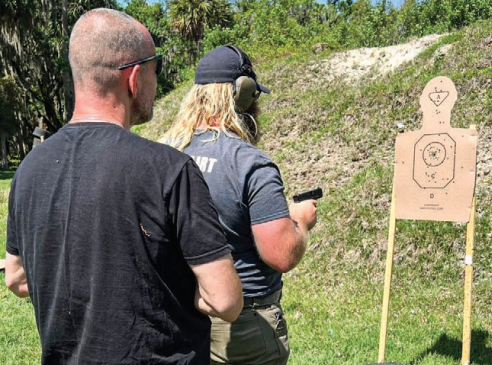
Puzikas’s reputation as a firearms and tactics trainer drew heavily on this symbolism. He was portrayed as someone who understood weapons not as hobbies or abstractions but as tools of applied force, to be mastered through repetition, discipline and obedience. Regardless of the precise details of his military background, Puzikas undeniably served as an instructor. He trained others in firearms handling, small-unit tactics and a combat-oriented mindset, which elevated him within militant networks and lent him legitimacy among those seeking preparation for conflict.
Unlike many firearms academies that focus on stance, grip or marksmanship, Puzikas emphasizes fundamentals as guiding principles rather than rote basics. He teaches that fighting is unpredictable, and training must prepare students for fluid, real-world scenarios. His courses often combine firearms handling with systema-inspired movement, force-on-force drills and psychological conditioning
CURRENTLY, PUZIKAS IS the director of training at Patriot Training, a one-of-a-kind indoor facility in Plano, Texas. Puzikas’s courses are not about static drills or rigid stances. Instead, he teaches students to adapt fundamentals to dynamic situations rather than memorizing rigid techniques.
To wit: Adaptability over repetition: Students learn why techniques matter, not just how to perform them.
Civilian context: Puzikas emphasizes that armed self-defense differs drastically from military combat. Condition both body and mind for the unpredictability of violence.
Integration of mind and body: Integrate firearms with broader combat skills, including movement, awareness and stress inoculation. This approach mirrors how Soviet and post-Soviet military doctrine is often characterized: less emphasis on individual expression, more on function, cohesion and mission completion. Puzikas also runs seminars across the US. His training classes include:
AK Fundamentals (AK-1): Focuses on the guiding principles of efficient performance with the AK platform, emphasizing why techniques are used rather than just memorizing drills.
Advanced AK Courses: Builds on fundamentals to develop adaptability in chaotic, real-world combat situations.

Shooter Fighter Matrix: A hybrid course combining handgun use with empty-hand fighting skills. Teaches students to integrate firearms into the broader reality of violent encounters, shifting the mindset from “gunfight” to “fight with a gun.”
Systema Training: Rooted in Russian martial arts, focusing on fluidity, adaptability and psychological resilience. Courses like Fear Inoculum emphasize stress inoculation and transformation under pressure.
Force-on-Force and Combat Conditioning: Scenario-based training where students face simulated combat situations. Includes conditioning drills designed to prepare both body and mind for the unpredictability of violence.
Instructor Development Courses: Designed for those who want to teach others, focusing on pedagogy, safety and advanced combat concepts.

have a clue about weapons disarms, but Puzikas is an exception to the rule.
PUZIKAS OCCUPIES A unique niche in the firearms training world. To some, he is a visionary who strips away dogma and prepares civilians for the harsh realities of violence. To others, his methods are risky. Regardless, his blend of Spetsnaz heritage and modern civilian instruction has left a lasting imprint on the tactical training community. On a personal note, readers are familiar with the fact that I write about people who are not only well known in their disciplines but also happen to be personal friends of mine. Puzikas is no different. I have known him for many years, and will state on the record that, while known for understanding brutal violence and its realities, he would automatically be among my top five instructors in the country.
And over the years, I’ve watched a total transformation in the man – a man who dedicated his life to Jesus Christ and a man who has become a loving husband as well as a role model father. All of this has given Puzikas a new resolve in life, and with it, a highly intellectual/philosophical approach to all things necessary for life’s survival. Sonny Puzikas is now in my top three instructors in the country to train with! And that’s my two cents! ★
Editor’s note: Author Paul Pawela is a nationally recognized firearms and self-defense expert. For his realistic self-defense training, see assaultcountertactics.com.
“}]]

