

[[{“value”:”
Thank you for reading this post, don't forget to follow and signup for notifications!
Another step, and two deer scooted from a foggy clearing. But their dash into the alders suggested they’d not go far. Circling downwind, I drifted onto a deer trail, pausing at each step, glassing not yards ahead but feet. Then: a glint from the shadows. Stay still! Presently, beside the eye, an antler came clear. My bullet struck below the burr.
Almost any rifle and load could have claimed that blacktail. But hunters don’t bet their fortunes on arms that suffice only for brain shots at 20 feet.
So it was that a .308 also joined me in the Uintas. The elk were winning when, the last morning, a distant bellow sifted through the aspens. Dodging deadfall, I closed at a run. There! A long tine winked. A short dash ahead, a tree steadied the rifle. My Nosler drove from flank to scapula. The bull crashed away, then faltered. A second shot felled him.

After six decades afield, I’ve found no cartridge more useful than the pedestrian .308 Winchester. It hurls a ton of punch 250 yards to drop tough beasts with a point-blank hold. Eland twice as heavy as elk wilt to its jab. Indeed, Africa’s PHs say: “Clients with .308s — theirs or loaners — kill game. The violence of magnums makes hunters flinch. The .308 helps them hit.”
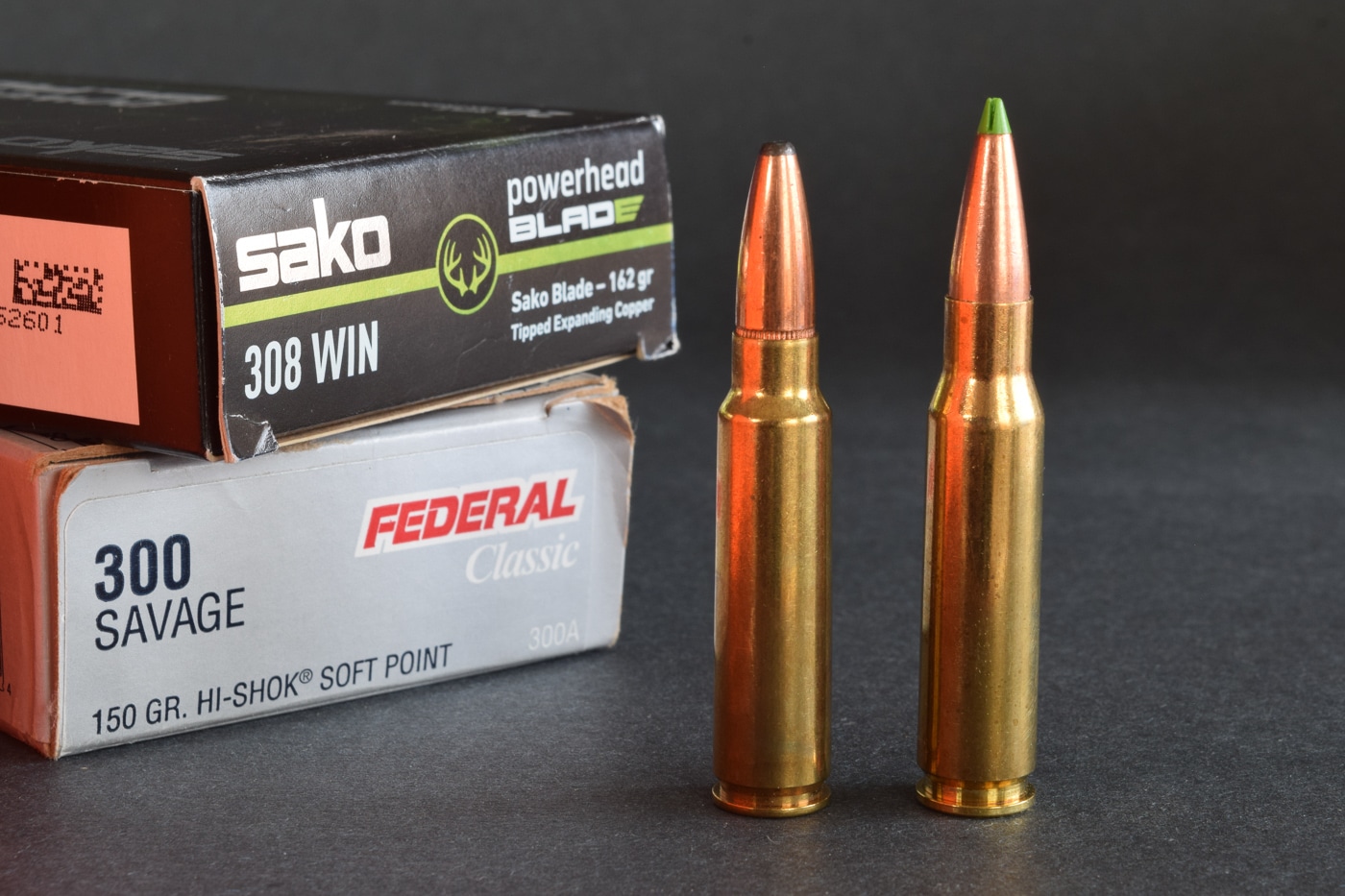
Its ancestor appeared nearly three decades after Arthur W. Savage, then 35, invented a spool-fed lever rifle to fire his rimmed .303 Savage cartridge. In ordnance trials, this repeater lost to the bolt-action .30-40 Krag-Jorgensen, which became the U.S. service arm in 1892.

Reconfigured for hunters, Savage’s rifle thrived. In 1920, a new .300 cartridge made it a top seller.
In 1944, Springfield Armory and Remington were asked to design a selective-fire rifle to replace the autoloading M1 Garand, in service since 1936. Shorter and lighter than the .30-06, the cartridge would have comparable reach and power. The .300 Savage came to mind. But some mechanisms balked at its 30-degree shoulder. Also, claims that its stubby .221-inch neck would enable the 1.871-inch case to bottle the oomph of the ‘06 (2.494-inch brass) proved fanciful. A slightly bigger case than the .300’s, with a 20-degree shoulder, evolved as the T-65.
This cartridge would earn the U.S. Army’s approval in 1954, two years after Winchester tapped its potential as a hunting cartridge and, with appropriate blessings, cataloged it as the .308. Other NATO countries would adopt it as the 7.62×51 in 1957. Given the 40,000-CUP pressure cap honored for .30-40 loads in period rifles, the .308’s 52,000-CUP thrust sends 180-grain bullets 170 fps faster. It trounces the .300 Savage by a wider margin.
The T44E4 became the 7.62mm Rifle M14 in June of ’54, departing from the Garand’s design in several ways. Its cycling was less abrupt. The gas block moved 8 inches back from the muzzle to improve accuracy. A detachable box held more cartridges than the M1’s internal clip and was easier to top off. But the M14 kept the Garand’s two-lug rotating bolt, its operating rod and forward recoil spring. The stock’s profile was similar, the M1’s walnut handguard ultimately giving way to polymer. Sights were essentially identical.
The M14’s high cyclic rate could empty a 20-shot box in 1.6 seconds in full-auto, recoil flinging successive bullets wildly off-target. So, the rifle was fitted with a lock to nix full-automatic fire. A switch made full-auto capability a quick choice.
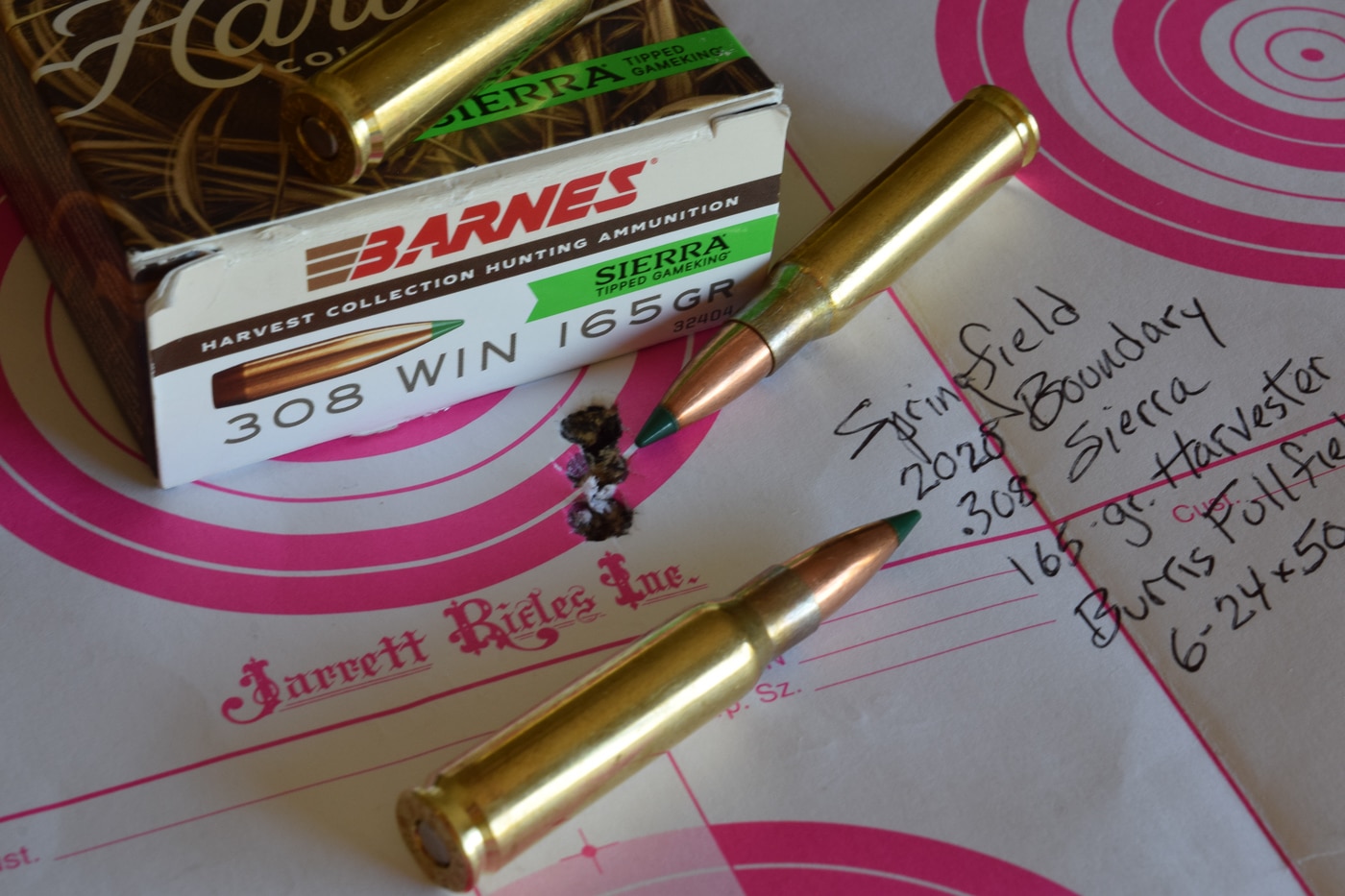
Production of 7.62×51 military and hunting ammo continued unabated after the M16’s ascension in the 1960’s. National Match loads with 41.7 grains IMR 4895 sent 174-grain BTHP bullets at 2,548 fps. Handloaded 168-grain Sierra MatchKings from a bolt rifle helped me through the National Match course. Bench Rest shooters embraced the .308 too. In the 1968 National Matches, Ferris Pindell won the sporter class with a tiny .3594-inch group, topping Dave Hall’s .4612 knot that drew gasps the year before. The .308 also brings out the best in hunting rifles. Many fine rifles later, I’ve come to like Springfield Armory’s Boundary, a hunting rifle of traditional profile but with a carbon-fiber stock and barrel. It’s therapy when only snug groups can bring a smile.
Note: Don’t miss Mark Hampton’s article on reloading .308 ammo.

Game loads proliferated as the .308 overtook the .30-06 in popularity. Credit its 2.015-inch case. It fits myriad actions designed around a loaded length of 2.750 inches. (Ammo for the .30-06 measures 3.340 inches.) The .308 case holds about half the powder of the .300 Weatherby Magnum, 20 percent less than the ‘06. At 2,620 fps, 180-grain bullets from .308 factory loads fall 100 fps shy of .30-06 velocities, but I’ve chronographed 180-grain .308 handloads driven by 42.5 grains H335 at 2,700 fps with no signs of strain. It’s easy to wring 2,400 fps from 200-grain bullets.
The .308 warms to a wide range of bullet weights. In a recent range session, a .6-inch knot with Hornady’s 110-grain TAP load at 3,200 fps matched my groups from 150- and 165-grain bullets, all fired in a Springfield Boundary with standard 1:12 rifling. (Its nimble 20-inch barrel predictably yields slightly lower velocities than published for 24-inch barrels.)
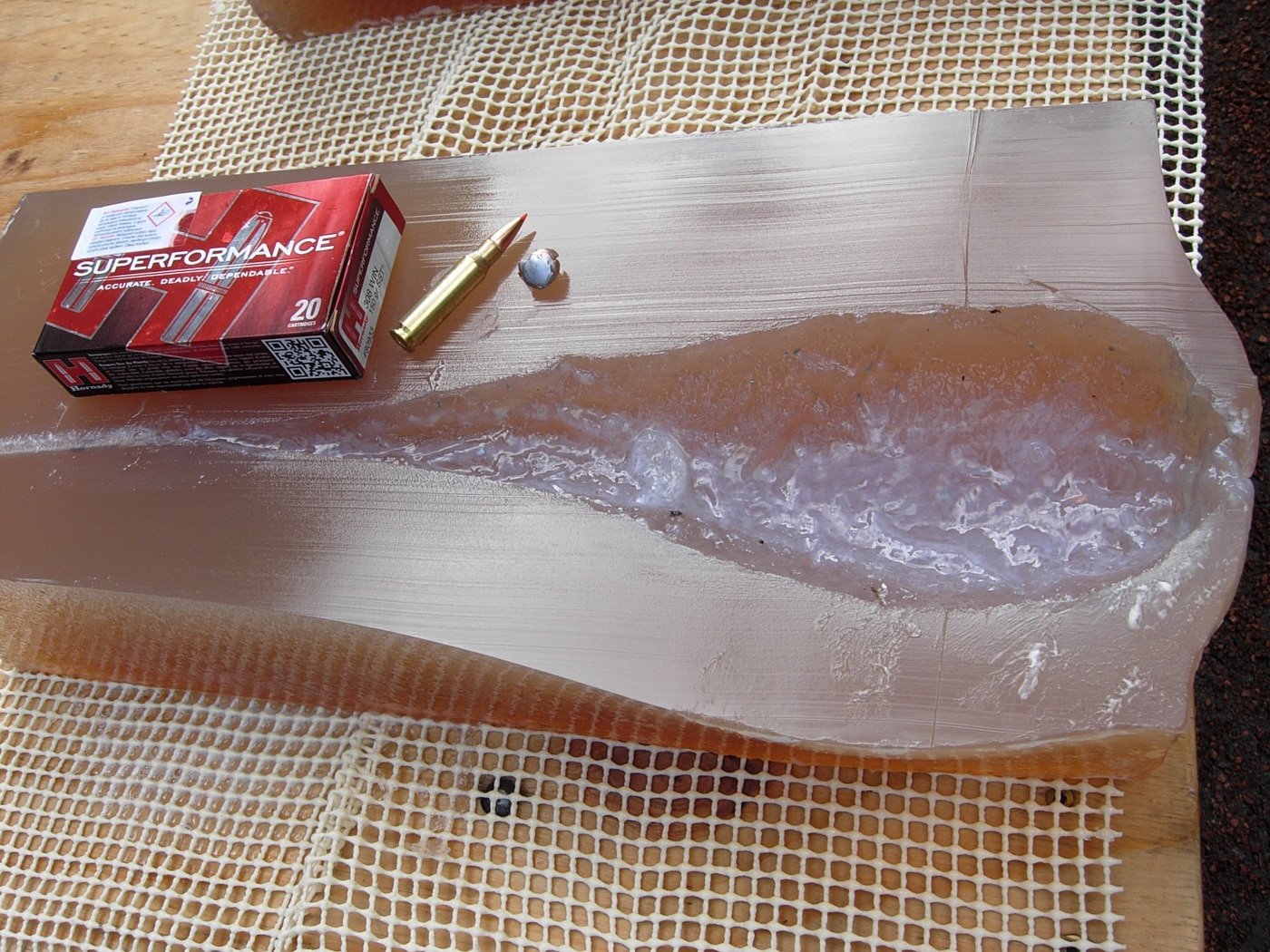
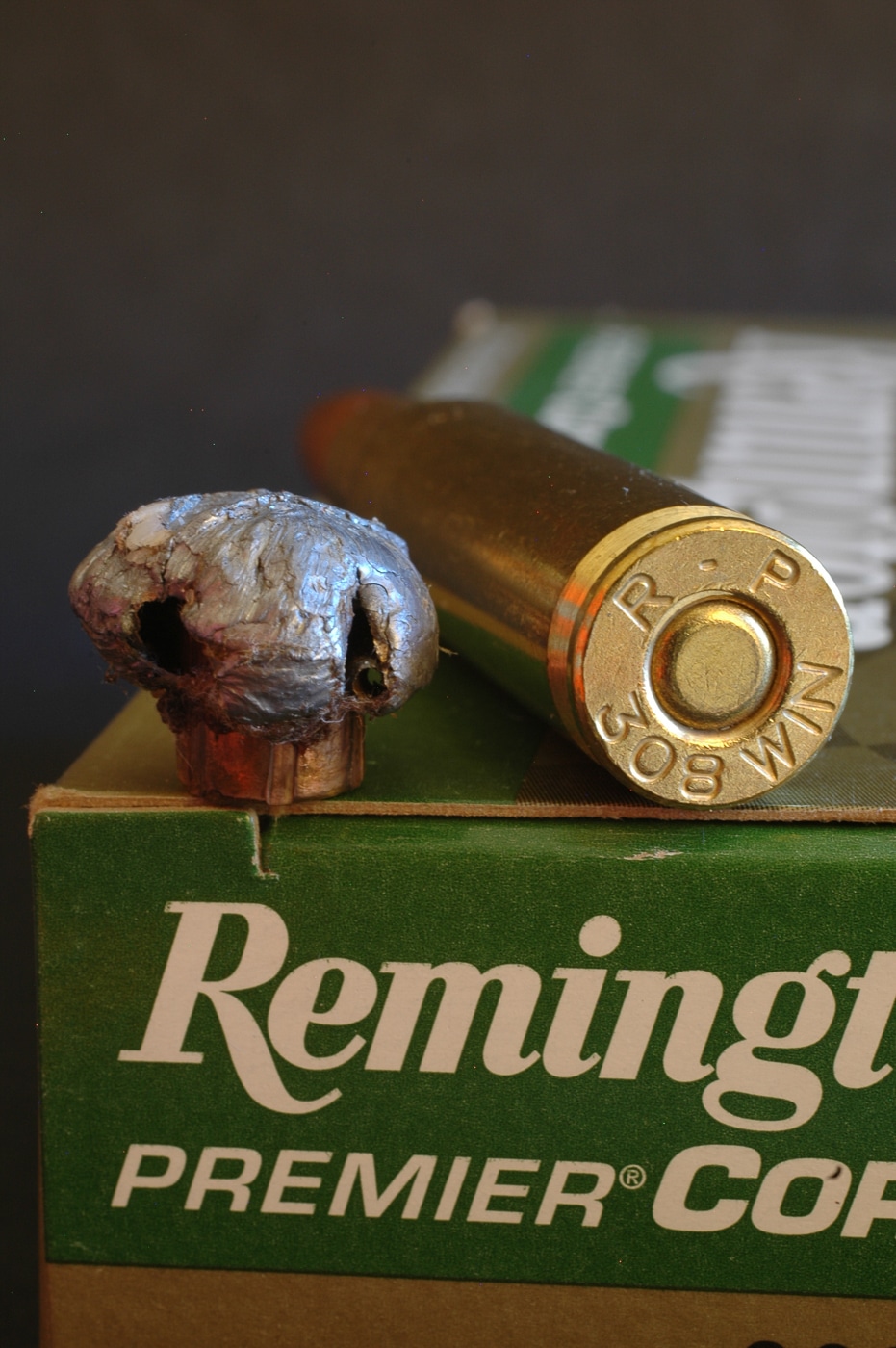
For most hunting, 165-grain bullets offer a useful balance of bullet weight and speed that’s hard to beat in a .308. A Superformance Hornady load hurls 165-grain InterBonds at 2,840 fps. Another high-octane Hornady option wrings 3,000 fps from 150-grain SSTs, trumping some .30-06 loads! But a quick start is just one measure of the lethality of hunting ammo. For some tasks, heavier bullets excel.
Note here that while the .308 starts with a speed deficit of 150 fps compared to the .30-06, and a 360-fps deficit compared to the .300, these disparities shrink with distance. Ditto differences in bullet energy. At the muzzle, the .308 has 317 ft-lbs less punch than the .30-06; but 300 yards out the gap has narrowed to 236 ft-lbs.
The .308 starts 792 ft-lbs behind the magnum; but reels in more than 200 ft-lbs over 300 yards, reducing its deficit to 587 ft-lbs. Drag has a big effect on downrange speed and energy. The faster a bullet starts, the greater the drag. A .308’s bullet sacrifices less killing effect to drag than do identical bullets driven faster. And shooters endure less recoil. In 8-pound rifles, the .308 is about 14 percent less violent than the .30-06, 29 percent less than the .300. Gentle rifles keep the focus on accuracy, not liniment.
Note: Gunspot wrote a great article on the .308’s effective range that is an excellent resource.
The magnum faithful should note too that .308 bullets drift little more than those from .300’s. There’s less than 2 inches difference in drift at 300 yards between the .308 and the .300 magnum with the same bullet. Even at 500, farther than many hunters will risk a shot at game, the disparity is just 1 m.o.a.! Bullet type has much greater effect on drift than does starting velocity. The blunt .30-30 bullet loses on both counts. Slow to start, it yields rapidly to drag, drift increasing apace.
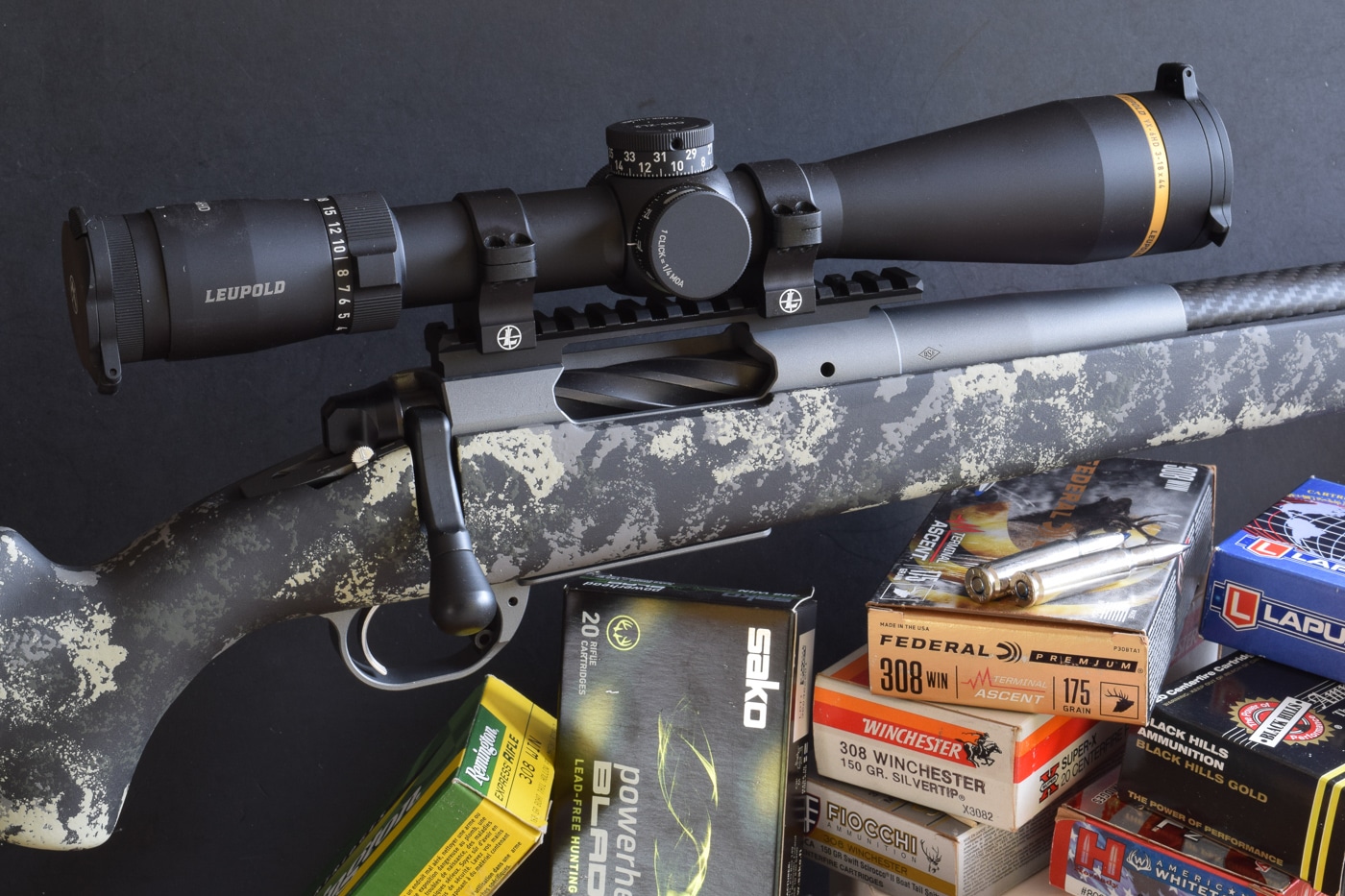
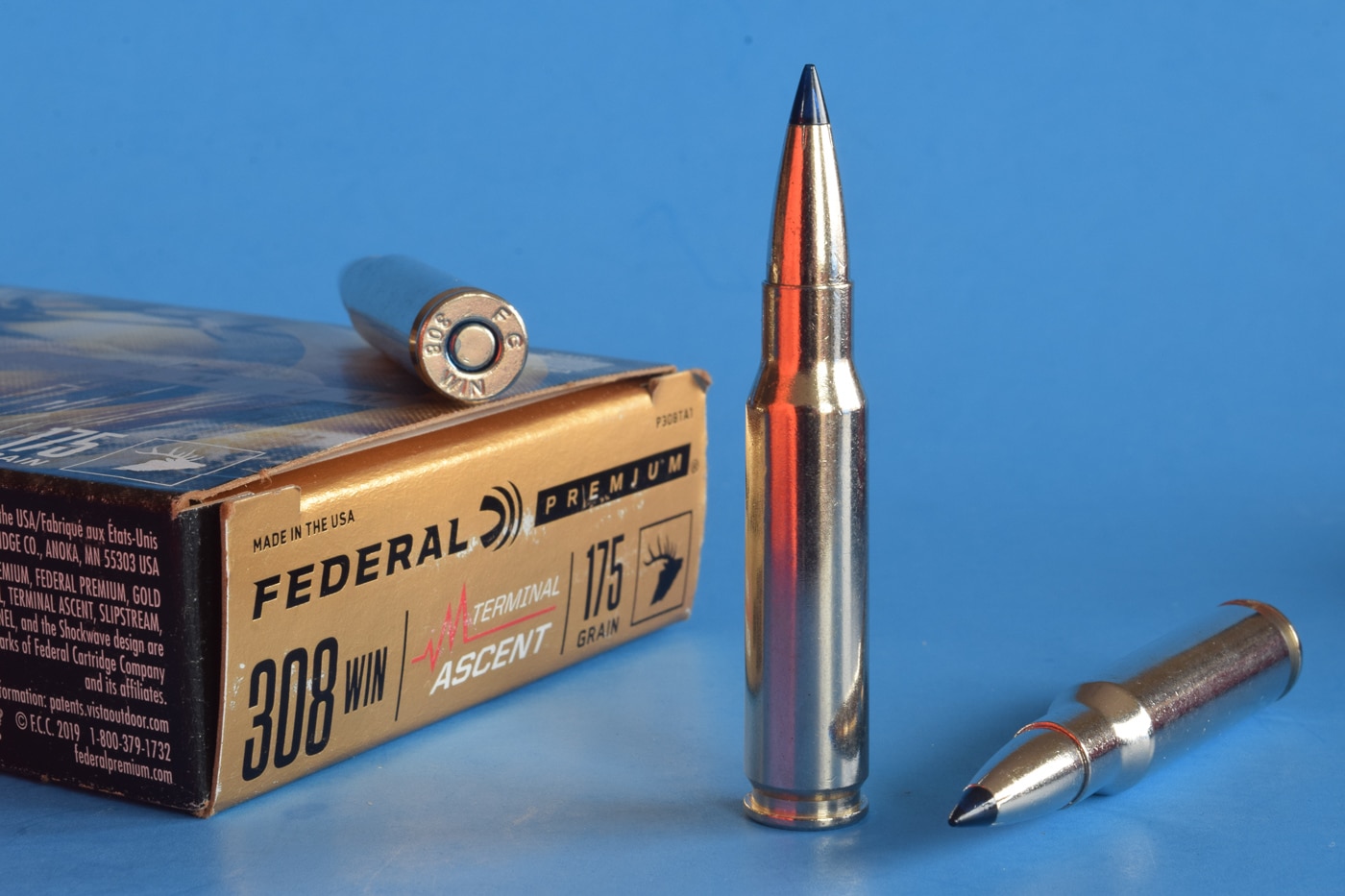
The .308’s versatility and its performance across a wide range of short-action rifles have placed it on more chambering rosters than any other centerfire cartridge. The number of commercial loads is eye-popping too: At this writing I count 118 for the .308 — from just seven U.S. manufacturers! Only the .223 can challenge that tally.
Factories the world over produce .308 ammo and ship it to far-flung game fields.
Read Massad Ayoob’s article on why he picks .308 for his SHTF rifle.
The cases are identical: 2.015 inches long, .473 at the rim, a 20-degree shoulder between same-length bodies and necks. Loaded, the .308 and 7.62×51 mic’ 2.800 inches, as specified by SAAMI and its European equivalent, CIP. “We use the same brass and primers for commercial and military loads,” says a Hornady spokesman. “Officials approve or tweak service specs. We hew to them.”
Differences in maximum average pressures — 62,000 psi for the .308 and 50,000 psi for the 7.62 — can be laid to disparities in measurement. Gun-maker Fred Zeglin notes copper crushers registered early 7.62×51 pressures. Current piezo-electric reads on .308 loads are more repeatable, often higher. I’m told Hornady meets velocity targets with piezo-checked pressures held comfortably under 60,000 psi.
Jeff Hoffman at Black Hills Ammunition notes differences in measurement location. “Pressures for the 7.62×51 NATO may be taken at the mouth instead of mid-case. We see slightly lower values at the mouth.” He adds that 7.62×51 velocities are often taken at 78 feet, not SAAMI’s standard 15.
SAAMI diagrams show a headspace measure of 1.630 to 1.640 for the .308. A Frankfurt Arsenal diagram indicates a range of 1.628 to 1.634 for the 7.62×51 NATO case. I’m told JGS reamers are held to 1.630-.640 for the .308 and 7.62×51. Free-bore and leade angle in the chambers differ. JGS reamers yield .900 inch freebore of .3100 diameter, with 1-45 leade angle for the .308. Chambers in 7.62×51 have 1.355 inch of 3.095 freebore, 5-40 leade.
Current U.S-loaded .308 and 7.65×51 ammo should fit and fire safely in either chamber. Be sure to read my prior article .308 vs. 7.62 NATO for additional details.
Claiming the .308 is the best hunting cartridge is pointless. Others are popular, widely chambered and loaded with bullets of many types. Others recoil civilly as they flatten game with a ton of swat at 250 yards and point-blank aim. Other cartridges seem inherently accurate. But few offer all that with factory loads that rank among the most affordable. Feeding .308’s is as easy as liking the results. There’s a reason the .308 is so popular.
Editor’s Note: Please be sure to check out The Armory Life Forum, where you can comment about our daily articles, as well as just talk guns and gear. Click the “Go To Forum Thread” link below to jump in!
“}]]

