

[[{“value”:”
Thank you for reading this post, don't forget to follow and signup for notifications!
Editor’s note: This Q&A is based on information provided by Jeff Welch and has been edited for length, clarity and style.
Some of the most important situations officers face are also the hardest to recreate in training. DUI stops, crisis calls and rapidly evolving encounters often occur before a new officer has had enough opportunities to practice them.
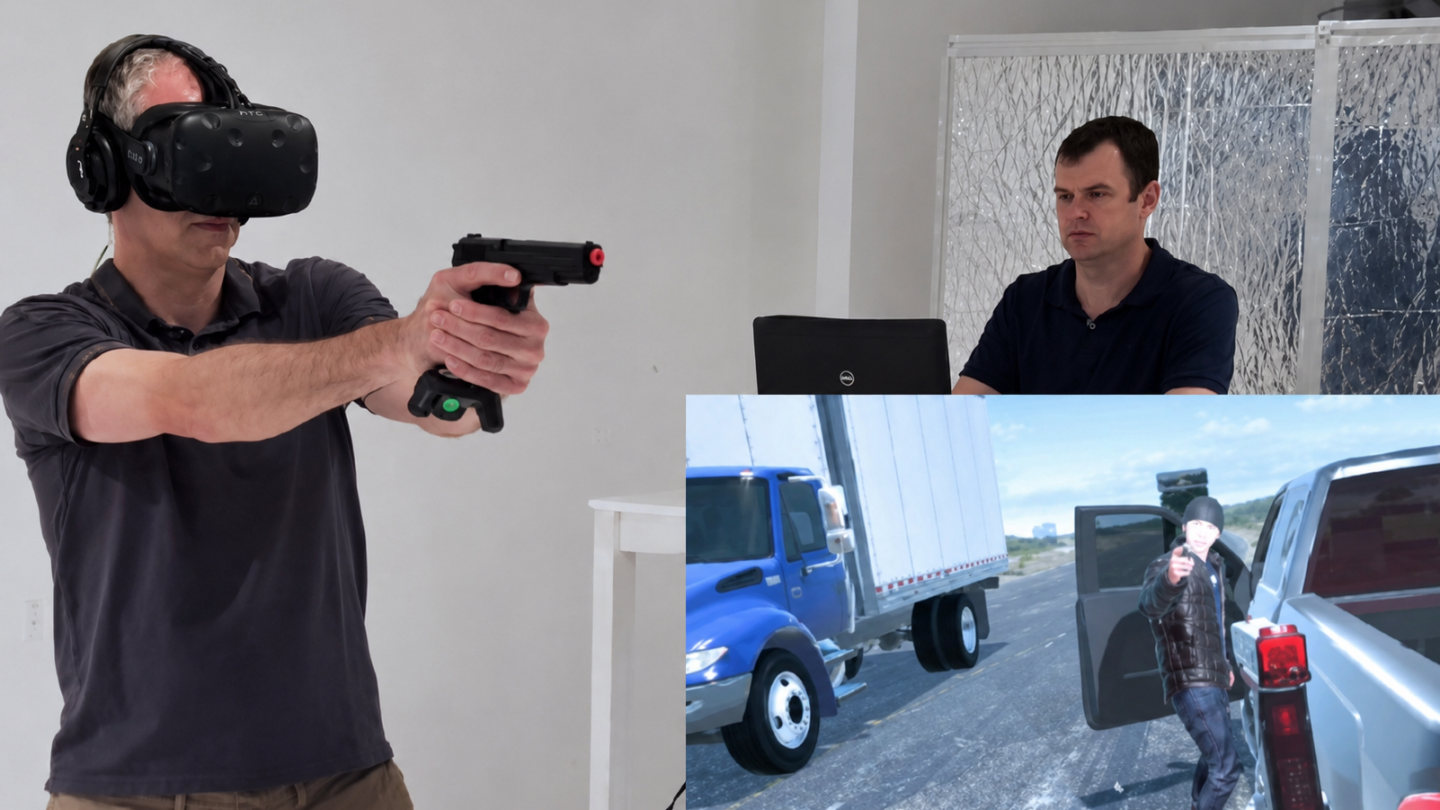
To better understand how one agency is using virtual reality as a training tool, Police1 asked Jeff Welch, training deputy with the Hopkins County Sheriff’s Office in Kentucky, to share his experience implementing VR training, the challenges it is designed to address and the lessons he has learned along the way.
Welch has served with the Hopkins County Sheriff’s Office for more than 28 years and is a certified Wrap Reality VR trainer, Crisis Intervention Training instructor and 25-year firearms instructor. He has helped expand the use of VR training to agencies across Kentucky.
Q: What training problem were you trying to solve when you began exploring VR?
A: One of the biggest problems in law enforcement training is that some of the calls officers need the most experience with cannot be manufactured on demand.
A DUI stop happens when it happens. A person in crisis does not wait for your new deputy to finish field training. A rapidly changing call does not pause until the officer feels ready.
When those moments arrive, officers respond based on the repetitions they have already had. The problem is that many officers do not get enough realistic repetitions before the stakes are real.
After 28 years in law enforcement, that was the gap I kept seeing. VR gave us another way to close it.
Q: What first convinced you VR might be different?
A: I first experienced VR training during a conference demo. I spent a few minutes in the headset and immediately knew it was different from other training tools I had used.
That was not the full evaluation process. That was just my first reaction.
The more serious evaluation came later, when I encouraged the Kentucky Association of Counties to assess VR for statewide use. KACO brought in multiple vendors for a demo day and included a doctoral student researching VR in law enforcement to help evaluate the technology.
From there, KACO purchased three units and began loaning them to agencies across Kentucky. In the past year, 80 to 90 agencies have checked out those systems. The program has since grown to 12 units across the state.
One thing that surprised me was the reaction from veteran officers. I expected some skepticism. I’m old-school myself, so I understood why they might question it. But after trying it, the reaction I heard again and again was, “I wish I’d had this when I was a rookie.”
That told me we were onto something.

Photo/WRAP Technologies
Q: How has VR changed your approach to de-escalation training?
A: De-escalation is one of the clearest examples of where VR has changed our training.
Communication training with live role players can be hard to run at the agency level. If the officer knows the person playing the agitated subject, the scenario can lose realism quickly. They are both in on it.
With VR, I can control the avatar’s words, tone and behavior in real time. I can get in an officer’s face, berate them, use language designed to provoke a reaction and watch what happens.
My goal is to make officers fail in a controlled environment so they learn to regulate themselves before the real call comes.

Photo/WRAP Technologies
That pressure matters. Emotional regulation does not develop when every scenario is designed for the officer to succeed. Officers have to work through frustration, irritation and stress in training so they can stay firm, clear and professional in the field.
Supervisors have reported seeing a difference in field contacts. Complaints may still come in, but when body camera footage is reviewed, we are seeing officers who are firm and clear, not rude or reactive. That is exactly what we are trying to train.
The takeaway for trainers is simple: Do not build scenarios that let officers coast. Build scenarios that make them work for a positive outcome.
Q: How are you using VR with newer officers?
A: New officers need repetitions before the stakes are real.
A good example is standardized field sobriety testing. Think about the rookie who is struggling with SFSTs. In VR, we can run the appropriate scenarios until that officer meets the standard.
Compare that with my first time administering a field sobriety test. It was 2:30 a.m. I was dealing with a genuinely intoxicated person while my field training officer graded me in real time. If I did it wrong, a defense attorney could use that mistake to challenge the arrest in court.
The stakes were real before I was ready.
VR gives officers a zero-consequence environment where they can make mistakes, correct them and come out technically confident. The same applies to basic skills like a traffic-stop approach or how an officer walks up to a vehicle window. Those are skills officers need to practice before they are doing them with real drivers on real roads.
For trainers, the question is: What are the two or three skills your newest officers consistently get wrong? Build drills around those skills before the field has to teach the lesson.

Photo/WRAP Technologies
Q: Can VR help agencies reduce firearms training costs?
A: It can, especially with recruits who have little or no firearms experience.
We are hiring people today who have never held a pistol. Range days with zero-experience recruits can be frustrating because you fix one issue and another one falls apart. Every round also costs money.
Before a new recruit reaches the live-fire range, we can use the VR firing range to work on grip, sight picture and dry-fire fundamentals across different environments. By the time that recruit picks up a real firearm, the basics are already in place.
VR does not replace live-fire training, but it can reduce the amount of remedial work needed on the range. Hopkins County estimates about $1,000 in ammunition savings from VR pre-qualification training alone.
For agencies evaluating the cost, start by calculating what you spend on remedial range time for low-experience recruits. That number gives you a practical baseline for discussing return on investment.

Photo/WRAP Technologies
Q: What does VR not do?
A: I want to be direct because hype is as damaging as ignorance.
VR does not replace range days, defensive tactics or field experience. Agencies that buy a system expecting it to solve their entire training program are going to be disappointed.
It is a tool that makes other training methods more effective. It fills the gap between classroom instruction and real-world competency by giving officers repetitions on scenarios they might otherwise encounter for the first time on the job.
Ease of use matters, too. If the system is difficult to set up, instructors will not use it consistently. But even when the technology is easy to run, someone still has to own the program. Someone has to maintain the scenario library, integrate the training into the calendar and make sure the system does not collect dust.
Q: What should agencies ask before investing in VR training?
A: Start with the training gap, not the technology.
Do not ask, “Should we buy VR?” Ask, “What call is our newest officer most likely to handle badly, and what are we doing to prepare that officer before it happens?”
That answer should drive the decision.
For one agency, the gap may be de-escalation. For another, it may be field sobriety testing, traffic stop approaches, crisis intervention or firearms fundamentals. VR works best when it is tied to a specific training objective.
The technology can help agencies save money, but the bigger value is preparing officers before mistakes carry real consequences. Better training can improve officer safety, reduce liability and build confidence for both officers and the communities they serve.
Q: What is the biggest lesson you have learned from implementing VR training?
A: Officers need more opportunities to practice before the stakes are real.
That has always been true in law enforcement. What VR gives us is another way to provide those repetitions. It will not eliminate risk. No training tool can do that. But it can help officers build confidence, regulate their emotions and make better decisions before they encounter those situations on the street.
If one system helps an officer handle a call better, avoid a preventable mistake or stay safer, that matters.
For trainers, the question is worth asking again: What call is your newest officer most likely to handle badly, and what are you doing to prepare that officer before it happens?
If the honest answer is “not enough,” that is the gap worth closing.
“}]]

