

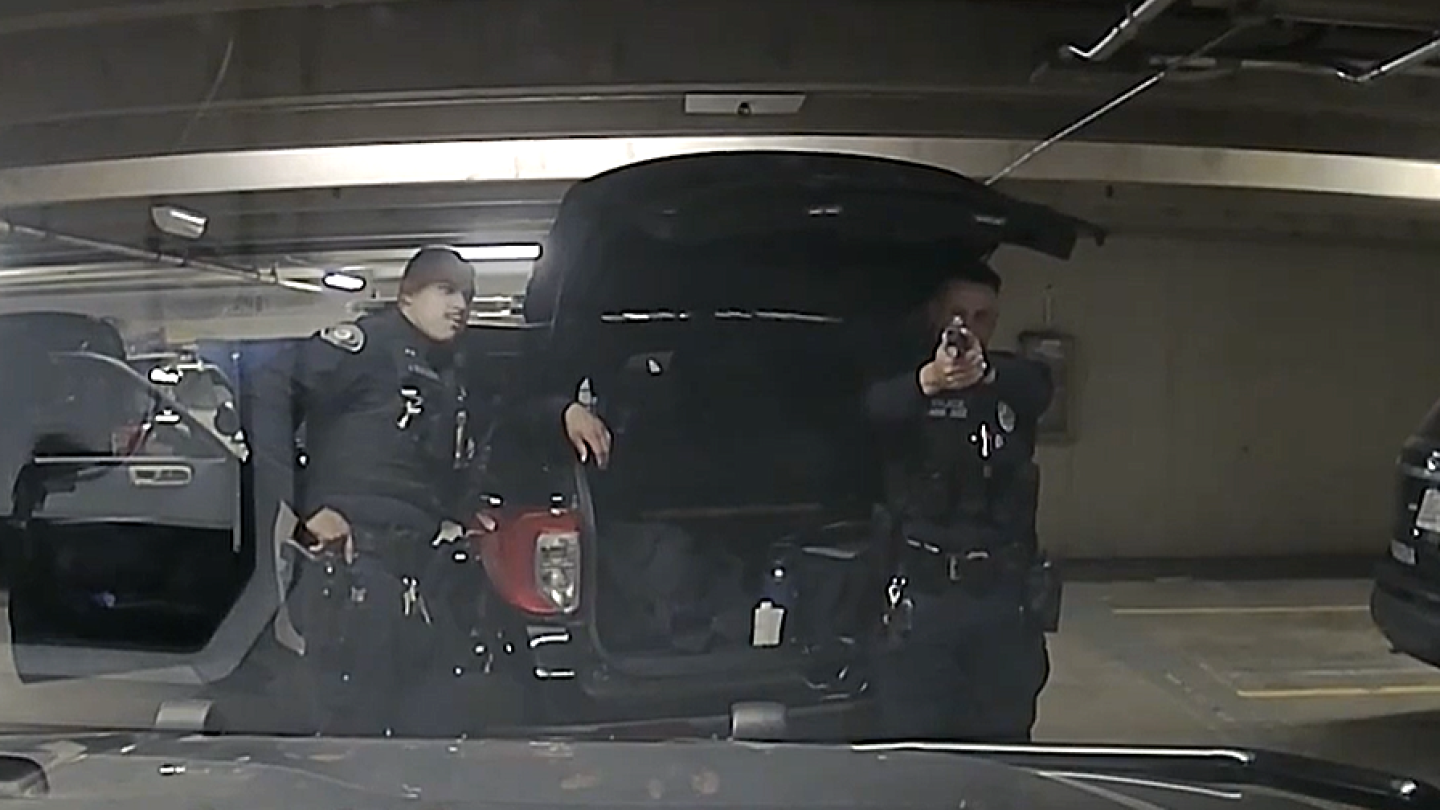
Dashcam video captured the moment an officer pointed a firearm at a colleague and pulled the trigger.
Thank you for reading this post, don't forget to follow and signup for notifications!
Pasadena police described the event as “horseplay.” That characterization tells us almost everything we need to know about the mindset that allowed it to happen.
This was not a harmless prank that went wrong. It was a fundamental failure of firearms discipline, professional judgment and culture. And while I don’t know Pasadena PD’s leadership, training program or internal practices, the broader lesson applies to every agency that issues firearms to its officers.
| WATCH THE VIDEO OF THE INCIDENT:
The safety mindset
Firearms safety rules exist for a reason. The foundational rule is simple and non-negotiable: Never point a gun at anything you are not willing to destroy. Some instructors prefer more positive phrasing, such as, “Always keep the muzzle pointed in the safest possible direction,” but the principle is the same.
Pointing a loaded firearm at another human being without lawful justification is not funny, harmless or acceptable. That said, I believe this incident reflects more than a momentary failure of discipline or a few seconds of buffoonery.
Exceptions to safety
Law enforcement has a long-standing habit of carving out exceptions for ourselves when it comes to firearms handling:
- “Except for felony stops…”
- “Except for active shooter response…”
- “Except for training…”
- “Except it’s unloaded…”
- “Except I know what I’m doing…”
Those exceptions become rationalizations, and rationalizations erode discipline. The moment an officer starts to believe the basic rules of firearm safety do not apply because of the setting, the assignment or their own experience level, the door to negligence is already open.
There is no special category of police work that suspends the laws of physics. There is no scenario that eliminates the need for muzzle discipline and trigger finger discipline.
If an officer cannot be trusted to keep the muzzle pointed in the safest possible direction and their finger off the trigger until a lawful decision to fire has been made, that officer should not be carrying a firearm professionally.
Pounding the table
For years, I’ve argued that firearms safety rules must apply in the classroom, on the range and in the field. That position has drawn criticism, especially when applied to real-world police scenarios. But incidents like this are exactly why the standard has to remain clear.
The rules do not stop mattering because the gun is believed to be unloaded. They do not stop mattering because the officer is experienced. They do not stop mattering because everyone in the room assumes nothing bad will happen.
The cause(s)
Incidents like this rarely stem from a single failure. I submit they are the product of multiple overlapping problems:
- A culture that tolerates casual handling of firearms.
- Leadership and trainers who fail to enforce standards consistently.
- Training that emphasizes when to shoot far more than when not to point a gun at another person.
Blaming any one factor is too convenient. The practical reality is that when training and culture treat firearms safety as a box to check rather than a non-negotiable professional standard, these events become more likely.
Prevention
The solution is simple to me. It is relentless, uncompromising enforcement of the fundamentals at all times, in all situations:
- A culture that does not accept anything less than the highest standard of professionalism.
- Muzzle discipline at all times.
- Trigger finger discipline at all times.
| RELATED: The thin line between safety and tragedy: Muzzle control in policing
Leadership and training
When leadership and training divisions treat firearms safety as optional or situational, they create the conditions for exactly this kind of incident. Thankfully, the officer in the incident will recover but he could have just as easily ended up dead. The difference between a painful recovery and a funeral is measured in inches and dumb luck in this case. We read about these incidents and assume it will never happen to us or our people, but it’s just a matter of time. Except, it doesn’t have to be.
|NEXT: ‘Shots Fired’ podcast: Inside the Pasadena ‘horseplay’ shooting that injured a cop

