Thank you for reading this post, don't forget to follow and signup for notifications!
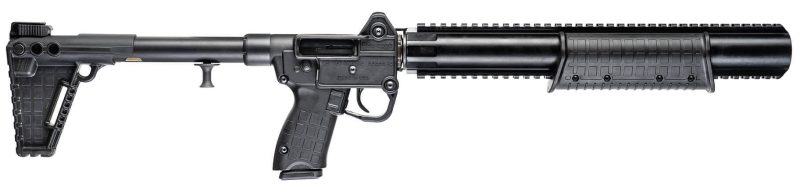
The KelTec Sub2K series has proven to be one of the most dichotomous firearms in the industry. On the one hand, vast numbers of shooters deride them much the same way they do Hi-Points. On the other hand, many of those same shooters own (or want to own) a Sub 2000. It’s hard to blame them, either. Not only are they lightweight and literally foldable, but they also feed off the most common pistol magazines on the market. And there’s a very short, integrally suppressed 9mm carbine version: the KelTec CQB PCC. And it only requires one NFA Stamp.
CQB stands for Carbine Quiet Barrel, by the way. PCC, of course, stands for Pistol Caliber Carbine.
Grunts: Dichotomous
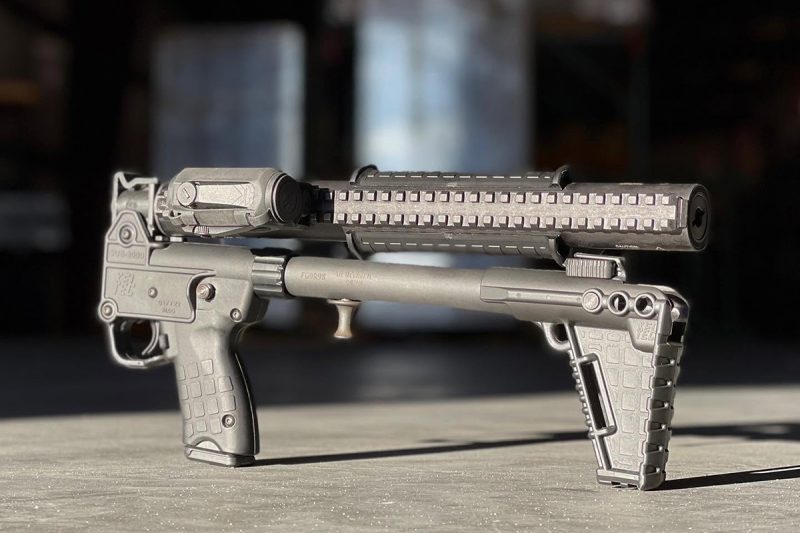
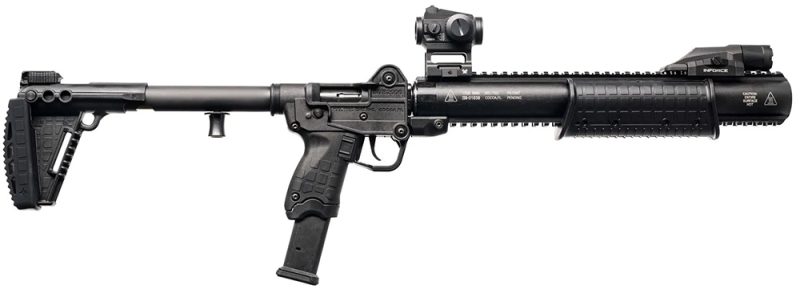
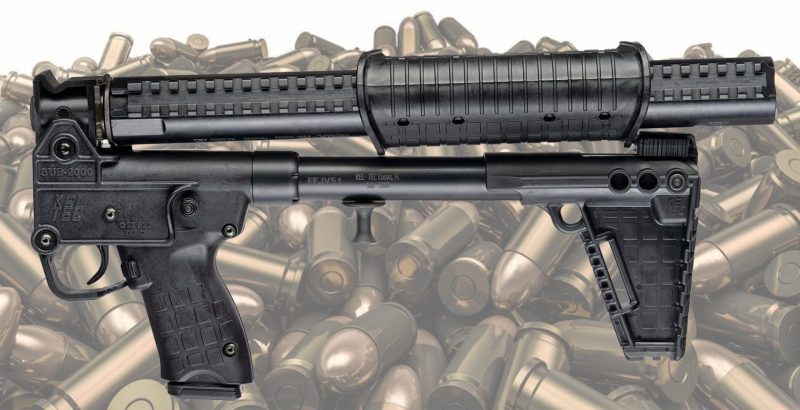
Much like its standard Gen 3 Sub2K cousin, the Gen 3 KelTec CQB can fold in half with an optic mounted. Prior versions did not offer this advantage. If you mounted an RDS, even a small one, to the top rail, you couldn’t fold the barrel backward or lock it down. At least not without crunching the optic.
Neither the Gen 3 Sub2K nor the CQB has that issue, but they address it in different ways.
In simple terms, the barrel of the “standard” Sub 2000 is mounted at a slight physical tilt, angled just a little to the side (this doesn’t affect its potential for accuracy). When you pull the trigger guard to fold it, the barrel swings straight back, but the top Picatinny rail ends up lying down the side of the stock line. This creates just enough physical clearance to keep a low-profile red dot mounted and holding zero without interference.
The Gen 3 Sub 2000 CQB is engineered with a thick aluminum suppressor tube around the barrel liner. That angle isn’t sufficient to allow an RDS to clear the frame. So, KelTec built with an internal rotating collar. You actually physically twist the entire handguard-and-silencer assembly 90 degrees to the side, then pivot it backward at the hinge.
Unless you’re using a really big light or light/laser combo, those accessories will clear the frame as well. Typical weapon lights should be okay.
Magazine System: “MultiMag” Gen 3 Swappable Magazine Compatibility
NFA Standing: Single-Stamp Suppressor Item (not an SBR)
More information is available in the Sub2000 Owners Manual
Thanks to some canny engineering upgrades, you can fold the integrally suppressed Gen 3 Sub2K without issue…even with your optic mounted.
Some examples of mechanical evolution…aren’t. In the case of the KelTec Sub 2000 CQB, the transition from Gen 2 to Gen 3 absolutely was. Here are what we consider the two most significant improvements.
Creation of a Locking Interface.
The legacy Gen 2 CQB’s rotating barrel assembly was secured at the receiver with a plastic locking tab. As more than a few unfortunate shooters discovered, this tab was a potential point of failure. It frequently failed to hold tight tolerances and sometimes sheared right off.
The Gen 3 CQB doesn’t have such a tab. Instead, it is secured with a much more rugged and reliable steel-reinforced bottom plate lockup. The user pulls down on the trigger guard, twists the handguard, and folds it over to lock directly onto M-LOK slots on the stock.
Addition of MultiMag Capability.
The first Gen 3 SUB was only compatible with Glock mags. That’s not a huge issue for a PCC, but it certainly limits its versatility. It also reduces the appeal of such a carbine for anyone who carries a Beretta, CZ, SIG, or other pistol. A PISTOL Caliber Carbine that runs on different magazines than the PISTOL you’re already carrying (e.g., PCC vs handgun) doesn’t hold much appeal.
The new version of the Sub 2000 CQB features the “MultiMag Gen 3 Hub System.” This feature allows a shooter to remove a couple of screws and field-swap the internal mag catch in a couple of moments. Now your backpack gun, truck gun, or road rifle (whatever you call it) boasts interchangeability not just with a Glock but also with an S&W M&P, SIG P320 or P226, Beretta 92, CZ75, or Canik TP9. That opens the potential versatility of the CQB to a lot more gun owners with the simple – but by no means insignificant – expedient of being compatible with more models of sidearm.
You might think a folding rifle with a 4.25-inch barrel and a can on it would require two (2) NFA stamps. One for the Short Barrel Rifle (SBR) registry and another for the suppressor registry.
You might think that, but you’d be wrong, and we have to congratulate KelTec on this.
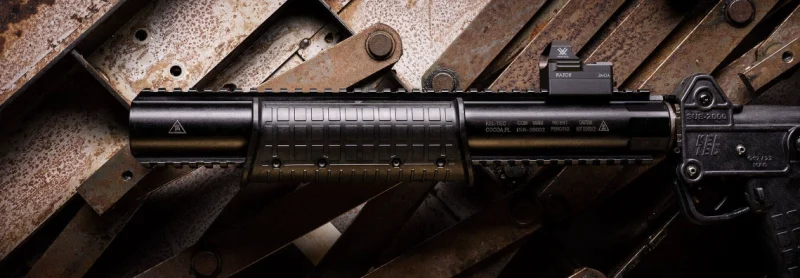
The KelTec CQB suppressor assembly is pinned and welded, eliminating any SBR issues.
George Kellgren and his Kelgineers eliminated the need to be dual-crueled by pinning and welding the outer suppressor shroud assembly directly onto the receiver. This effectively adds the suppressor’s length to the overall barrel length (because the suppressor tube cannot be detached from the gun, at least not without a hacksaw and a lot of effort). This permanent attachment means the BATFE measures overall barrel length from the breech face to the endcap…which makes it a non-NFA affected 16.25 inches.
It’s not a new concept, but it’s a good one. Tip of the hat to you all for that!
And don’t forget the travel advantage.
Remember, crossing state lines with an SBR requires filing an ATF Form 5320.20 and waiting for approval. You don’t have that restriction with a (legally owned) suppressor. That means both intra-state and inter-state travel can be enjoyed without killjoy bureaucratic restrictions. At least this particular integrally suppressed 9mm carbine, anyway.
SUB2000 CQB Defender
There is another Sub2K CQB option if you want something that’s “equipped and ready” when it ships. That would be the SUB2000 CQB Defender model integrated suppressor carbine. Mechanically it’s the same weapon, but it ships with some pre-installed accessories for use right out of the box.
This version of Kellgren’s quite little folder features a Vortex Crossfire red dot optic, an INFORCE WML Gen 3 weapon light, and a thick Kel-Tec Extended Butt Pad. The latter has been described as “recoil dampening”, but it’s a 9mm, so…prob’ly it’s mostly to give you a little extra available length of pull. You can always get a different version of both light and optic if you’d prefer. There are several versions of INFORCE lights available, and the Crossfire is usually pretty inexpensive.
We haven’t spent enough time behind the Keltec CQB to provide personal insight, but there’s plenty of anecdotal evidence and documentation that the SUB2000 CQB can be finicky when it comes to ammunition.
Some weapons use fluted/ported barrels to bleed off gas pressure. This allows them to shoot a standard, 124-grain supersonic cartridge at subsonic speeds.
This KelTec is not one of those.
Because the Sub2k CQB uses a solid, non-ported liner, rounds exit the rifling directly into the baffle stack at full velocity (for the cartridge and barrel length).
Kellgren’s integrally suppressed carbine can be finicky when it comes to ammo preferences. This is not an omnivorous PCC.
Field reviews and video evidence from a variety of sources (including Guntubers) indicate that 124gr NATO or 115gr ball ammo may perform poorly in a Sub2k CQB. High-volume, admittedly field-expedient, testing has shown that this kind of ammunition patterns erratically and inconsistently. There’s also the problem with using a supersonic round when you’re wantin’ to stay (i.e., shoot) quiet.
Those issues seem to go away once you start feeding it heavier subsonic rounds. The use of 147-grain ammo or specific subsonic cartridges seems to reduce that noise signature (and issues with inaccuracy) significantly. Although we ourselves have not had the opportunity to obtain our own empirical evidence on decibel levels, reports indicate the weapon’s signature drops down into the mid-130 decibel range. Accuracy seems to stabilize as well, though all shooters would do well to remember: you will never shoot better than your personal competency. This will typically, though not always, be less than the weapon’s mechanical potential.
Check availability and prices across several sites
Get you one from Tactical Sh!t
Go direct with KelTec
This is a compact weapon with a number of advantages (and a pretty good fun factor). It’s definitely optimal for a number of uses (looking at you, backpack and trunk guns). However, the design properties that recommend it for such uses also forced certain compromises that might arguably be considered disadvantages.
Clunky Manual of Arms. This is caused by a few things:
The CQB uses a straight blowback system, so the bolt requires a heavy recoil spring (with commensurate effects).
The charging handle is placed more than a little awkwardly. It’s up underneath the buffer tube assembly along the stock.
There’s no automatic bolt hold-open. You have to manually pull the handle back and hook it into a slot to lock the action open.
These issues tend to make mag changes, particularly under stress, slower and less intuitive than many other carbines (though, as with most gun handling issues, this can be mitigated or eliminated with good training repetitions).
Damned Hot Handling. It’s all about the aluminum handguard and the can beneath it.
The entire handguard surrounds the suppressor tube. Aluminum gets hot and tends to stay that way.
This might not be an issue if you’re shooting just a few rounds, particularly if doing so slowly. Things are different if you’re burning through high round-count strings from multiple consecutive mags. In that case, the gun will treat your hands and forearms the way a metal playground slide does the back of your thighs in summer.
There’s a reason KelTec put a heat warning on the frame and recommends using shooting gloves.
Deflector (In)durability. Not the whole weapon, mind you, but enough parts of it to be wary.
KelTec uses a lot of glass-filled nylon polymer. That’s one of the ways they keep prices down.
Informal and anecdotal reports indicate that the spent casing deflector behind the ejection port won’t take long before it starts sporting some scars, e.g., gouging and erosion from the repetitive deflection of hot brass off that composite material.
That’s what we have for you so far. If we get more, or learn of further developments, rest assured, we’ll let you know immediately. Or as soon as we quit daydrinking.
INTREP KelTec CQB
About the Author
Reported on today by the News Desk. Our goal is to inform, educate, edify, and enlighten. Warrior-scholar or everyman, we believe everyone should think and be dangerous.