

[[{“value”:”
Thank you for reading this post, don't forget to follow and signup for notifications!

Designate The Lodge at AmmoToGo.com as your preferred source on Google News
An in-depth look at the Ruger American Gen II Predator rifle with field testing, specs and more details about the 22-inch barreled hunting rifle.
The Ruger American is one of the nation’s top-selling hunting rifles. With good reason. It’s rugged, affordable, and available in many popular hunting cartridges. In fact, my favorite gun store sells more Ruger Americans than any other model, and they tell me it isn’t even close. Who am I to argue? It seemed I needed a Ruger American Gen II Predator.
Buying one for myself seemed like an obvious choice since I was already looking for a dedicated test rifle for hunting and non-tactical accessories like scopes or whatever. I went easy on my shoulder with the light-recoiling .243 Winchester chambering, whose long-established popularity also helps with ammo availability. The .243 is a capable whitetail cartridge didn’t hurt either. I can absolutely see myself taking this rifle into the deer woods.
I had several variant choices, but I chose the Gen II Predator model because of several features, which I’ll get to, and the fact that it looks good. This rifle immediately caught my eyes, and I was glad that it had what I wanted, along with my preferred chambering. My gun dealer made a quick sale and we were both happy.
Like other variants, the Gen II Predator has wide caliber availability, and some specifications hinge on a given rifle’s chambering. I note those general differences in the specs table below. You can see full details on the Ruger product page linked above. Our discussion will focus on my particular rifle.
Ruger American Gen II Predator Rifle Specs
Caliber: Various. Our test model is chambered for .243 Winchester
Magazine: AI-Style, AR-Style, Single Stack, or Flush Fit Detachable Box Magazine, depending on caliber. The test model features an AI-Style magazine.
Capacity: Model-dependent. Our test model is 3+1 for .243 Winchester
Barrel Length: 22 inches
Overall Length: 43.25 inches, including the standard length-of-pull spacer
Length of Pull: 12 or 13.75 inches
Weight: Model-dependent. Our .243 Winchester test model weighs 6.7 pounds.
Standard Gen II Predator “Green Splatter” pattern synthetic stock
Burnt Bronze Cerakoted Spiral-fluted Barrel with Threaded Muzzle (5/8-24”) and Muzzle Brake
Twist Rate: Model-dependent. The test rifle’s twist rate features a 1:9 right-hand twist.
Ruger American Gen II Predator Features
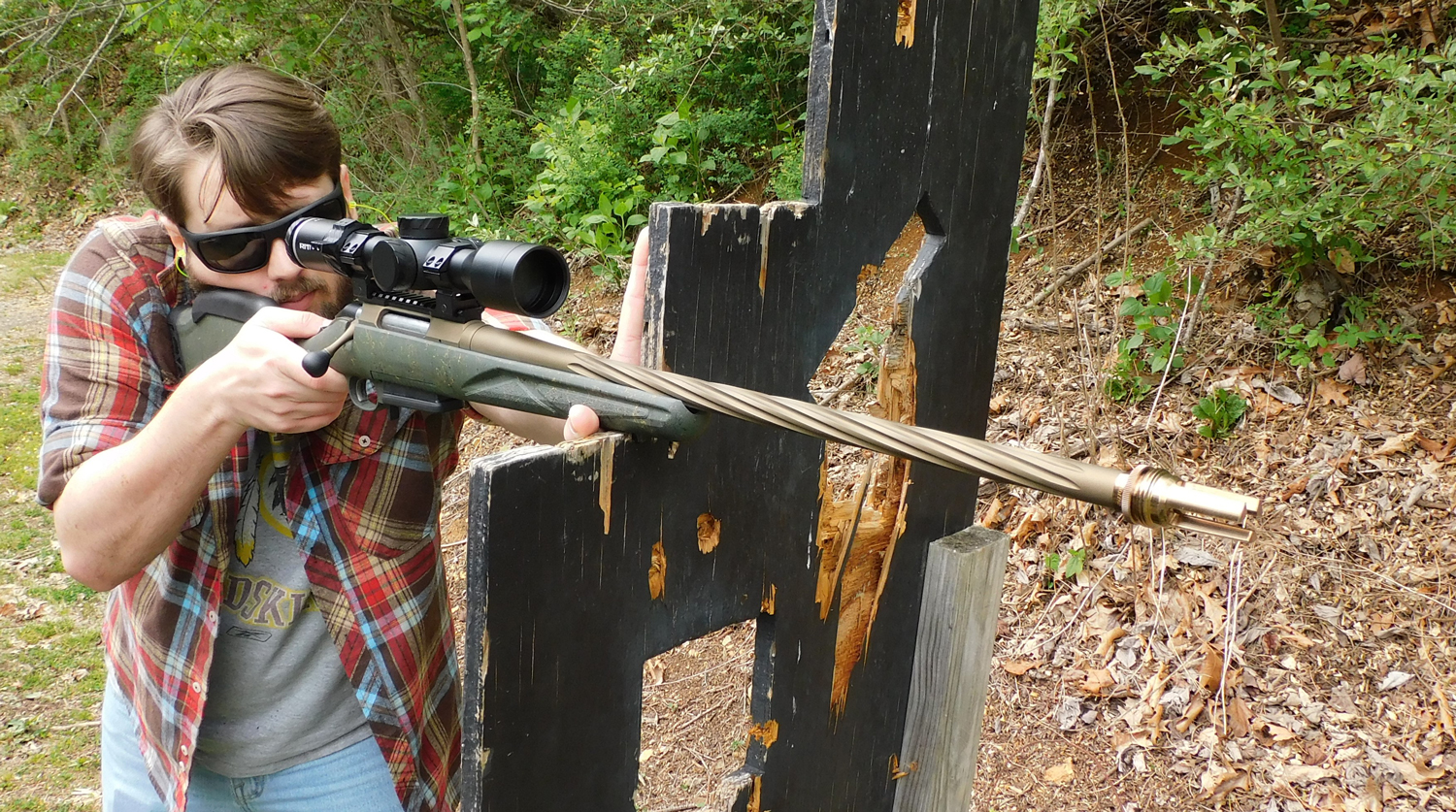
The Ruger American’s price alone quantifies it as a “budget rifle.” That’s fair. Mine cost around $525, which is a bargain in today’s market. This clearly isn’t a premium rifle, but it’s not a bare bones, no frills firearm either. Let’s dig into why I say that.
Burnt Bronze Receiver and Barrel
I’m not certain which I noticed first at the gun store: the Green Splatter stock or the burnt bronze Cerakoted receiver and barrel. Both drew my attention, standing out from the typical black finishes. The Cerakote not only looks good, but it provides extra protection from wear and the elements. All my other hunting rifles are wood and blued steel. I can already see myself choosing this rifle for wet or snowy weather.
Ruger does not provide specifics regarding the receiver and barrel material, other than calling it “alloy steel.” There’s really nothing more to say about that, except to remember that less expensive firearms are less expensive for a reason. I’m confident that the American Gen II Predator is well-constructed, but the steel quality likely doesn’t match higher-end rifles. That would likely only come into play after many rounds over many years, so it doesn’t bother me with this one.
Use with Suppressor
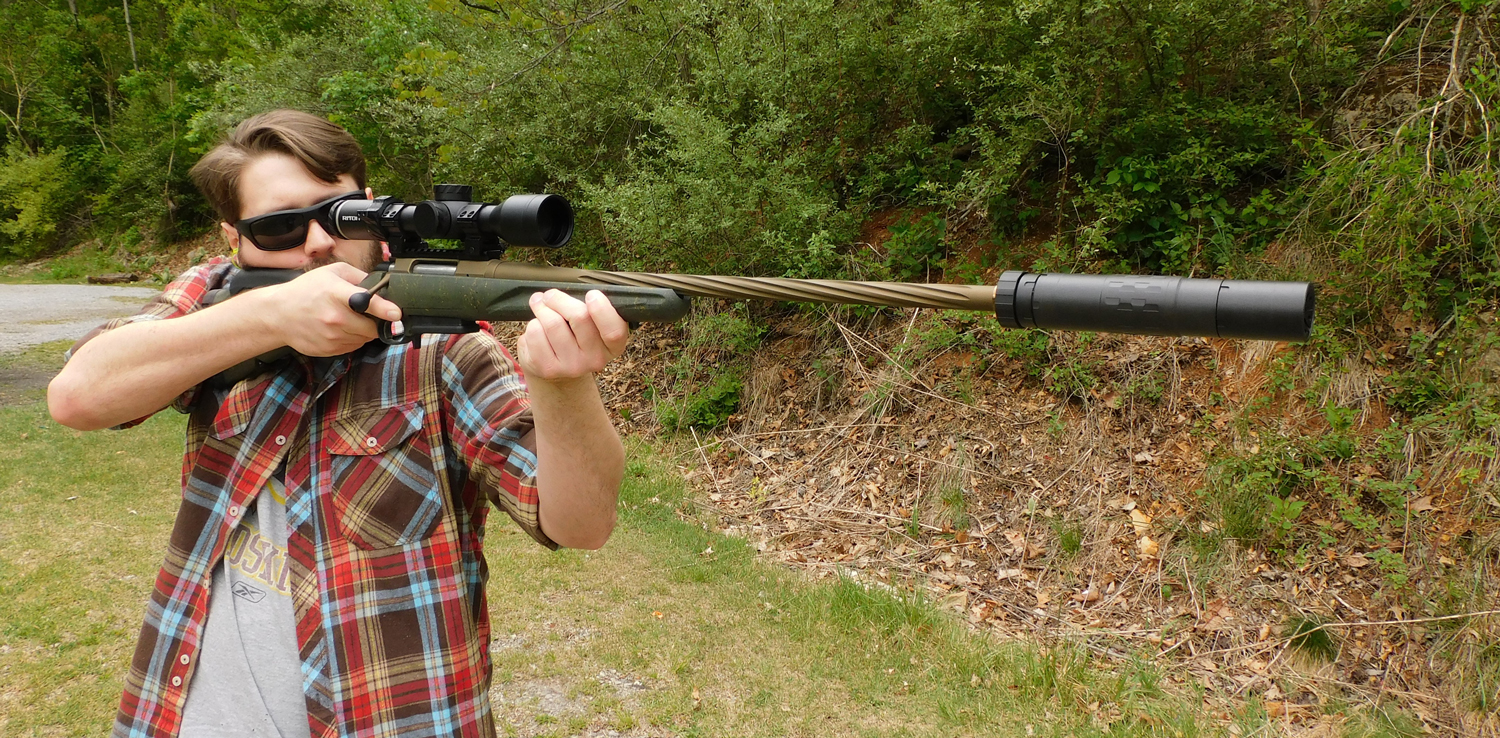
The medium-contour barrel is fluted to reduce weight, while the included muzzle brake reduces recoil. That’s not really an issue with .243, but it will be with more powerful cartridges. I recently replaced the brake with a SilencerCo ASR flash hider, to which I can attach my SilencerCo Omega 36M suppressor. Being able to suppress this rifle was a big factor in my choosing to buy it.
The receiver is solid, with a full-length Picatinny rail up top. I particularly like this feature since I’m constantly swapping optics and other accessories on my test guns. And Pic rails are just easier than installing rings on a tapped and drilled receiver. I don’t mind that on my higher-end personal rifles, though I also wouldn’t mind a Pic rail. It’s just easier and I like it.
“Green Splatter” Synthetic Stock
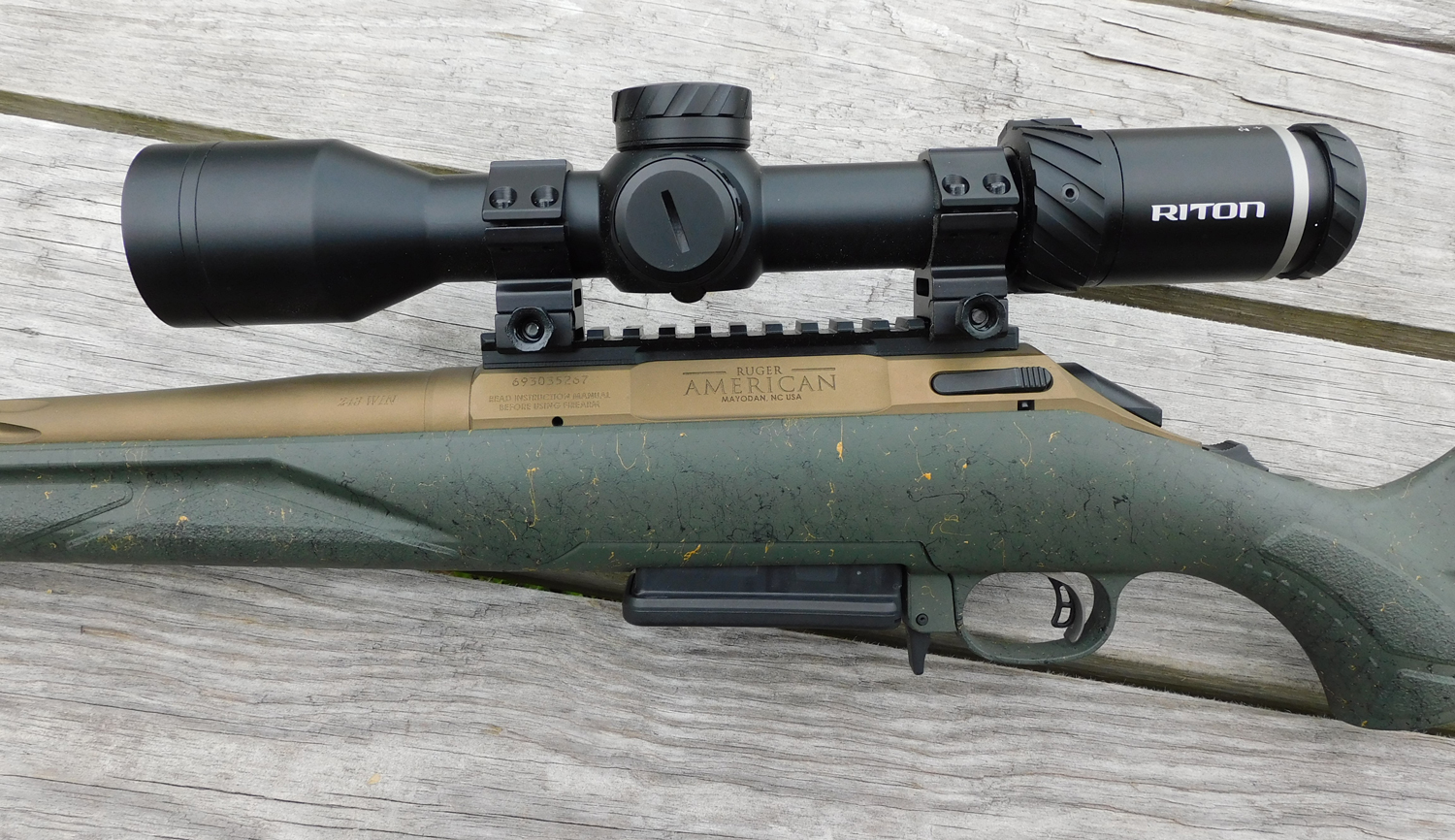
The Splatter finish isn’t just for looks. It provides texturing over the whole stock for a positive grip. That includes extra texturing on the pistol grip and along the forward finger grooves for the support hand. I find it just about perfect. I can maintain a good grip but the texture isn’t overly aggressive.
The stock is adjustable in a way you wouldn’t expect from a budget rifle. I like the raised, black polymer comb for high optics. But if you don’t like it, or don’t need it, the comb is easily removed with a screwdriver. The stock also includes a 1.75-inch spacer with which to adjust the length of pull. Again, it’s easily removed and reduces the length of pull from 13.75 to 12 inches. I kept both features on my stock, though I did confirm the ability to quickly remove and reinstall them.
The butt consists of a thick, soft rubber recoil pad. It’s quite nice, and the .243 shoots like a dream through this rifle. The pad no doubt becomes more important with heavier-recoiling cartridges.
Ruger American Gen II Predator Controls
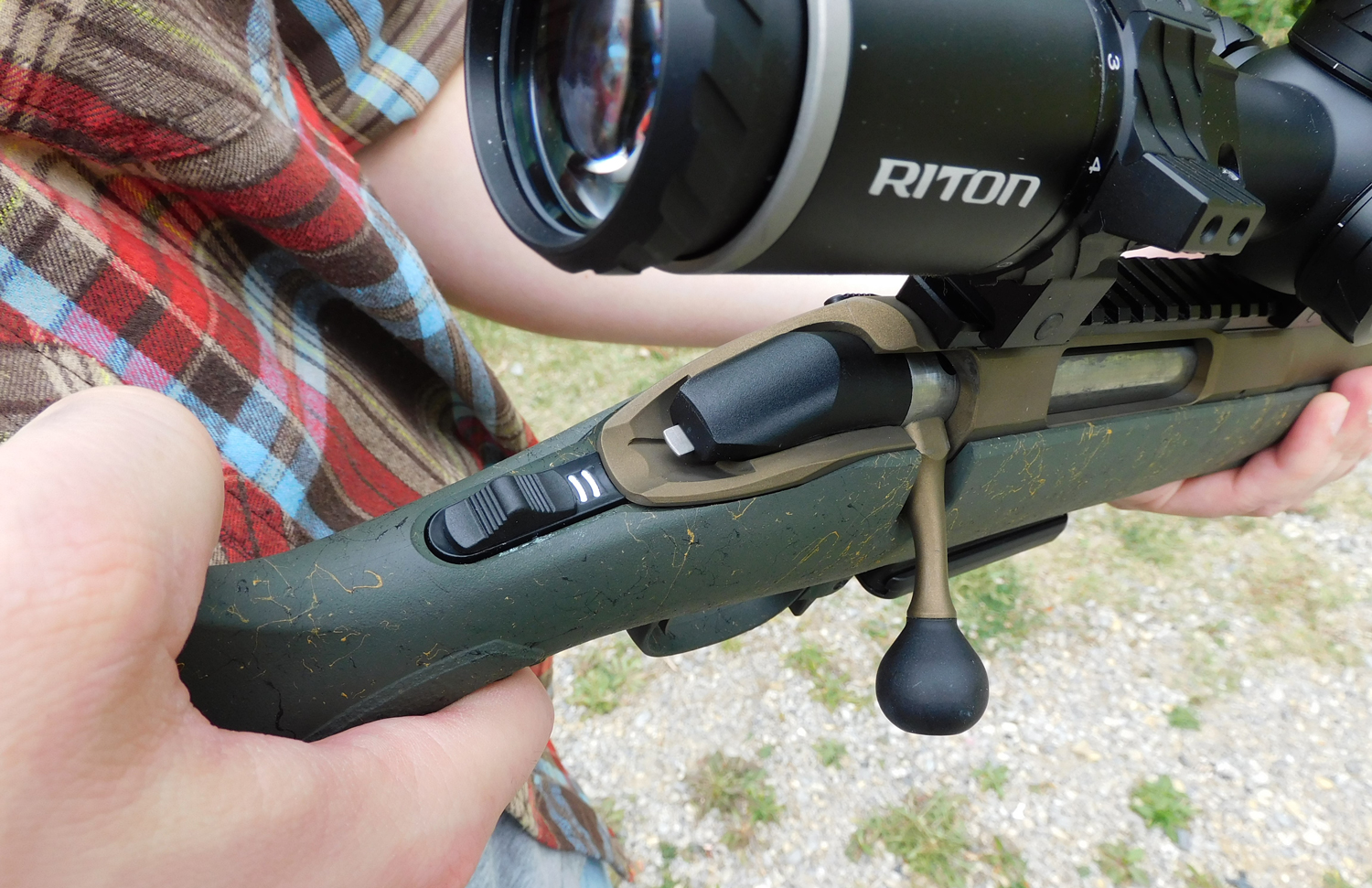
Ruger’s Marksman Adjustable Trigger is actually quite good. It has the blade safety, as on many pistols. The trigger has no slop and breaks much cleaner than I anticipated. My Lyman trigger gauge reads the break at an average of 2 lbs., 3 oz. I have a couple of premium hunting rifles whose triggers are better, but this one is certainly no slouch, and I don’t intend to upgrade or even adjust the factory setting.
The tang-mounted three-position safety catch is perfectly located for my thumb to operate instinctively. A simple downward glance at the three red or white marks instantly tells me the rifle’s status. Alternatively, the catch is tactile, so I can operate it by feel if necessary.
Rifle Action
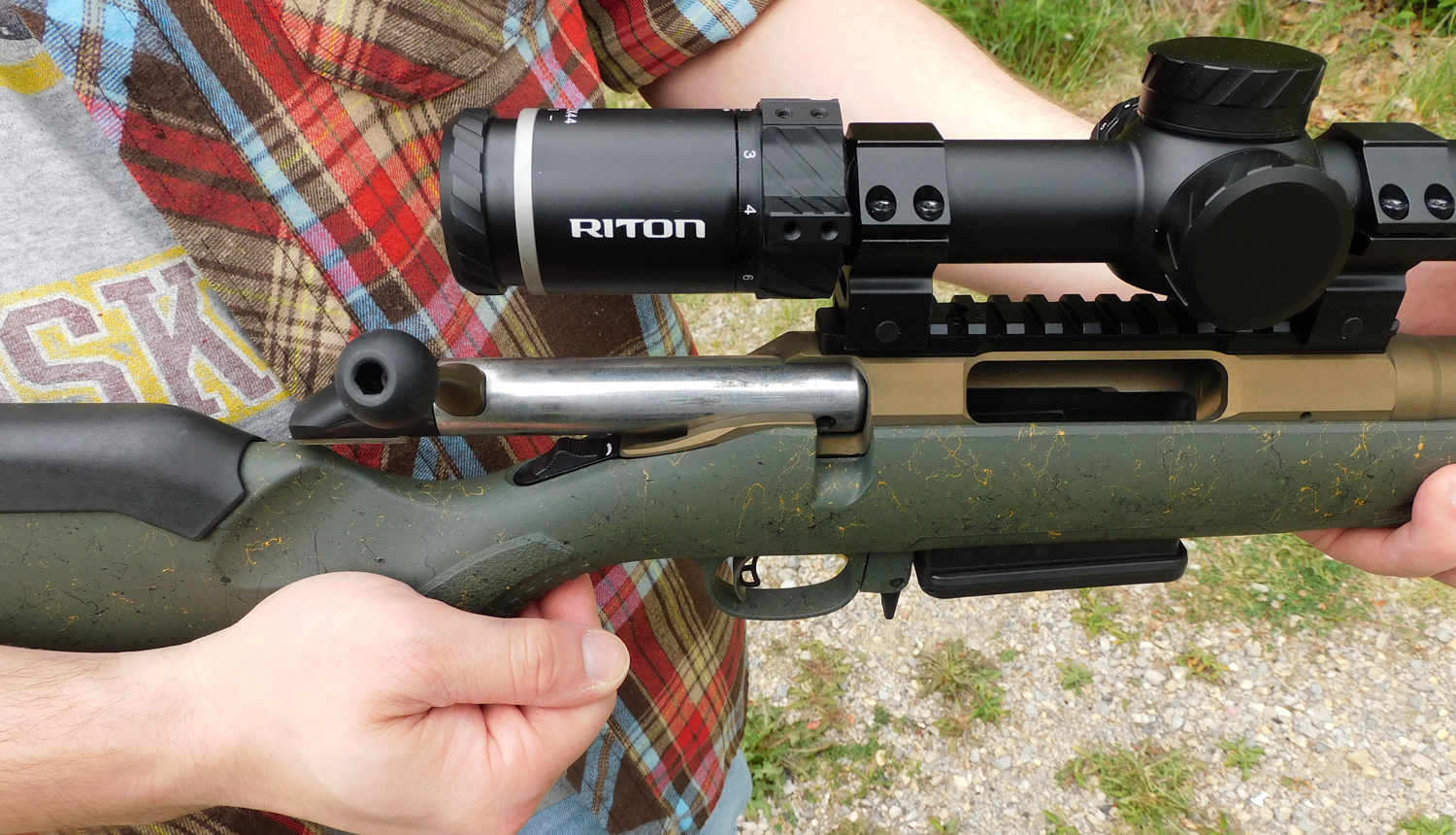
The American features a push-feed bolt action system. The bolt is machined from a single block of stainless steel. The three forward locking lugs provide strength and solid lock-up. The bolt handle is attached, not machined. Such a cost-saving choice isn’t uncommon, even on more expensive rifles. The handle’s Cerakote matches the receiver and barrel, and the bolt knob has a matte black finish. You can replace it with an available knurled or textured knob if desired.
The bolt operates smoothly, though it’s not slick like my higher-end rifles. But it works reliably, and it’s certainly not sticky. The 70-degree throw allows a wide range of scoping options. A catch on the receiver’s left side allows easy removal for cleaning or maintenance.
The AI-style magazine catch works, but I’ve never liked that mechanism, including on my Ruger 10/22s. It’s smooth enough, but the magazine doesn’t eject or even drop free. I have to use my other hand to pull it out. Not a deal breaker for me on a hunting rifle but I don’t particularly like it either.
Ruger American Gen II Predator Accuracy
The Ruger American is a handy little rifle. It’s light and it’s accurate without being a tack driver. I don’t expect a tack driver for $525, but I will take consistent 1 to 2.5-inch groups at 100 yards, which is what I got.
Ammo Tested
- 100-grain Hornady American Whitetail
- 100-grain Winchester Power Point
- 80-grain Remington Core-Lokt PSP
We fired one box of each from the bench, representing four 5-round groups for each load. I did that over three separate range trips. One for each load. I let the rifle cool between groups while I did other things. All 60 rounds were fired using the Omega 36M suppressor for consistency.
The Hornady American Whitetail was the most consistent, delivering 1 to 1.5-inch groups with only one flyer out of 20 rounds. That flyer was probably me, given the round’s performance otherwise.
The Remington and Winchester loads weren’t inaccurate, but they weren’t as consistent as the Hornady in this rifle. The groups opened up to the 2 to 2.5-inch range, with a few flyers. Again, those were probably me, but the overall results indicate that this rifle likes the Hornady load better. The flyer rounds were still within “Minute of Whitetail,” landing 2 to 3 inches from the main group, though such a flyer could certainly mean the difference between hitting the animal’s heart or not.
Functionality
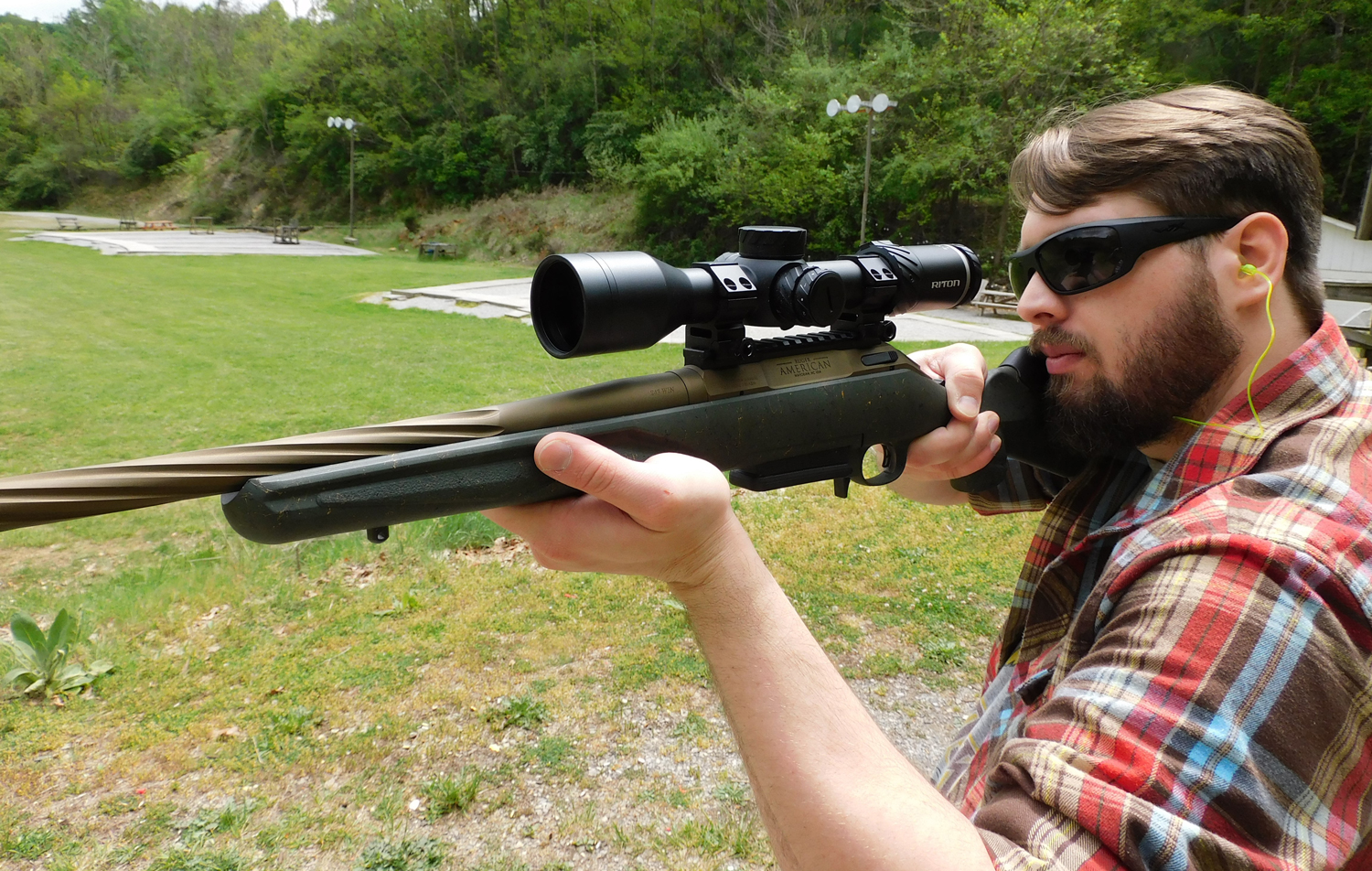
As noted, this is a handy rifle. It’s fairly light and handles well. The stock is very ergonomic. More so even than a couple of my premium rifles. My grip is firm and I like the raised comb. The safety is perfectly placed and I operate it intuitively. The bolt cycles reliably and it cleanly ejects the spent casings. I won’t go into push feed versus controlled round feed, but it does the job just like other good push feed actions. The trigger is quite good and the .243 Winchester recoil is light, with muzzle brake or suppressor. The rifle itself has been 100 percent reliable for me.
My only issues have been magazine-related. The three-round detachable box magazine occasionally fails to feed the third round for some reason I’ve been unable to determine. Deliberately and carefully loading the magazine seems to help, as does opening the bolt before inserting the magazine and tapping it before closing the action. Inserting the mag on a closed bolt can cause the mag to fall out when cycling the bolt after the first shot. It’s not difficult, but it can be annoying. I believe this is a magazine issue, but I can’t say whether it’s a design flaw or just that my mag is defective. For now, I’m just careful to load it properly.
Final Observations
Despite the occasional magazine issues, I like the Gen II Predator. It shoots reliably and well, and it’s been a good test rifle. I like it well enough that I plan to take it hunting too. Living in the Appalachian Mountains a handy, fairly light, weather-resistant deer rifle is a good thing to have. I almost never hunt varmints, but coyotes encroach further every year, and the Predator in .243 could certainly handle that application if needed.
But I most appreciate this rifle’s value. A hunting rifle is ultimately a tool. And a $525 tool can provide meat just as ably as a $2,000 tool. It won’t look as pretty, and the groups won’t be quite so compact, but the real criteria is whether it will drop that deer reliably. This rifle will do that, assuming you do your part. And frankly, not everyone can drop a bunch of money on a rifle. The Ruger American series means they don’t have to, but they can still get that meat for the table every year.
This is a solid rifle. I’m glad I bought it. Check it out yourself. You might be glad too.
“}]]

