

[[{“value”:”
Thank you for reading this post, don't forget to follow and signup for notifications!

Designate The Lodge at AmmoToGo.com as your preferred source on Google News
In this article, we break down the differences between the .303 British and the .308 Winchester. We’ll review everything you need to know, including the history, market conditions, firearms, and size differences. We’ll also go over the ballistics so you can make the best decision for your next hunting rifle.
Although they come from two very different eras, the .303 British and the .308 Winchester were both made (essentially) for combat. The .303, which was launched in the 19th Century, was a standard rifle cartridge for the British Empire and saw use in conflicts going as far back as the Boer War. It was essential materiel for British and Commonwealth troops throughout the First World War and lasted well into the War on Terrorism.
The .308 Winchester is a bit more modern, having been launched in the mid-20th Century. It’s the civilian version of the 7.62x51mm NATO, which was used in the Vietnam War through today’s current conflicts.
While their roots are in the military, these cartridges have found a comfortable place in hunting fields across the globe. The Winchester is a popular option in America, while the British remains a staple in Canada, largely because of their historical connection to Great Britain.
On either side of the border, these two rounds deliver excellent performance for deer and other medium game, while remaining a fun option for long-distance target shooting. Which is right for you? Let’s examine these two rounds to find out…
Fast Answers: .303 British vs .308 Winchester:
Here’s a quick summary of the advantages for each cartridge:
Advantages of the .303 British
An interesting cartridge for collectors and history enthusiasts
Slightly better recoil
Higher ballistic coefficient for most bullets (More aerodynamic)
Advantages of the .308 Winchester
Faster velocities
Higher energies
Semiautomatic capability
.303 British vs .308 Winchester: The Initial Analysis
| .303 British | .308 Winchester | |
|---|---|---|
| Released | 1889 | 1952 |
| Bullet Diameter | 0.312 inches | 0.308 inches |
| Neck Diameter | 0.34 inches | 0.3433 inches |
| Base Diameter | 0.46 inches | 0.4728 inches |
| Case Length | 2.222 inches | 2.015 inches |
| Case Capacity | 3.64 cubic centimeters | 3.6 cubic centimeters |
| Overall Length | 3.075 inches | 2.8 inches |
| Bullet Weights | 150 – 180 grains | 110 – 185 grains |
| Typical Firearm | Bolt-action rifle | AR-10 and some bolt-action rifles |
Size and Shape
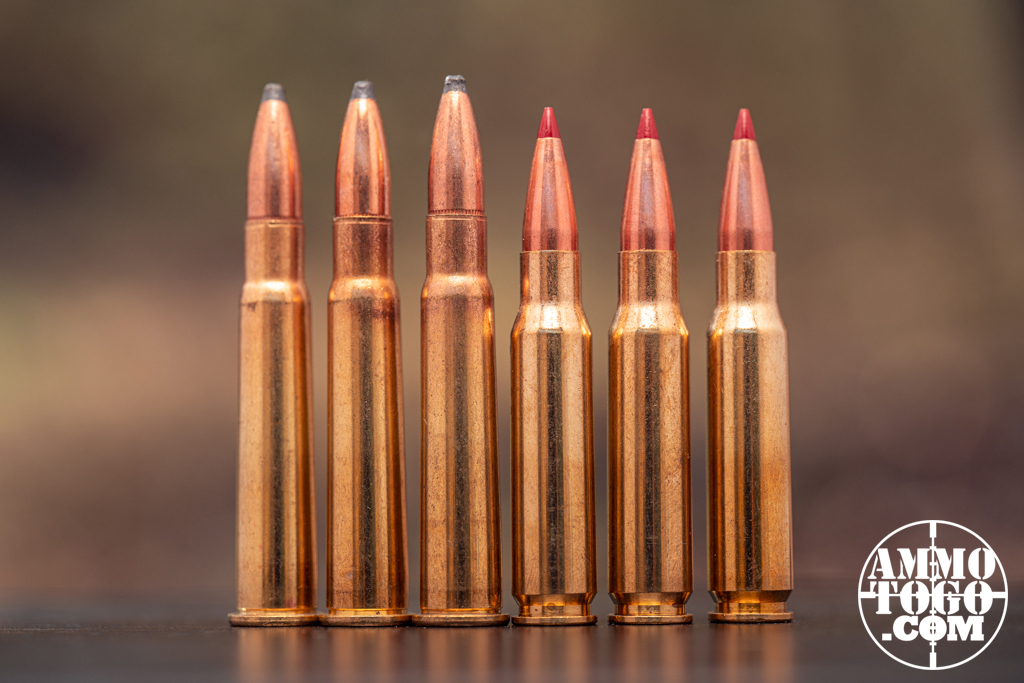
When propped side-by-side, the .303 British appears long and tall while the .308 Winchester looks a bit squat. For diameters, they are largely the same, although there are subtle differences; the neck diameter, for example, is different by 0.0033 inches. The bullet diameters are different as well, although the .303 British is wider by only 0.004 inches. Another “difference” that’s hard to see with the naked eye.
The most important difference is the case length. The .303 British has a longer case (although slightly slimmer); we’ll see how this impacts ballistics when we examine velocity, energy, and trajectory.
Bullet Weights
Both of these cartridges seat bullets from 150 to 180 grains, but the overall range for the .308 is bigger. It has bullets going as light as 110, and can go as heavy as 185. For the majority of products, however, are 150 and 180, the most common bullet weights for both rounds.
Ammo Availability and Pricing
At least for American shooters, .308 Winchester ammo is far more accessible and affordable. This is one of the most common rounds in the country, and it has been adopted by numerous shooters for target, home defense, and hunting. Manufacturers have responded to this popularity by providing numerous cartridge options for nearly every conceivable purpose. The .303, by comparison, is less common on shelves and comes in a smaller variety.
The Winchester is also more affordable. It’s not the cheapest cartridge, but users can find ammo for as low as $0.80 per shot, while .303 British ammo, at a minimum, costs about $1.20. That’s only forty cents, but it adds up if you are shooting hundreds of rounds a month.
Overall, we can reasonably say that the .308 Winchester is more shooter-friendly than the .303 British.
Rifle Differences
If you have a favorite type of rifle, your choice may have been made already. The .303 British is fired from bolt-action rifles, including the famous Lee-Enfield rifles that were standard issue for the British forces. The .308 is fired primarily from the ever-popular AR-10 platform, giving shooters semi-automatic capability and nearly endless customizability.
Some may see the AR-10 as an advantage, but many hunters and long-range shooters prefer the style and performance of a classic bolt-action rifle.
.303 British vs .308 Winchester: Ballistics
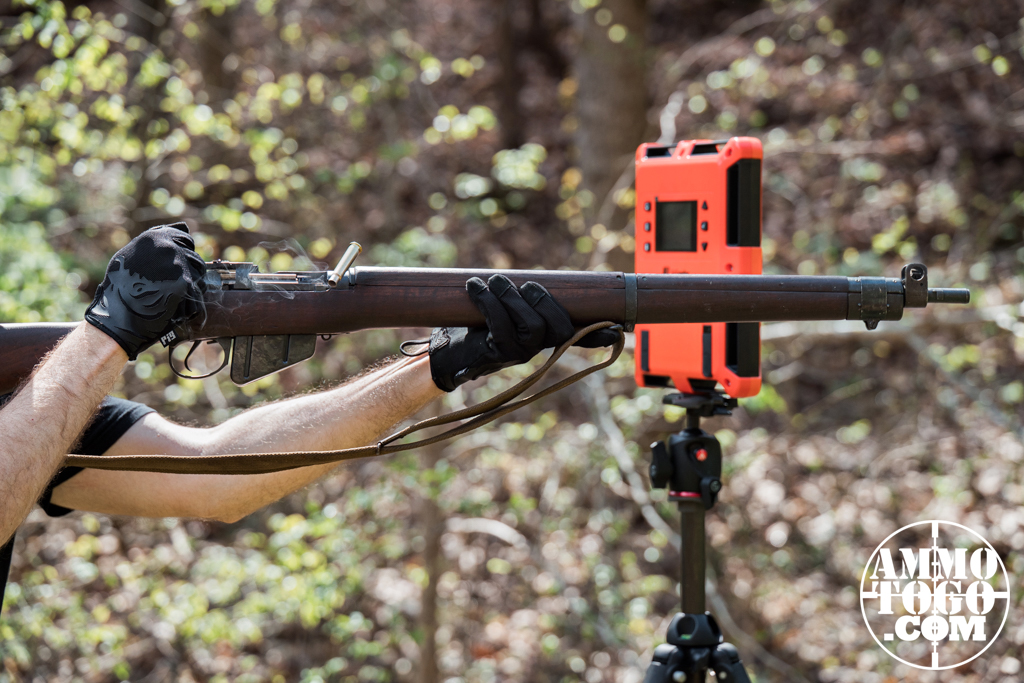
The .303 British and .308 Winchester are similar in many ways, yet have distinct differences. How do these differences play out for ballistics? Let’s take a look at stats from a handful of .303 and .308 cartridges to find out…
Velocity
| Muzzle (fps) | 100 | 200 | 300 | 400 | 500 | |
|---|---|---|---|---|---|---|
| .303 British 150-gr Power-Shok Rifle (Federal) | 2,690 | 2,442 | 2,208 | 1,988 | 1,780 | 1,590 |
| .308 Winchester 150-gr Power-Shok Rifle (Federal) | 2,820 | 2,532 | 2,261 | 2,007 | 1,771 | 1,557 |
| .303 British 180-grain Power-Point (Winchester) | 2,460 | 2,233 | 2,018 | 1,817 | 1,629 | 1,459 |
| .308 Winchester 180-grain Power-Point (Winchester) | 2,620 | 2,392 | 2,179 | 1,971 | 1,779 | 1,600 |
| .303 British 180-gr Core-Lokt (Remington) | 2,460 | 2,125 | 1,818 | 1,545 | 1,314 | 1,138 |
| .308 Winchester 180-gr Core-Lokt (Remington) | 2,620 | 2,274 | 1,955 | 1,667 | 1,415 | 1,213 |
| .303 British 150-grain InterLock SP (Hornady) | 2,685 | 2,441 | 2,211 | 1,993 | 1,789 | 1,601 |
| .308 Winchester 150-grain InterLock SP (Hornady) | 2,820 | 2,561 | 2,316 | 2,085 | 1,868 | 1,667 |
There is an interesting trend with velocity stats. While the .308 Winchester starts faster in all examples, it loses velocity faster. It starts with an advantage of roughly 150 fps, but drops fast, allowing the .303 to catch up.
Look at the Federal products listed at the top. The .308 starts with a clear advantage, but at 500 yards, the .303 is actually faster. This is odd, as both seat a 150-grain bullet. Why the difference? We can assume it’s related to ballistic coefficient. (The .303’s BC is .356 while the .308’s is .312.) This indicates better aerodynamics, which is likely why the .303 maintains speed.
All that aside, the .308 is still a faster overall cartridge, especially at the muzzle, an advantage that can be attributed to higher internal pressures.
Energy
| Muzzle (ft-lbs) | 100 | 200 | 300 | 400 | 500 | |
|---|---|---|---|---|---|---|
| .303 British 150-gr Power-Shok Rifle (Federal) | 2,410 | 1,987 | 1,624 | 1,316 | 1,055 | 842 |
| .308 Winchester 150-gr Power-Shok Rifle (Federal) | 2,648 | 2,134 | 1,702 | 1,341 | 1,044 | 807 |
| .303 British 180-grain Power-Point (Winchester) | 2,418 | 1,993 | 1,628 | 1,320 | 1,060 | 851 |
| .308 Winchester 180-grain Power-Point (Winchester) | 2,743 | 2,287 | 1,892 | 1,553 | 1,264 | 1,023 |
| .303 British 180-gr Core-Lokt (Remington) | 2,418 | 1,805 | 1,321 | 954 | 690 | 518 |
| .308 Winchester 180-gr Core-Lokt (Remington) | 2,743 | 2,067 | 1,528 | 1,111 | 800 | 588 |
| .303 British 150-grain InterLock SP (Hornady) | 2,401 | 1,985 | 1,628 | 1,323 | 1,066 | 854 |
| .308 Winchester 150-grain InterLock SP (Hornady) | 2,649 | 2,184 | 1,787 | 1,448 | 1,162 | 925 |
To maintain a fair comparison, we paired matching bullet weights. (150 compared to 150, for example.) So it’s no surprise that with better speeds, the .308 Winchester is more powerful. The difference is minimal, but from the cartridges we examined, we see stronger energy stats from the American cartridge.
Trajectory
| 100 | 200 | 300 | 400 | 500 | |
|---|---|---|---|---|---|
| .303 British 150-gr Power-Shok Rifle (Federal) | 2 | 0 | -9 | -27 | -57 |
| .308 Winchester 150-gr Power-Shok Rifle (Federal) | 2 | 0 | -9 | -26 | -55 |
| .303 British 180-grain Power-Point (Winchester) | 3 | 0 | -11 | -33 | -68 |
| .308 Winchester 180-grain Power-Point (Winchester) | 2 | 0 | -10 | -28 | -58 |
| .303 British 180-gr Core-Lokt (Remington) | 3 | 0 | -14 | -43 | -92 |
| .308 Winchester 180-gr Core-Lokt (Remington) | 3 | 0 | -12 | -36 | -79 |
| .303 British 150-grain InterLock SP (Hornady) | 2 | 0 | -9 | -27 | -56 |
| .308 Winchester 150-grain InterLock SP (Hornady) | 2 | 0 | -8 | -25 | -51 |
Again the differences are so minimal that most shooters won’t notice, especially for the 150-grain products.
However, the 180-grain rounds showed a strong advantage for the .308. The drop at 500 yards was different by nearly 13 inches, suggesting that perhaps the .308 is better for long-range accuracy with heavy bullets.
Recoil
The .303 British tends to have a slight advantage in recoil, although it’s minimal. (To be fair, all the .308’s victories were minimal as well.)
With lighter muzzle energy, the .303 delivers moderate recoil. It’s also aided by heavier rifles that tend to absorb recoil. However, the semiautomatic AR-10 rifles absorb recoil through the cycling action, giving shooters more control. Overall, experienced shooters find that the recoil difference is virtually unnoticeable.
Which to Choose?
Choose the .303 British if…
- You prefer a slightly softer recoil for manageable shooting
- You are interested in unique cartridges, collectibles, and firearms history
- You want a better ballistic coefficient for long-range shooting
Choose the .308 Winchester if…
- You need higher velocity and energy performance
- You want to shoot with an AR-10 or semiautomatic rifle
- You want a more affordable, readily available cartridge
Your Next Hunting and Target Ammo Shipment!
Are you ready for top-quality hunting and target ammunition delivered straight to your front door? Check out our large in-stock inventory and you’ll find the ammo you need at a price you can afford!
“}]]

