

Editor’s note: This article is part of the Police1 Leadership Institute, which examines the leadership, policy and operational challenges shaping modern policing. In 2026, the series focuses on artificial intelligence technology and its impact on law enforcement decision-making, risk management and organizational change.
Thank you for reading this post, don't forget to follow and signup for notifications!
In law enforcement, policy is often born in the aftermath of an incident. Over the course of my career, I’ve watched the cycle repeat itself: something goes wrong, a policy is rushed into place and suddenly an entire category of tools or tactics is restricted or eliminated. Months — or sometimes years — later, after the emotion fades and the facts settle, that same policy is quietly revised back toward what it once was.
I’ve seen this happen with surveillance tools, investigative techniques and operational workflows. I’ve also seen policies written not from internal failures, but from external pressure — driven by headlines, misunderstandings or public concern about practices that were already being conducted responsibly.
Artificial intelligence is now entering that same cycle.
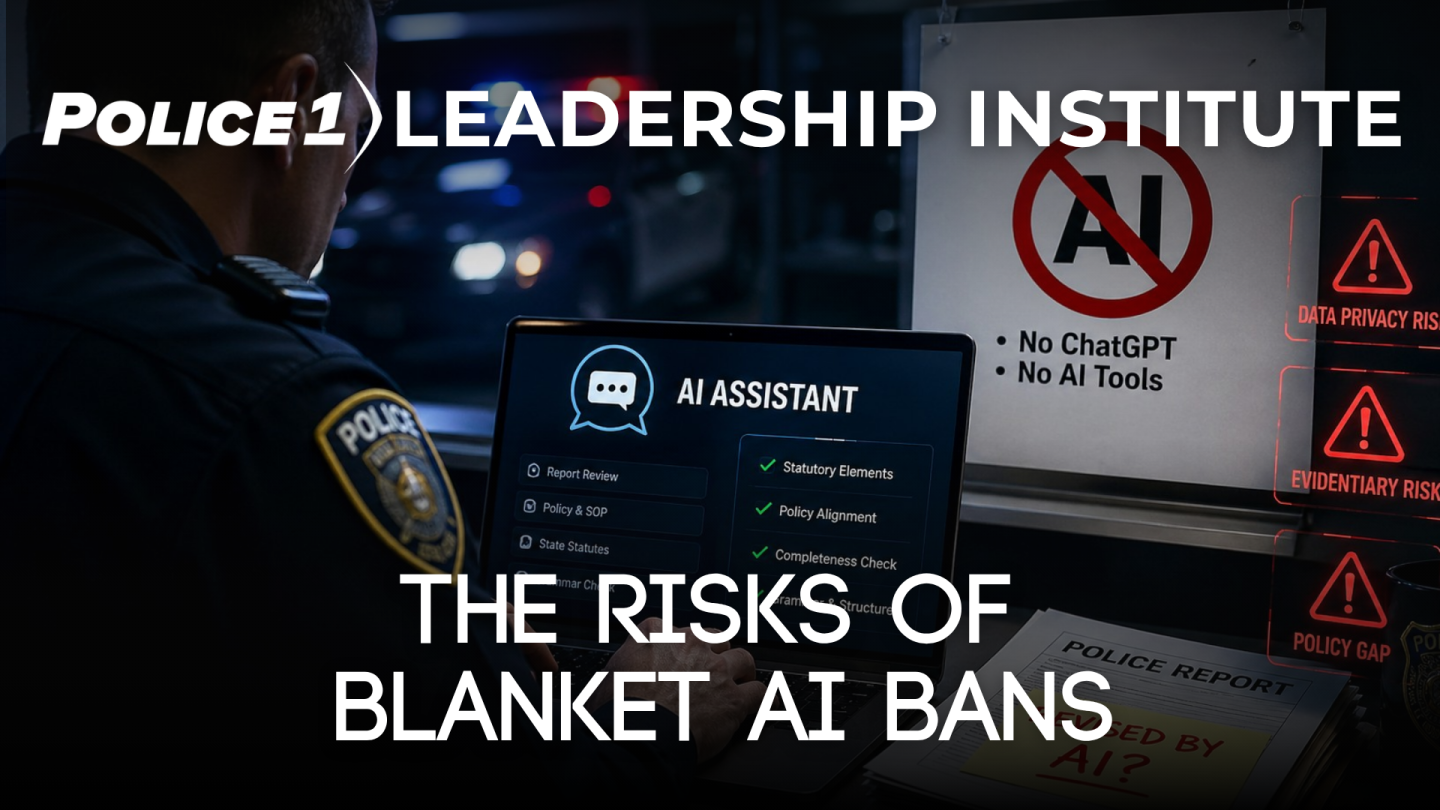
In many agencies, the response to AI has been a knee-jerk one: no AI, no ChatGPT, no experimentation, no exceptions. These blanket bans are often written by well-meaning administrators trying to protect their agencies from risk. But they are frequently authored by people who do not fully understand what these tools are, how they work or how they are already being used — sometimes by their own personnel on personal devices. The result is not safety. It’s a policy gap.
Consider a realistic — almost humorous — example.
An agency announces a strict “no AI” policy. Yet somewhere in the same building, command staff are using grammar-enhancement tools like Grammarly to draft emails, memos or reports. Those tools are powered by AI. It is almost guaranteed they are already in use somewhere within the organization. So if leadership is willing — sometimes unknowingly — to use AI-driven tools for efficiency and clarity, what do we realistically think is happening at the patrol level?
When a time-constrained officer is jumping from call to call, trying to complete reports before the end of shift, the temptation to use publicly available AI tools for assistance is not theoretical. It is predictable. Blanket bans do not eliminate use. They eliminate transparency.
AI is not a single tool. It is a category as broad as “the internet” or “software.” Treating it as a monolithic threat leads to rules that are overly rigid, operationally unrealistic and ultimately unenforceable. Worse, it pushes innovation underground, where officers either stop exploring beneficial uses or begin using unsanctioned tools without guidance or oversight.
We have seen this before. When policy is driven by fear instead of understanding, it rarely ages well. In the case of AI, the stakes are higher because this technology is not optional. It is already shaping investigations, reporting, translation, analysis and evidence review — inside and outside law enforcement.
The question agencies should be asking is not, “How do we ban AI?” It is, “How do we govern it intelligently?”
Two patrol scenarios — same tech, very different outcomes
Before getting into policy frameworks, it helps to look at how this plays out in the field.
Scenario one: Structured and governed AI use
An officer finishes a domestic violence arrest near the end of shift. The body camera footage is lengthy. The statute has multiple elements that must be clearly articulated. The agency has an approved internal AI assistant trained only on department policy, SOPs and state statutes.
The officer asks the system to:
- Outline the required statutory elements for the charge
- Compare those elements to the narrative he has written
- Flag any missing components
- Review grammar and structure
The AI does not replace the officer’s judgment. It does not invent facts. It ensures the report aligns with statute and policy. The officer reviews everything before submission.
The result: a cleaner report, fewer returns from supervisors, better articulation in court and more time back on the road.
That is AI as a quality-control tool.
Scenario two: AI unsanctioned use under a blanket ban
Another officer is overloaded with calls. There is no approved AI tool available. He opens a public large language model on his personal phone and pastes his narrative in for help.
He does not notice that the system subtly rewrites part of the report. A suspect is described in softer language. A key element is paraphrased in a way that shifts meaning. In an attempt to clean up the writing, the model changes phrasing in a way that could later be challenged in court.
Worse, sensitive details were entered into a system outside CJIS-compliant safeguards.
This is not malicious. It is careless — and predictable.
Public large language models are optimized for fluency, not evidentiary precision. They may soften tone, summarize aggressively or reshape language in ways that feel helpful but alter substance. “AI slop” is real.
The difference between these two outcomes is not the officer. It is policy.
When agencies provide structured tools with clear guardrails, officers use them responsibly. When agencies ban the technology without providing alternatives, they create conditions for improvisation.
Improvisation in evidence handling has never been a best practice.
What smart AI policy actually looks like
If blanket bans are not the answer, what is? The solution is not reckless adoption. It is structured governance.
1. Build an AI working group — not just a policy memo
If everyone in the agency may eventually interact with AI tools, then everyone deserves a voice in how they are governed. Create a task force that includes command staff, patrol officers, detectives, IT, legal advisors and training personnel. The patrol officer writing reports at 3 a.m. understands workflow pressures differently than a captain drafting policy. Both perspectives matter.
When policy reflects operational reality, compliance improves. When it ignores reality, workarounds begin.
2. Consider building internal AI capabilities
Not every agency must rely on public AI tools. In-house solutions — whether a private chatbot, a controlled large language model or a secured internal AI assistant — allow agencies to control their data, set boundaries and scale responsibly. Start with policies, SOPs and state statutes. Build a knowledge base rooted in your standards. Expand deliberately. Maintain ownership of your data.
An internal AI tool trained on agency policy will provide more reliable outputs than a public system guessing at your procedures.
3. If you do not build it, vet the vendors
Not every department has the resources to build internally. That is fine. But if you bring in outside AI vendors, do it strategically. Ask:
- Where does the data live?
- How are models trained?
- Does your data become part of a learning pool?
- Are CJIS and government-grade cloud standards met?
Best case, you find a strong partner that propels your agency forward. Worst case, you do not sign a contract — but your team becomes more educated through the evaluation process. Either way, knowledge reduces fear.
4. Keep the guardrails on
This article encourages openness, not recklessness. If your agency does not fully control the AI environment, strict guardrails must exist. Policies should clearly state:
- No evidence uploads into public AI systems
- No personally identifiable information entered into non-secure platforms
- No investigative material shared with publicly accessible LLMs
- Clear consequences for misuse
AI governance should mirror evidence-handling protocols. We would never allow officers to take evidence home to experiment with it. The same principle applies digitally.
Smart AI policy is not about unlimited access. It is about responsible access.
Final thought
AI will not wait for policy to catch up. Officers will use it. Criminals will use it. Vendors will continue embedding it into the software agencies rely on every day.
Blanket bans may feel safe, but they create blind spots. Intelligent governance creates control. The agencies that build structured policy now will shape how AI serves them. Those that refuse to engage will spend the next decade reacting to it.

