

This article is reprinted with permission from Axon’s Customer Stories.
Thank you for reading this post, don't forget to follow and signup for notifications!
Saturday morning on Miami Beach’s 41st Street began like any other — families heading to synagogue, traffic flowing through the heart of the city’s Jewish community. Then, at 8:15, that rhythm broke. A man stepped into the street, approached an officer’s patrol car and asked about the bus schedule. When the officer responded, the man’s demeanor shifted abruptly.
“He became irate,” recalled Miami Beach Police Department Sergeant Mike Muley. “[The officer] asked him to step out of the street and that’s when the officer came on the radio and said, ‘I have an irate male. He’s threatening to catch himself on fire or ignite a bomb.’”
Sgt. Muley was just a block away and responded quickly. “There were groups of 10 to 15 people walking down the street,” he said. “My concern was not allowing him to get south of our location.”
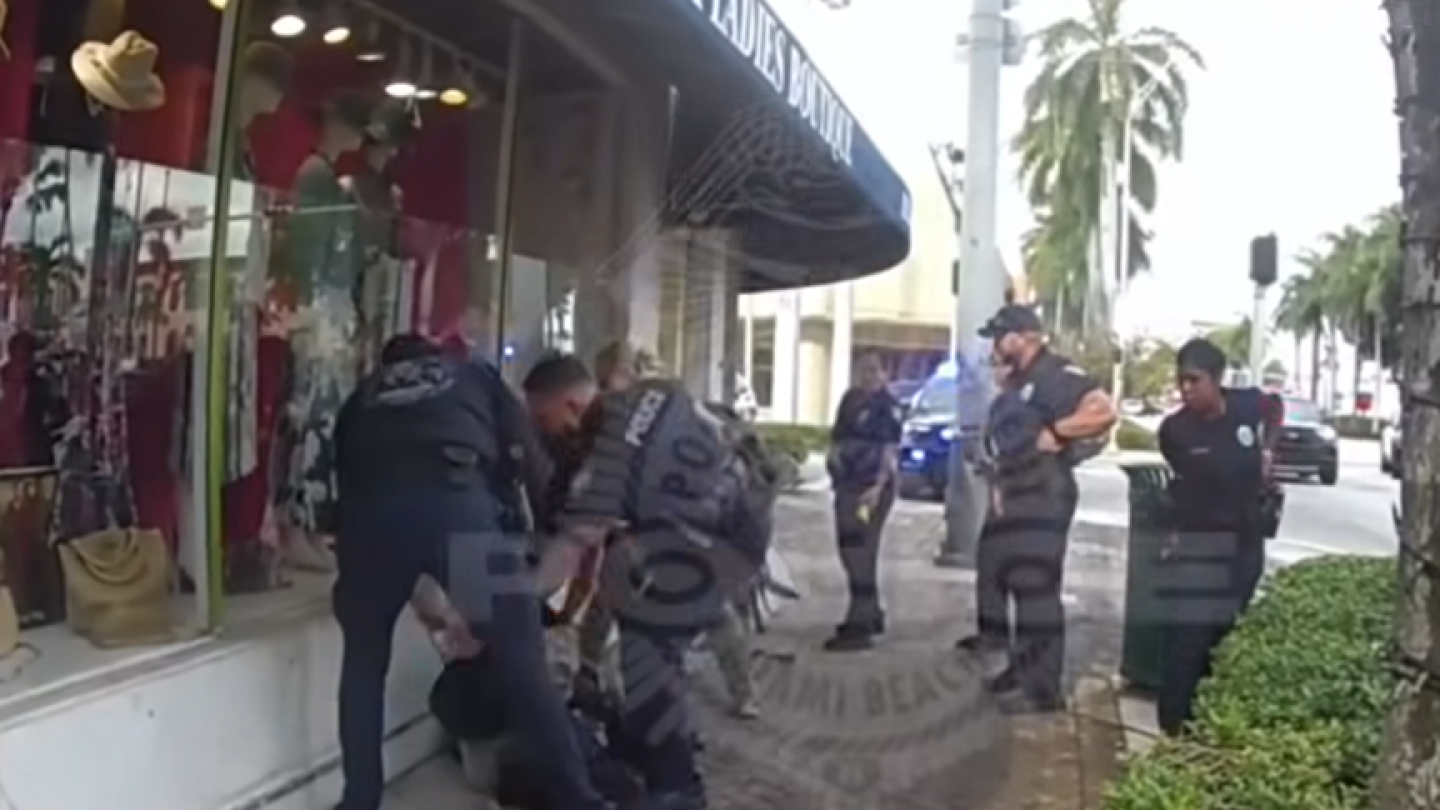
As more officers arrived, the man moved to the sidewalk and began challenging them. “He pulls a kitchen knife out — probably five to six inches in length,” Muley said. “He also has a lighter and two black cylinders he claims are gasoline. At one point, he called them the mother of all bombs. He said he was gonna blow up the block and himself and us.”
Containment sets the tone
Officers quickly blocked off traffic and began setting up a secure perimeter. Muley’s first priority was containment — keeping the man in one place and the public at a safe distance. “I started trying to get officers where I needed them to be,” he explained. “I wanted to get fire rescue there in case he lit himself on fire, or us.”
On body-worn camera video of the incident, one of the newer officers on scene could be heard commanding the man to drop the knife. Sergeant Muley let it play out at first but soon stepped in. “He got stuck in the loop of ‘let me see your hands, put it down,’ over and over again. I said, ‘Hey, relax, everybody take a deep breath. Let him talk. He’s gonna tell us what is going on.’”
Slowing the moment
Muley, who also serves as a supervisor on the department’s hostage negotiation team, was listening for clues. “I was looking for something to feed back to him. Like, ‘I’m angry at the government,’ or ‘I don’t like [this group of people].’ But it seemed like he just didn’t like himself or us at that time.”
The man’s repeated shouts echoed through the street: “Shoot me, I’m gonna make you shoot me. Shoot me.” Muley stayed calm. “We don’t want to do that,” he told him. “That’s not what we’re standing here to do.”
Understanding that time was a critical resource, Muley made a call over the citywide radio. “I went on the radio and asked, ‘Is there anybody in the city that has a less-lethal beanbag shotgun?’” he said. “One officer came on the air who had one in another district, and I had him come lights and sirens to our location.”
Time creates options
It took eight to ten minutes for that unit to arrive — eight to ten minutes during which the suspect continued to posture, challenge officers, and threaten violence. But the perimeter held, and no one moved too quickly.
When the beanbag rounds were finally deployed, they struck the man four times in the midsection. “None missed,” Muley said. “No effect.” Still, the man dropped the knife — briefly — before bending to pick it up again. That’s when Muley authorized a TASER deployment. “He was verbally threatening us, but he hadn’t advanced. He was just standing his ground, seeing what we were going to do,” Muley explained. “When he saw we weren’t gonna shoot, he started to walk off. As soon as he dropped the knife and went to pick it up, I called for TASER.”
The TASER deployment was successful. Officers moved in to take the man into custody, but he resisted violently, head butting an officer. That officer later required stitches. “Considering the gravity of the incident,” Muley said, “we had no one [seriously] injured.”
One of his longtime colleagues, Officer Julio Blanco, turned to him after the arrest and said, “You saved that guy’s life, man.”
“That meant something,” Muley admitted. “We were able to figure this thing out together, all of us. We used the resources we were provided, we used the training we were taught, and it worked out positively.”
Leadership that drives the outcome
Dr. Noel Castillo, a department use-of-force expert and member of the training unit, reviewed the incident and called it a textbook example of de-escalation. “He set his containment. He set control of the scene, of his officers, of himself,” Castillo said. “Then came communication. Let the guy talk. Use your active listening. That’s what Sergeant Muley did. He stopped doing the talking and listened. He slowed things down.”
Castillo explained that Miami Beach PD trains extensively in de-escalation techniques, integrating principles from multiple nationally recognized training groups. “We talk about the C’s of de-escalation,” he said. “Containment, control, communication, contact or connection, and confirmation.”
From Castillo’s perspective, every element was there. “Mike did textbook. Not PowerPoint textbook, but real-life textbook,” he said. “He set the stage. That’s what buys you time. And time gives you options.”
For Castillo, the scene highlighted more than training — it showed leadership in action. “Mike’s a master sergeant,” he said. “He set the tone, controlled the resources, communicated clearly. That’s what kept this from going a very different way.”
In the days after, Muley stayed humble about the incident’s outcome. What defined that morning wasn’t just training — it was patience under pressure, teamwork, and time. “We gave him a chance to live,” he said. “That’s what matters.”
| NEXT: Tactical analysis: Officer dragged in vehicle struggle highlights critical decision points

