

[[{“value”:”
Thank you for reading this post, don't forget to follow and signup for notifications!
By Captain Kelly Robbins and Maureen “Mo” McGough
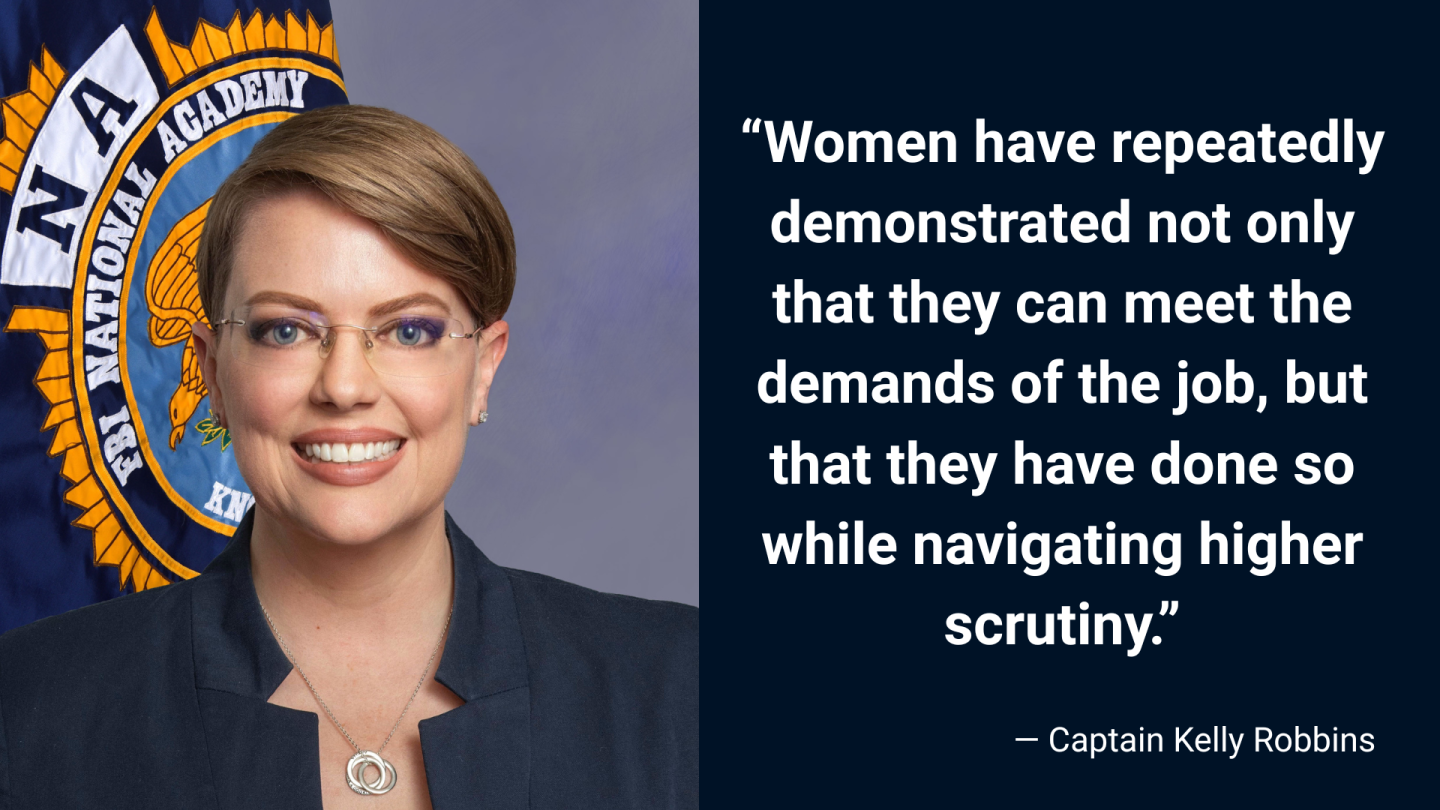
Historically, the role of women in policing has been framed as a question of capability. Can women do the job? Can they handle the physical and emotional demands? Can they withstand the male-dominated culture? Those questions have been asked and answered time and again. Women have repeatedly demonstrated not only that they can meet the demands of the job, but that they have done so while navigating higher scrutiny, fewer supports and organizations that were not designed with them in mind.
There is also a growing body of robust empirical research demonstrating that women not only perform as well as their counterparts, but are uniquely valuable in areas society cares deeply about, such as improved crime victim outcomes, reduced uses of force and stronger relationships with communities.
The real question is not whether women can and should do the job. It’s whether police departments and the leaders who run them are willing to confront and redesign the systems that keep women out and fail them once they’re in.
| REGISTER: How women in law enforcement can build confidence, credibility and career momentum
How it started
Women’s entry into American law enforcement has been hard-fought against societal norms that siloed policing as a man’s domain. In the late 19th and early 20th centuries, women were mainly hired as “police matrons.” Job tasks centered on caring for women and children in custody but fell short of full enforcement authority. Meaningful access to patrol, investigations and leadership was intentionally prevented by entrenched cultural resistance, even as legislation requiring workplace equality became more common.
Following the Voting Rights Act of 1965, within the broader civil rights movement, women began to push for equal access within police departments and agencies. They wanted to serve their communities in the same capacity and with the same authority as men.
One of the earliest examples of women breaking into the profession occurred in Philadelphia and was echoed in other departments across the nation. In 1976, after a federal class-action lawsuit compelled the city to hire women as full patrol officers, the first 100 women entered the department and were assigned to street patrol. Among them was Maureen Rush, who went on to become chief of police and vice president of public safety for the University of Pennsylvania. She later described how the pilot program was designed to drive the women to quit by assigning them to isolated foot beats in harsh weather, with improper gear and little support. Female officers were frequently left to make arrests without backup, guidance or necessary training. While some of the initial cohort succumbed to the constant hazing and pressure to resign, Rush and about 70 of her classmates refused to quit, enduring and excelling to pave the way for future generations.
While this dynamic may not have been unexpected in the early stages of gender integration, similar attitudes and stereotypes have persisted in the nearly 60 years since, despite clear evidence of the benefits women bring to the profession. Many women entering policing today can anecdotally confirm what research shows: while overt bias has decreased, female officers still hear repeated assertions from coworkers and the public that they do not belong, experience sexual harassment, navigate workplaces that fail to meet their needs and endure regular microaggressions.
In 2010, one of the authors of this article was told directly and unashamedly by a coworker, an officer of her own generation, that “women have no place in the police profession.” This came after years of working side by side in a proactive tactical squad, where both had earned their positions through sustained gun and felony arrests. This example is not isolated.
How it’s going
Today, women represent a growing but still small share of policing — about 13% of sworn officers in the United States. Across major agencies, women hold an even smaller proportion of command positions, with roughly 3%-6% of top leadership roles filled by women. In the state policing sector, progress has been even slower.
Research continues to identify the same barriers to recruitment and retention: bias, unvalidated assessments, harassment and workplaces that fail to understand and meet women’s needs. What is striking is not just the persistence of these barriers, but the lack of institutional response at scale.
These failures are not experienced equally. Black women and other women of color, LGBTQIA+ women and other marginalized groups face compounding challenges that reflect broader systems of inequity within and beyond policing. Women are not a homogenous group, and meaningful progress must be pursued through an intersectional lens. Failure to do so risks replicating many of the harms this work seeks to address.
What’s next
Understanding and meeting the needs of underrepresented groups is not tokenism or favoritism; it is intentional work to ensure that everyone’s basic needs are understood and met. In doing so, departments can modernize their workforce and improve working conditions for everyone.
Efforts like the 30×30 Initiative have demonstrated that no- and low-cost changes can produce measurable improvements in representation and experience. In the five years since its launch, more than 400 agencies have partnered in this work, with participating agencies reporting a 28% increase in the representation of women in recruit classes.
But there are 18,000 police departments in the United States.
The gap between what is possible and what has been achieved remains vast. Progress must be measured by whether departments actively redesign the systems that determine who joins and who advances. It must also mean that agencies stop asking women to adapt to environments that were not built for them, and instead take responsibility for building environments where all officers are valued and their needs are met. Doing so creates more credible agencies, more effective service and a healthier, more resilient workforce.
Ultimately, progress will require disrupting the status quo, holding leaders accountable for meaningful change and refusing to accept “this is how it’s always been” as justification for inaction.

About the authors
Kelly Robbins is the Captain and Commanding Officer of the 1st Police District, in Philadelphia, Pennsylvania. A graduate of the FBI National Academy and the School of Police Staff and Command at Northwestern University, she holds an M.S. in Criminology from the University of Pennsylvania and a Certificate in Applied Criminology and Data Management from the American Society of Evidence-Based Policing. A LEADS Scholar with the National Institute of Justice, her research focuses on procedural justice, police legitimacy, emerging technology, and operationally realistic crime reduction strategies. A 2026 inductee into the George Mason University Evidence-Based Practices Hall of Fame, she is a nationally recognized “pracademic” and advocate for evidence-based policing.
Maureen “Mo” McGough is the co-founder of the 30×30 Initiative, senior advisor for collaborative reform at NYU Law’s Policing Project, and on the faculty of the Center for Excellence in Policing and Public Safety at the University of South Carolina School of Law. She spent much of her career as an attorney and senior policy advisor at the US Departments of Justice and State, where her work focused on countering violent extremism, advancing evidence-based policing, promoting sentinel event reviews, and combatting human and wildlife trafficking. She earned her JD from George Washington University School of Law.
WOMEN IN LAW ENFORCEMENT
“}]]

