

[[{“value”:”
Thank you for reading this post, don't forget to follow and signup for notifications!
In past articles, we at AmSJ have explored the role of pocket pistols in personal defense—sometimes even comparing them to full-size handguns. At face value, the conclusion seems obvious: micro-sized pistols are not as powerful as full-size firearms. A shorter barrel typically means reduced velocity, less energy transfer, and often a smaller caliber.
But focusing only on ballistics misses a much bigger—and arguably more important—point.
Effectiveness in self-defense isn’t just about power. It’s about how the weapon is employed.
This is where pocket pistols start to shine.
CCW Breakaways
When discussing pocket pistols, many people get caught up in specifications—caliber, muzzle energy, magazine capacity. While these are important, they don’t fully define effectiveness in real-world scenarios.
The true advantage of a pocket pistol lies in accessibility, concealment, and timing.
A pocket pistol is easier to carry consistently. It’s lighter, less intrusive, and often more discreet than a full-size handgun. And here’s a hard truth: the gun you actually have on you is infinitely more valuable than the one you left at home.
But beyond convenience, the real discussion is about how and when the firearm is brought into play.
This is where insights from respected instructors like Craig Douglas of ShivWorks come into focus.
Craig Douglas emphasizes something that many traditional shooting programs overlook: most violent encounters begin as “unknown contacts.”
These are interactions that don’t immediately appear dangerous. A stranger approaches. Someone asks for directions. A casual conversation starts. Nothing about the situation screams “immediate threat.”
Yet, these moments can quickly evolve into something far more dangerous.
Douglas teaches that managing these encounters is less about speed and more about awareness, communication, and timing.
And this is where the pocket pistol offers a unique advantage.
There is nothing glamorous about drawing a pocket pistol. It’s not fast in the traditional sense. You’re not beating a shot timer. You’re not performing a competition-style draw from a holster.
And that’s the point.
Douglas emphasizes that you don’t need to obsess over drawing as fast as possible. Instead, you should learn how to blend your actions into natural human behavior.
This means:
- Talking naturally
- Maintaining eye contact
- Using your voice as a tool
- Managing distance
- Reading body language
While doing all of this, you can discreetly access your pocket pistol—often without drawing attention.
This is a completely different mindset than standing on a range practicing draw strokes.
If you’re still not getting it, think of it this way:
Self-defense isn’t always about reacting to an obvious attack. Often, it’s about recognizing and managing a situation before it escalates.
“Unknown contacts” require you to:
- Stay calm under pressure
- Engage verbally
- Assess intent
- Look for escape routes
- De-escalate when possible
In some cases, the best outcome is simply walking away—even if that means giving up your wallet.
Yes, that may be hard to accept. But your goal is survival, not winning an argument.
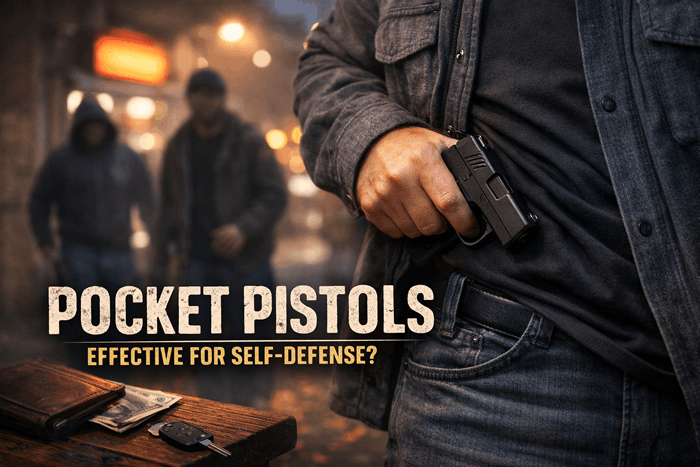
A pocket pistol allows you to prepare discreetly while still appearing non-threatening. Your hand can already be in your pocket, establishing a grip, without signaling to the other person that you are armed.
That’s a powerful tactical advantage.
The Importance of Decision-Making
One of the most overlooked aspects of self-defense is decision-making under stress.
When do you draw?
When do you comply?
When do you disengage?
These decisions happen in seconds—and often before a weapon is ever used.
Training should include:
- Verbal skills
- Situational awareness
- Threat recognition
- Emotional control
In many ways, these skills are more important than marksmanship alone.
Because if you can avoid the fight entirely, you’ve already won.
Let’s address the comparison directly.
A full-size pistol offers:
- Greater accuracy at distance
- Higher capacity
- More manageable recoil
- Increased terminal performance
These are undeniable advantages.
However, they come with trade-offs:
- Harder to conceal
- Less comfortable for everyday carry
- More noticeable when accessed
A pocket pistol, on the other hand, offers:
- Deep concealment
- Ease of carry
- Discreet access
- Lower profile in public interactions
In a close-range, rapidly evolving encounter—especially one that begins as an unknown contact—these advantages can be significant.
Caliber debates are endless. But in the context of self-defense, the reality is simpler than many make it out to be.
If a firearm can place rounds into vital areas, it has the potential to stop a threat.
Shot placement matters more than caliber alone.
A pocket pistol may not deliver the same energy as a full-size handgun, but it is still capable of causing serious bodily harm. That alone can be enough to:
- Deter an attacker
- Interrupt their actions
- Create an opportunity to escape
Again, the goal is not necessarily to “win” the fight—it’s to survive it.
There’s also a psychological component to consider.
The presence of a firearm—even a small one—can change the dynamics of a confrontation. An attacker who suddenly realizes their target is armed may hesitate, disengage, or flee.
While you should never rely solely on this, it’s part of the overall equation.
If you choose to carry a pocket pistol, your training should reflect its intended use.
This means going beyond static range drills.
Focus on:
- Drawing from concealment (realistically, not just quickly)
- Verbal engagement scenarios
- Movement and positioning
- Close-range shooting
- Retention techniques
And most importantly:
Practice thinking, not just shooting.
Because in real-world encounters, your brain is your primary weapon.
Yes—when used within their strengths.
A pocket pistol is not a replacement for a full-size handgun in every scenario. It has limitations, and those limitations should be understood and respected.
But effectiveness in self-defense is not defined by size or power alone.
It is defined by:
- Awareness
- Decision-making
- Timing
- Tactical application
If a firearm—pocket-sized or otherwise—can place a round into a vital area of a threat, it has the potential to stop that threat.
And when combined with proper mindset and training, a pocket pistol can be a highly effective tool for personal defense.
The big picture is this:
Any firearm, regardless of size, is a tool. Its effectiveness depends on the person using it and how it is used.
Pocket pistols excel in situations where discretion, accessibility, and timing matter most—especially during those critical “unknown contact” moments.
So instead of asking whether a pocket pistol is as powerful as a full-size gun, a better question might be:
Can you deploy it effectively when it matters most?
Because in the end, that’s what truly defines effectiveness in self-defense.
“}]]

