

By Joan Hill
Thank you for reading this post, don't forget to follow and signup for notifications!
Every major incident confirms the same operational truth: Response effectiveness is inseparable from communications reliability. For public safety agencies, that reality now extends well beyond voice radio. Drone programs, fixed and mobile cameras, sensors and command applications all depend on a resilient data backbone.
Increasingly, agencies are turning to mesh communications to provide that backbone, particularly for unmanned aircraft systems (UAS) operating in real-world environments. For law enforcement leaders and public safety managers, the question is no longer whether drones will be part of the response, but whether those drones will still communicate when conditions are at their worst.
The Pentagon’s Drone Dominance Program (DDP), which aims to field more than 200,000 small UAS by 2027 through competitive Gauntlet evaluations and fixed-price contracts, is accelerating the domestic manufacturing base for exactly the kind of low-cost, supply-chain-secure platforms that public safety agencies are increasingly evaluating for DFR operations. As DDP drives down unit costs and expands NDAA-compliant vendor options, law enforcement procurement officials will find a broader and more competitively priced field of platforms to assess against their mesh integration requirements.
| RELATED: The DFR decisions every chief faces before the first drone ever flies
What mesh networks actually do
Traditional field networks rely on centralized infrastructure: a tower, a cell site, a vehicle repeater or a single access point. When that central node fails, becomes overloaded or loses line of sight, connectivity disappears.
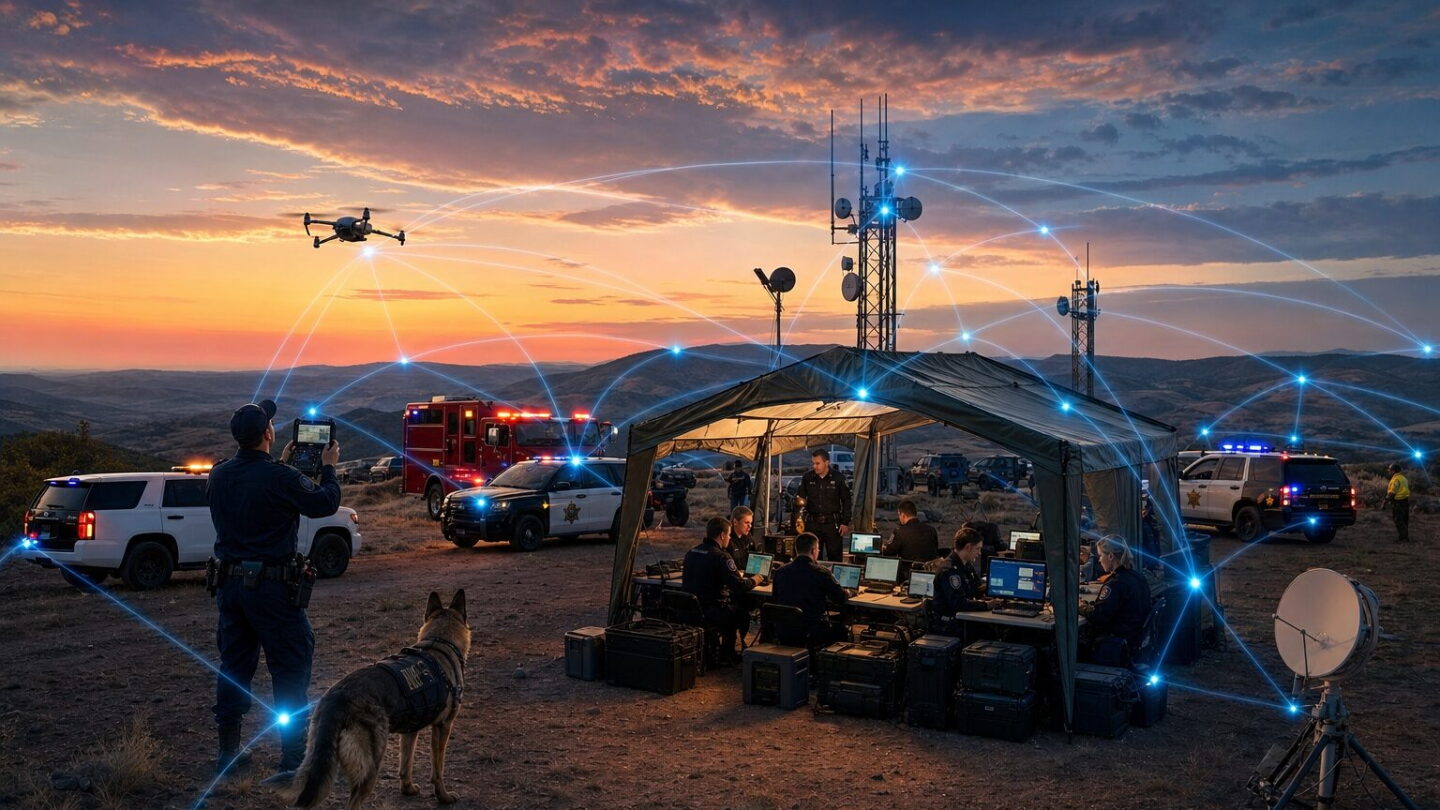
Mesh networks are designed differently. Every node — whether a radio on a SWAT operator, a drone, a vehicle or a portable relay — is part of a self-forming, self-healing network. If one path is blocked by terrain, buildings or damage, communication automatically routes through other nodes, allowing officers, UAS platforms and command posts to continue sharing video, position data and messaging even when individual assets fail or move out of range.
Agencies applying mesh in public safety contexts identify this “any node to any node” resilience as preserving real-time situational awareness when traditional networks are congested or unavailable.
Why drone programs depend on mesh
Far beyond simple aerial video, UAS now support live mapping, thermal search, overwatch for warrant service, K-9 team coordination and large-scale event management. Each of these missions assumes that live video and telemetry will reliably reach tactical commanders and fusion centers — a fragile assumption when relying on a single RF link or commercial LTE alone.
Mesh-enabled drone integration places the aircraft directly within the tactical network, making the drone another node that extends coverage, not just a camera attached to a single operator’s link. Video can route through multiple ground radios or vehicles, giving the feed multiple paths to its destination. In dense urban environments, on large campuses or around high-rise structures, that multi-hop flexibility is often the difference between a usable feed and a frozen screen.
Mesh as a prerequisite for Drone as First Responder programs
For agencies pursuing autonomous or semi-autonomous Drone as First Responder (DFR) programs, mesh communications are a foundational requirement. DFR aircraft must maintain a continuous, low-latency command-and-control link throughout flight, and relying on commercial LTE introduces a single point of failure that a hardened mesh architecture eliminates. Without reliable mesh networking, autonomous flight corridors and beyond-visual-line-of-sight (BVLOS) operations carry connectivity risks that can compromise aircraft control, degrade video quality during the critical first minutes of an incident or trigger return-to-home protocols that remove the UAS from the scene entirely.
| CASE STUDY: How Prosper PD built a DFR program to keep pace with a fast-growing Texas town
Operational advantages across incident types
Mesh communications deliver concrete advantages across a range of operational scenarios. Real-time deployment research has shown that mesh nodes can be rapidly positioned to extend connectivity into locations where traditional wireless infrastructure underperforms: large buildings, tunnels, subways, industrial facilities and wide rural areas. Network survivability improves as well. If one vehicle, drone or portable node fails, traffic automatically reroutes through the remaining nodes without manual reconfiguration — a meaningful advantage in dynamic law enforcement operations where assets are constantly moving.
Beyond voice, mesh supports high-definition video, telemetry, blue-force tracking, sensor data and edge-based mission applications. As agencies adopt body-worn cameras, perimeter sensors, gas detectors and other IoT technologies, mesh networks provide a scalable transport layer for moving that information to decision-makers in real time.
Security, interoperability and procurement implications
Public safety networks must balance the access required for mutual aid with the security required for tactical operations. Modern mesh architectures address both. Devices are provisioned through management portals, and only authorized nodes can participate in the network. End-to-end encryption and authentication protect video, location and command data in contested environments. Interoperability configurations allow partner agencies to join the mesh during an incident without compromising security, which matters because major incidents rarely respect jurisdictional boundaries.
New drone procurements should evaluate whether platforms integrate with existing or planned mesh systems through native radios or payload interfaces. Communications RFPs should assess mesh vendors on their ability to support moving assets — drones and vehicles — not just fixed nodes. Agencies should also evaluate lifecycle and interoperability alignment with regional or statewide public safety broadband plans. When live video and telemetry are mission-critical deliverables, the communications backbone that carries them must be treated as a core requirement, not an afterthought to aircraft procurement itself.
Sources
- Rajant Public Safety
- IEEE Computer Society
- NIST Real-Time Mesh Deployment
- Baycom/Rajant White Paper
- Silvus Technologies – Law Enforcement
- IEEE Public Safety Communications
- goTenna Public Safety
- Harvard Berkman Center for Internet & Society
- DefenseScoop – Drone Dominance Program
About the author
Joan Hill is a freelance editor and writer with a background in financial planning. Connect with her on LinkedIn. Joan’s husband is a retired law enforcement officer and founder and CEO of LE Drones, which specializes in NDAA-compliant and Blue-UAS listed drone platforms.
| WATCH: What early adopters of Drone as First Responder programs learned

