

Editor’s note: Police1 is proud to announce the launch of Decision Point, a new Bodycam Briefings series featuring Duane Wolfe, the 2025 ILEETA Trainer of the Year and one of the most respected voices in law enforcement training. A founding member of ILEETA, longtime Police1 columnist, and retired police officer and educator, Wolfe has spent more than five decades combined in policing and law enforcement education, helping officers and instructors translate research into practical, field-tested tactics.
Thank you for reading this post, don't forget to follow and signup for notifications!
Each episode uses real body-worn camera footage to break down the critical moments that shape an encounter, giving officers practical lessons in tactics, communication, decision-making and officer safety. As with all Bodycam Briefings content, this review is intended as a training opportunity. The purpose is not to blame or ridicule the officers involved, but to examine the decisions, actions and outcomes of the incident and identify lessons that officers can apply in the field.
Responding officers often have only seconds to assess chaotic scenes, identify immediate threats and make decisions that carry life-or-death consequences.
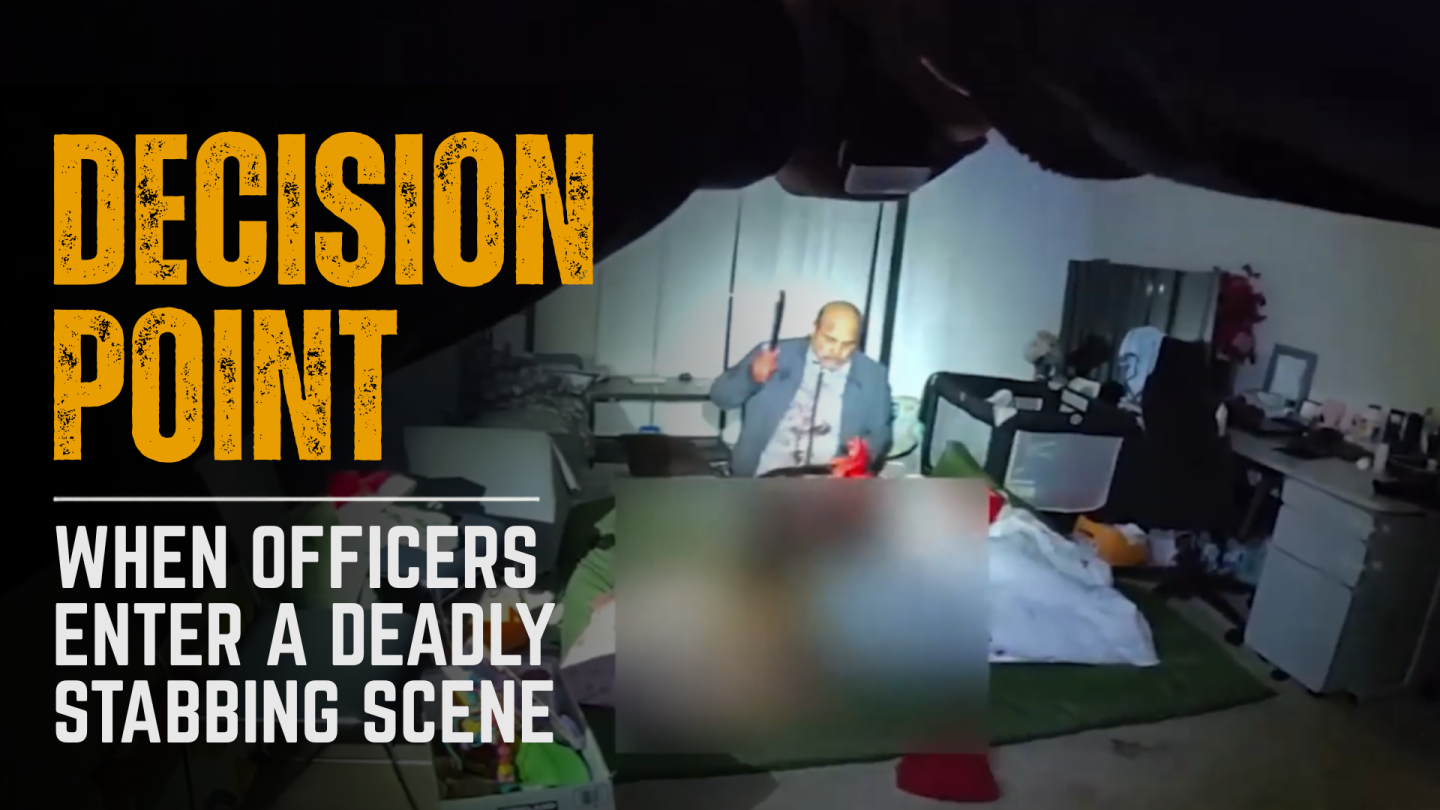
In this incident, Fairfax County officers arrive at an apartment complex after reports of screaming, an armed man and an injured woman. Inside, they face a rapidly unfolding threat: multiple stabbing victims, a child nearby and a suspect armed with a cleaver. Their decisions — from making an emergency entry to using deadly force — illustrate the challenges officers face during rapidly evolving critical incidents.
As you watch the video, consider the key decision points throughout the encounter: What would you have done?
What happened?
On Feb. 23, 2026, Fairfax County police officers responded to reports of people screaming, an injured woman and an armed man at an apartment complex. Officers located a severely wounded woman in a blood-covered hallway while hearing a child screaming inside the apartment.
Hearing a child screaming inside an apartment, they make the decision to make entry in the apartment. Once inside, they see a man armed with a knife kneeling over a badly wounded man and a small child in close proximity to the danger. After issuing verbal commands, officers fired when the suspect raised a large cleaver and appeared to continue the attack. The suspect was stopped, the child was rescued and officers secured the scene before rendering aid.
Two adult women died from their injuries. An adult male survived. The child was uninjured. Authorities later said the suspect had a history of mental health issues.
Decision point 1: Can you bring the victim to you?
When officers found the injured woman in the hallway, they initially attempted to have her crawl toward them rather than immediately rushing into an unsecured area.
Maintaining time, distance and cover whenever possible reduces officer risk while still attempting to help injured victims.
When it became clear she could not move, officers had to advance into an area where the threat remained unknown.
Decision point 2: When do exigent circumstances justify entry?
Without a warrant or consent, officers must determine whether exigent circumstances exist before entering a residence.
In this case, officers observed:
- A critically injured stabbing victim outside the apartment
- Blood throughout the hallway
- A child screaming inside
- Reports of an armed suspect
Taken together, these circumstances created an immediate need to enter to prevent death or serious bodily harm.
Officers should continually evaluate whether they understand when exigent circumstances legally justify making entry without a warrant in other emergency situations.
Decision point 3: Are you prepared to make entry?
The apartment door happened to be unlocked, allowing officers to enter immediately. But what if it had been locked?
Do you carry breaching tools? Have you received training on forced entry? Have you practiced those skills recently enough to perform under stress?
Equipment alone is not enough. Officers must know how and when to use it.
Decision point 4: Can you perform under low-light conditions?
As officers entered, they used weapon-mounted lights to identify the threat inside the apartment.
Whether using a weapon-mounted light, handheld flashlight or both, officers should regularly train in low-light environments.
Have you practiced target identification, movement and accurate shooting under realistic lighting conditions?
Decision point 5: When is a verbal warning feasible?
When officers first encountered the suspect, he was momentarily motionless. That brief pause allowed the officer to issue commands for the suspect to drop the weapon before using force.
Tennessee v. Garner recognizes that officers should provide a warning before using deadly force when feasible.
Officers should ask themselves: When would circumstances make a warning impossible? Have you practiced giving clear verbal commands before engaging a deadly threat?
Decision point 6: Can you shoot fast enough — and accurately enough?
When the suspect raised the cleaver and appeared ready to strike again, the officer fired five rounds in about one second to stop the deadly threat.
The speed of the response was only part of the challenge. The officer also had to avoid striking the wounded victim and the child, both of whom were just feet away.
Have you trained to shoot that quickly? More importantly, have you trained to shoot that quickly while maintaining the accuracy needed to stop the threat without endangering innocent people? Are you confident you could make that decision under the same circumstances?
Decision point 7: What comes after the shooting?
Once the suspect was down, the incident was far from over.
Officers immediately faced competing priorities:
- Remove the child from danger.
- Secure the suspect.
- Clear the apartment for additional threats.
- Render aid to the victims.
Until the suspect and apartment are fully secured, the scene remains dangerous.
Critical incidents don’t end when the shooting stops — they shift into a new phase requiring equally important decisions.
Key lessons
- Bring people to you when possible: Maintaining time, distance and cover can reduce officer risk, but officers must also recognize when circumstances require moving forward to save lives.
- Know exigent circumstances: Officers should understand when emergency conditions legally justify entering a residence without a warrant.
- Train beyond qualification standards: Real-world encounters demand proficiency with low-light shooting, weapon-mounted lights, breaching tools and other critical skills that require ongoing practice.
- Train beyond the gunfire: Scenario-based training should continue after shots are fired, forcing officers to prioritize scene security, medical aid, communication and continued threat assessment.
Every critical incident contains a decision point. The question is: What would you do?
| PREVIOUSLY ON DECISION POINT: When a robbery response turns into a fight for control of a fleeing vehicle

Bodycam Briefings
Bodycam Briefings curates body-worn camera footage from real-world incidents across the country. Whether presenting raw footage or offering deeper analysis, the collection is designed to inform, prompt discussion and reinforce practical lessons officers can apply in the field.

