

[[{“value”:”
Thank you for reading this post, don't forget to follow and signup for notifications!
This article is part of an ongoing series on leadership development for new law enforcement leaders. Each article addresses a specific area of leadership competency offering learning points, strategies and tips. Click here to access the entire Leadership Development Series.
Among the many responsibilities of a law enforcement supervisor, few have a greater impact on employee development than the performance evaluation. While many supervisors view evaluations as an administrative task, effective leaders recognize them as opportunities to coach, motivate, recognize achievement and improve performance.
Yet some supervisors dread writing and presenting employee performance evaluations. You may be one of them. Although they may not be loved, these exercises serve important needs within the law enforcement organization.
Most employees are at least a little apprehensive when they know their work style, work ethic and performance are being scrutinized. For the individual whose job performance is under the microscope, this can result in all kinds of emotion, even if the officer knows he or she is doing a good job. If the person under scrutiny is not functioning according to the supervisor’s expectations and realizes it, the stress may be magnified.
That is precisely why performance evaluations are such an important leadership responsibility. Done well, they provide employees with meaningful feedback, recognize exceptional work, identify areas for improvement and help officers continue to grow professionally.
Why performance evaluations matter
A professional law enforcement organization reviews the job performance of its employees for the same reasons it charges its supervisors with handling counseling and disciplinary tasks. Performance reviews are done to let the employee know how he or she is doing in the eyes of the supervisor. Most employees, cops included, want that feedback. In the process, exceptional work can be recognized and performance lapses identified for repair.
As with counseling and discipline, the performance appraisal is intended to strengthen the work team and the entire organization by identifying areas in which individual job performance can be improved. The review also can identify employee talents that can be utilized for the benefit of the entire organization. In some organizations, employee performance reviews are tied to performance incentive plans in which an officer can advance to a higher pay grade or receive some other reward for doing a good job.
Consistently high ratings also can provide supportive evidence when an officer seeks a special assignment or promotion. Alternatively, the appraisal can provide documentation of continuing problems that merit counseling, training or disciplinary action. A well-done performance review includes goals for an officer to pursue during the next evaluation period. Goal-setting can be even more productive when the employee helps set the goals.
A sound performance review system does more than point out strengths and weaknesses of individual employees. Properly administered and monitored by supervisors and command staff, it can aid in spotting weaknesses in the agency’s training, policy or operational activities. If, for example, numerous performance reviews point out weak accident investigation skills among patrol officers, it is time for the department to examine the training officers receive on the topic.
Employee performance review systems utilize many different formats, ranging from a column of satisfactory/unsatisfactory check-off boxes to a numerical (1-5) scale. Many systems require the supervisor preparing the document to include a narrative of some kind. Even if your employer does not require it, you should rely on your writing skills to summarize your officer’s performance over the review period. This is also a good place to detail your officer’s goals for the upcoming appraisal period. A well-written narrative always increases the practical value of a performance review.
Evaluating performance fairly and objectively
First, your organization must determine what is to be measured. Different departments may place varying degrees of importance on certain skills and behaviors. Technical skills may be highly emphasized at one agency while human relations skills are highly valued at another.
Second, performance reviews must look only at tangible, observable, measurable behaviors and actions that can be documented. These are things that can be observed and measured; it’s very hard to do the same with “attitudes.” It will not work to write that “Officer Julie has a bad temper” or a “poor attitude.” It is possible, however, to describe something that was reliably witnessed when Julie told a peer to “Stick it!” when he asked her to assist him with a legitimate police task. That quote needs to appear in Julie’s performance review.
While there always will be differences in exactly what is being evaluated at different law enforcement agencies, a core of characteristics, skills, knowledge and abilities will often be seen as competencies of an effective officer. They include officer safety, job knowledge, agency policies and procedures, communication skills, customer service, professional appearance, teamwork and acceptance of supervision. Many performance review systems also examine knowledge of the area, decision-making, judgment, attendance/punctuality, self-confidence, tactical skills, vehicle operation, interview/interrogation skills, patience and self-control, de-escalation tactics, arrest and control and weapons skills. You and your agency may have other job performance areas that you want documented, and it’s fine to include them. That’s why it’s important to have narrative included in your report. It bolsters what you have to say by furnishing concrete descriptions of what your employee has been doing.
Building a meaningful performance review
As a supervisor, it’s probable that you will have more than one or two performance reviews to complete. That’s why it is important to have them done well ahead of the last possible minute. A task that is rushed to completion just before a deadline is seldom your best work.
Before you start work on the report, assemble any relevant notes or other documentation you will need from the current evaluation period. This could include commendations, awards, training reports, sustained complaints and disciplinary notices. If you are including quite a bit of narrative, you might even want to use an outline to organize your thoughts in logical A, B, C order. If writing performance appraisals is new or uncomfortable for you, consider collecting a few well-done reviews to serve as guidance. You could pick up some good ideas as well as a few good writing hints. When you sit down at the keyboard, keep your sentences and paragraphs short and concise. Clarity for the reader is what you are seeking.
Do not spring surprises in your performance review document. The key things you put there should have been brought to your officer’s attention previously, either orally or (preferably) in writing. Be able to back up everything you state in the review. That’s one reason why including examples is so important.
A lot of cops think that their supervisors rely too heavily on “stats” when evaluating their officers’ work. Numbers are appropriate to include in a performance review report. It is a valid part of the overall picture to know who is doing the work and who isn’t. Just do not allow numbers to become the sole focus of your report.
There are some common errors you must avoid as you prepare your document. You must steer clear of the “halo or horns” effect. If you succumb to that error, it means you write only about either the good or bad the employee has done. Seldom is an officer’s work 100% fantastic or 100% awful. Even if the review’s summary will say he or she is doing good work or just the opposite, it should note evidence of anything that doesn’t fit that overall description, too. Sometimes even poor performers do something well.
You also must avoid falling victim to the “recency” effect. Here the supervisor writes only about what he or she recalls from the very recent past, perhaps only the last month or two. Yet something very significant happened months back but still within the current evaluation period. By keeping good notes in a supervisor’s log or by some other means, you dodge this problem.
Then there is the “central tendency” effect. In this one, a timid or lazy supervisor rates every category as “middle of the road.” The supervisor may feel that there is less work to do if no narrative is necessary to justify a high or low rating. A supervisor lacking in courage also might do this to avoid meeting with an employee displeased with a low rating in any category. This bad practice is one you should pledge never to fall victim to.
Particularly when reporting on the work of a long-term employee, sometimes a lazy supervisor will copy the officer’s last performance review, perhaps change a few words and present it as the new report. That is unfair to both the employee and the organization. You always will refuse to cut corners when there is important work to be done. Performance reviews are important work.
End the report with a summarizing narrative. This is an ideal spot in which to place the goals for the next evaluation period. There is no magic number of goals to set. Goals provide your officer with more than an opportunity to receive a favorable performance rating the next time. They also help him or her grow in experience and competency.
Be sure to proofread carefully the work you have prepared. Handing your employee a document that contains errors of any sort does not bolster your demand that he or she should “pay close attention to detail.” You also do not want anyone “upstairs” who reads the report to observe that it contains careless mistakes. Having provided your officer with the document to read ahead of the meeting, you are ready to proceed to the next important step in the performance review process.
Leading the evaluation conversation
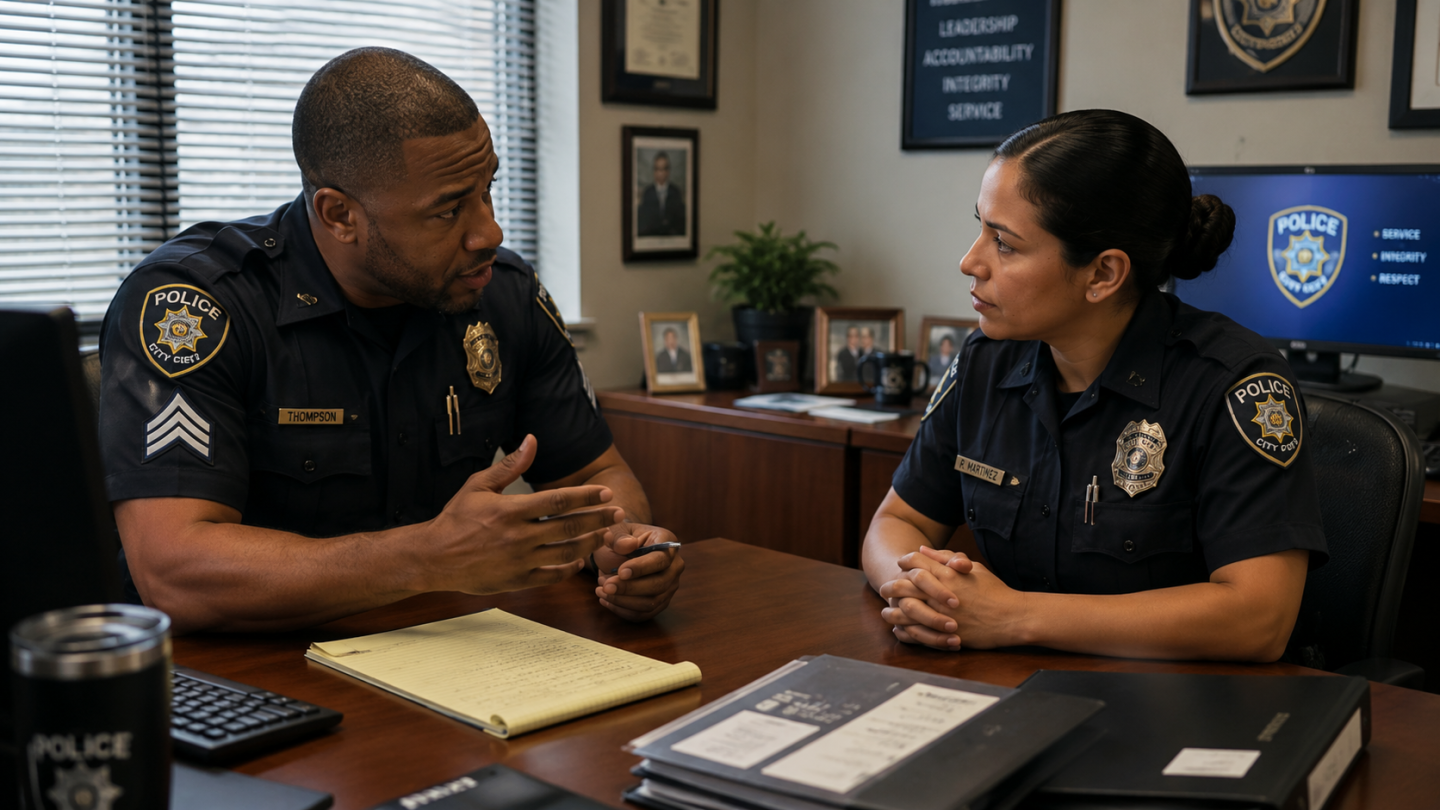
Make it clear to your officer that the meeting is important. As with any other sit-down meeting, choose the right time and place so that you are neither interrupted nor rushed. Ask your officer if he or she has any questions after perusing the report. Encourage questions throughout the meeting and respond honestly. Allow the employee to speak freely but steer him or her back to the document if he or she is straying too far afield.
If your officer brings to your attention what he or she sees as an obvious error of fact in the report, investigate it promptly unless you already can furnish an answer. Do not alter the document unless you have erred in some way. Do not change it just because he or she doesn’t agree with your assessment. Keep an eye on the emotions present — both your officer’s and your own. You will not engage in a shouting match. Take a short break if necessary. If your employee demands to talk to your boss, that’s fine. But right now, there is a meeting to complete. Then, let your supervisor know that there is a complaint coming his or her way. Brief the boss on the review’s contents as well as the nature of the employee’s issue and your response.
Fortunately, few employee performance review meetings will result in drama. As you approach the end of the meeting, discuss the goals you have established for your officer to accomplish during the upcoming evaluation period. The discussion should go even better if the employee has worked with you in setting the goals.
Remember throughout the work evaluation process not to compare your officer’s job performance with any of his or her peers. If possible, try to end the meeting on a positive note. Recognize good work and thank your officer for it.
Beginning with your observations over the time of the review period, through your careful work on review document preparation and finally in the performance review sit-down, you are seeking accuracy and fairness in equal parts. It is what exceptional supervisors do. It is what you do.
This article is excerpted from Gerald Garner’s “Supervising Patrol Officers,” available from Charles C. Thomas Publisher.
| WATCH: Chief Gerald Garner on how to turn good chiefs into great leaders
LEADERSHIP DEVELOPMENT SERIES
“}]]

