


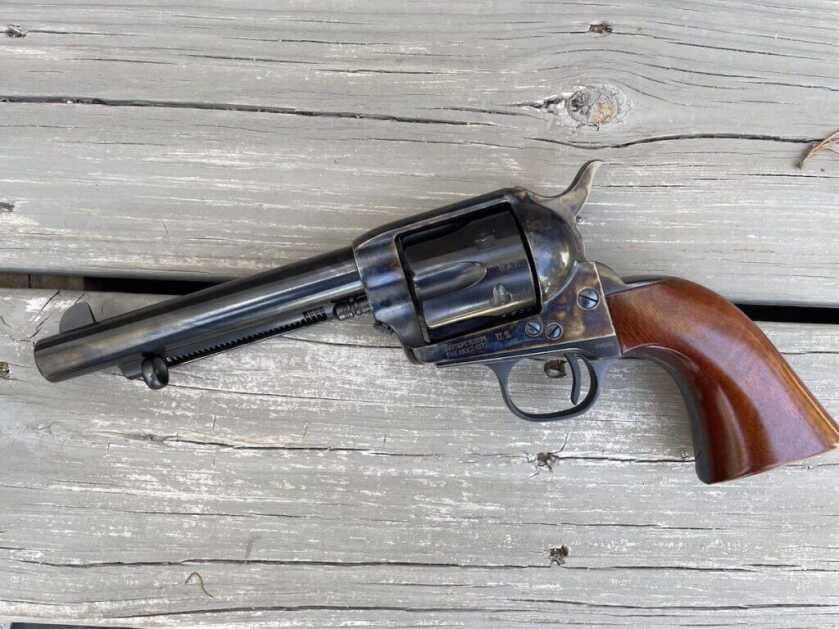
The Cimarron U.S.V. Artillery brings the Colt SAA Artillery legend back with .45 Long Colt punch, Rough Riders history, and old-school sixgun swagger. It is part history lesson, part range toy, and part reminder that sometimes the old ways still hit hardest.
Thank you for reading this post, don't forget to follow and signup for notifications!
Table of contents
- Refurbished Firepower for the Rough Riders
- Why the Colt SAA Artillery Story Starts With a .38 Problem
- The Military Cut the Colt SAA Down to Fighting Size
- Roosevelt, Rough Riders, and the Return of .45 Colt Authority
- Cimarron U.S.V. Artillery Details That Nail the Colt SAA Look
- How the Cimarron U.S.V. Artillery Handles and Loads
- Live Fire With .45 Long Colt: Mild Cowboy Loads and Man-Killer Ammo
- Cimarron U.S.V. Artillery Specs and Range Data
- Pros and Cons: Old-School Cool With Real .45 Colt Bite
- Final Verdict: The Cimarron U.S.V. Artillery Still Knows How to Fight
- Related Reads from GunsAmerica Digest
Refurbished Technology for the Rough Riders
Size matters. The Colt was too long. The Colt SAA Artillery revolver is a story about a military sidearm retired from service only to be reissued because the latest and greatest sidearms were in low supply and, besides, the latest technology was not always the best choice, though it did seem so at the time. Sometimes old ways are better, and this is how the Colt Artillery played a part in our military history, even though it was mothballed.
The story starts back in the 1890s with the newly adopted M-1892 Colt “New Army” Double Action .38 caliber revolver, which was a cutting-edge combat sidearm. The new .38 caliber revolvers had double-action/single-action triggers and were fast to reload with a new swing-out cylinder. The .38 Colt Long caliber actually started out as a black-powder cartridge and then made the jump to smokeless powder in 1903. The new smokeless powder cartridge was loaded with 148-grain bullets and produced a muzzle velocity of 750 fps and a muzzle energy of 185 ft⋅lb.
The new .38 caliber replaced the .45 Long Colt, which back then was a black powder load using a 255-grain bullet that produced a muzzle velocity of about 850 fps, which equates to about 409 ft-lb of energy at the muzzle. Good thing the new Colt .38 was fast to reload, because with only 185 ft-lb of energy, you are going to need multiple hits on the enemy to incapacitate him. But I’m getting ahead of the real story.

The new double-action Colts were initially issued to cavalry regiments. The venerable Colt Model 1873 Single Action Army revolvers chambered in .45 Long Colt, however, still remained the standard service revolver for the infantry and artillery, with the new .38s being specifically intended for cavalry issue first. Other branches of the military would be issued the new guns as they became available. Sound familiar? This is when the Colt SAA Artillery became real.
Complaints from the field continued to come into headquarters from light artillery regiments about the length of the SAA Colt’s barrel. Too long. The light artillery guys had long complained that the barrel and holster length were uncomfortable to wear, especially for the troops who rode on the caissons and limbers of the artillery pieces while they were being drawn by the team of horses. Remember, this was cavalry, as in horses.
As a result, in August of 1894, the Ordnance Department requested a study to be completed at the National Armory in Springfield, Massachusetts, regarding the feasibility of shortening the 7.5-inch long barrels on the .45 caliber revolvers to a more convenient length.
In true military bureaucratic style, a length test was conducted where the barrels of prototype Colt SAA revolvers were shortened to 6.5, 6, 5.5, 5, 4.6, and 4 inches. The same test process was conducted for each barrel length, and a thorough, exhaustive report was issued. Here’s the Cliff Notes version: The lengthy report regarding these tests is best summarized by a single sentence, which reads: “The conclusions drawn from the tests, … is that a length of barrel of 5 inches is the most advantageous.”
So the odd part, or maybe it was just corridors of power having a senior moment, is that the barrel length was changed to 5.5 inches. More than likely, the reason the switch was made to the 5.5-inch barrel was that the 5.5-inch length was a standard production factory barrel length for civilian market Colt SAA revolvers. Now that the barrel length was settled, the task was to refurbish all of the SAA Colts in storage.
Between 1895 and 1906, the U.S. Government had Springfield Armory in Massachusetts and the Colt factory in Connecticut rework over 16,000 Colt SAA Cavalry revolvers. Some of these old SAAs had seen about 20 years of hard service during the Indian Wars, while others were in storage and had never been used. The used guns were reworked by Colt, and the guns in storage were reworked by Springfield Armory.
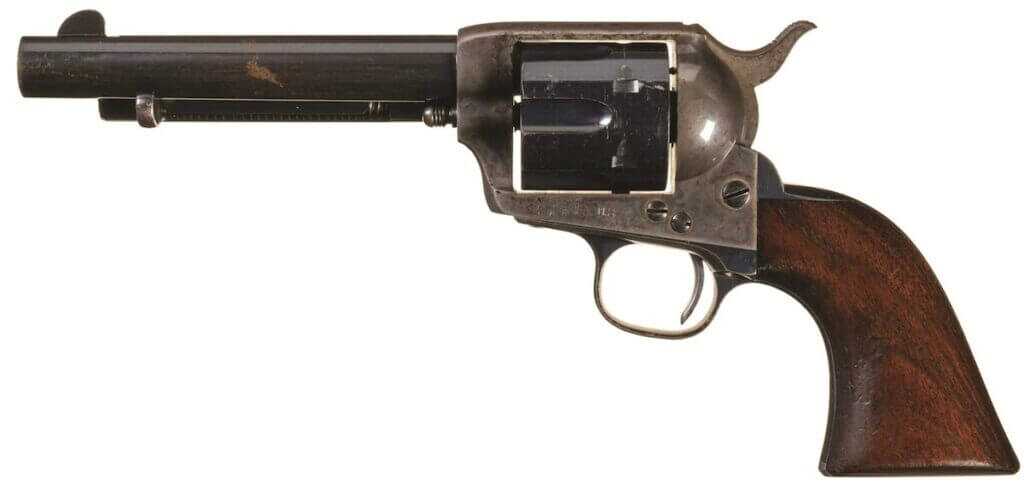
Some guns refurbished had mismatched serial numbers as worn parts were replaced with new parts. Guns were disassembled, and similar parts were grouped together. No effort was made to keep serial-numbered parts together. The government saved on the cost because of this practice of mixing serial numbers.
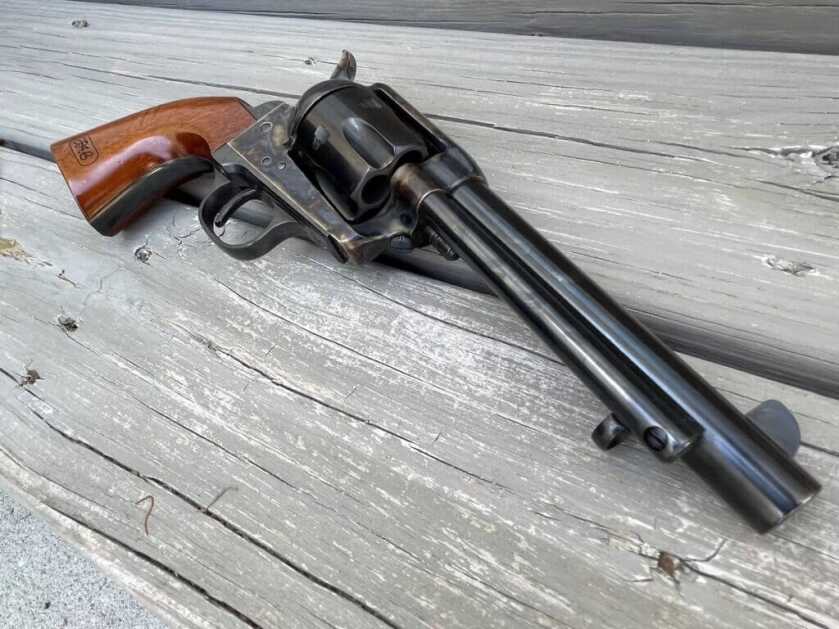
Since the refurbished SAA Colts were issued to light artillery units, they are known as Colt Single Action Army Artillery revolvers. So now you know the story of how the Colt became known as Artillery models.
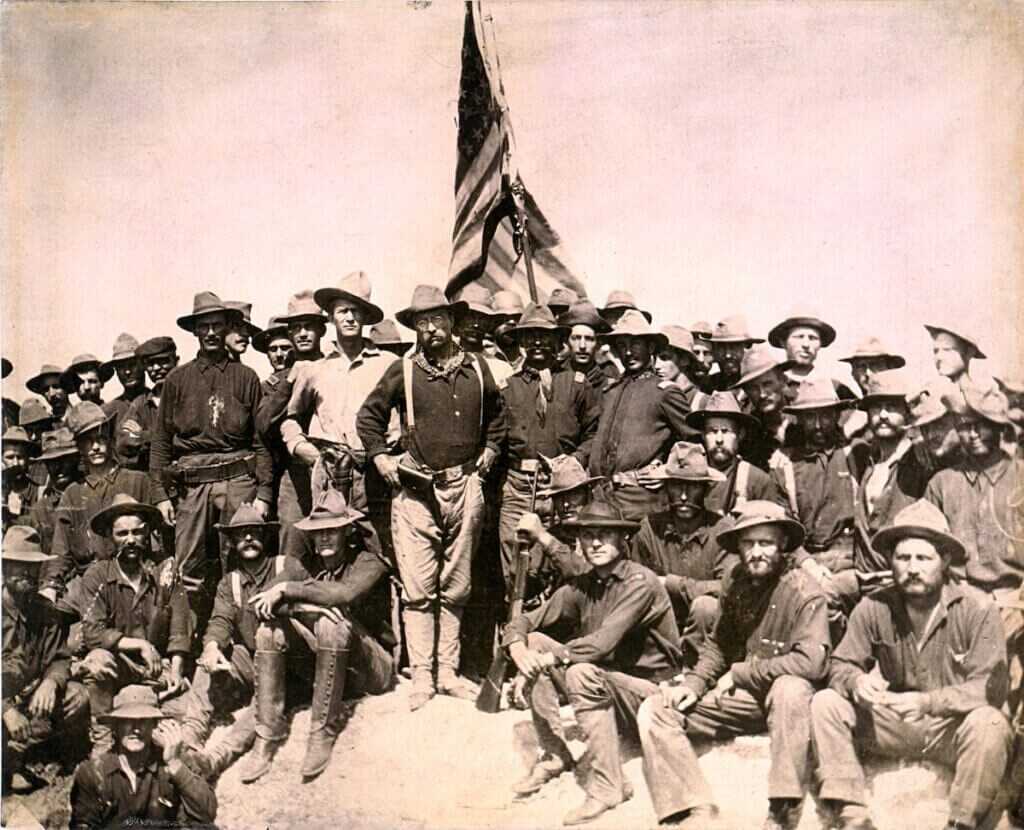
Back in the real world, the battleship Maine was blown up in Havana harbor in Cuba, igniting the Spanish-American War of 1898. In the same year, the first U.S. Volunteer (U.S.V.) The cavalry was formed under the command of Theodore Roosevelt. This group was made up of cowboys and trained at Camp Wood, Texas, and they would become known as the Rough Riders.
Roosevelt had specifically requisitioned the Colt Artillery revolvers for his troops, who carried the Artillery model during the battles of San Juan Hill and Kettle Hill. Later in 1899, another hot spot flared up in the Philippines. During the Philippine-America War, the Artillery Colt saw additional service.
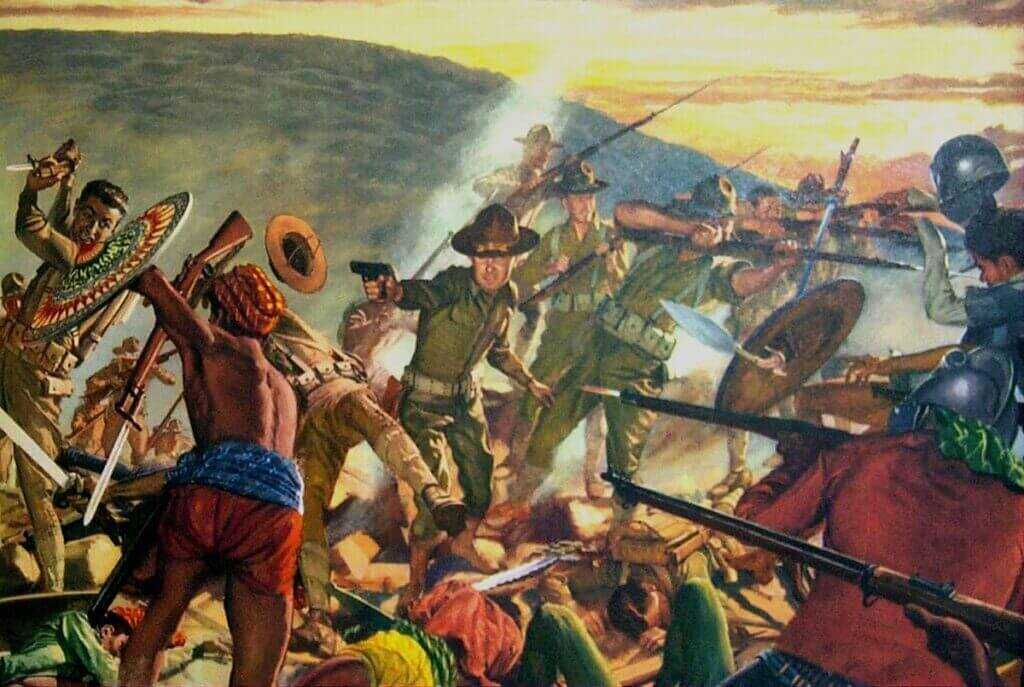
Troops needed firepower to deal with Moro tribesmen juiced up on narcotics, bound in rope to prevent wounds, and believing they were invincible. The Moros were vicious fighters, wielding spears and bolo knives. They worked themselves up to such a fervor that troops found the stopping power of the new.38 Long Colt was pitiful. What they needed and what the troops wanted was good old .45.
With the shortcomings of the .38 Long Colt, the U.S. government had embarked on finding a new caliber. The Model 1911 chambered in .45 ACP was the solution, but not enough new 1911s were available to troops, so the Colt Artillery, like the cavalry, came to the rescue.
Cimarron U.S.V. Artillery Details That Nail the Colt SAA Look
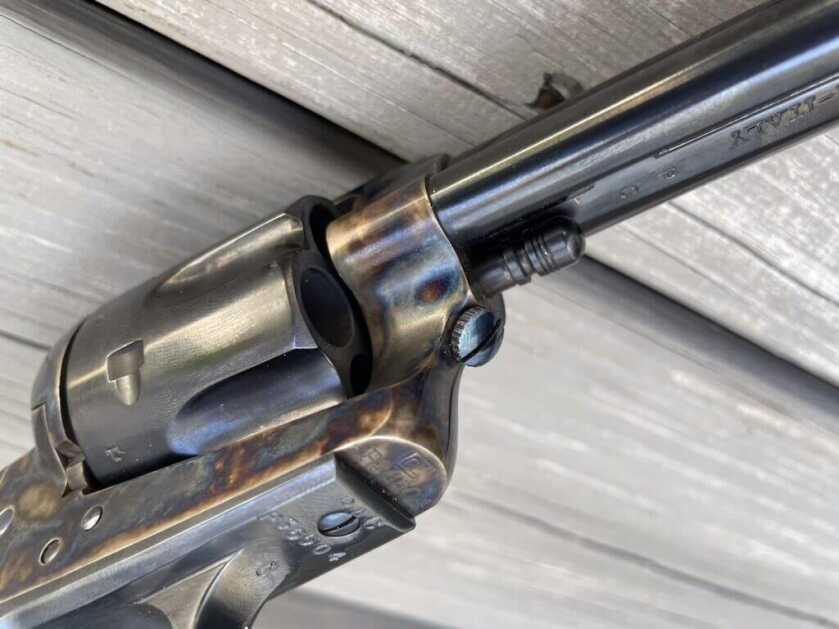
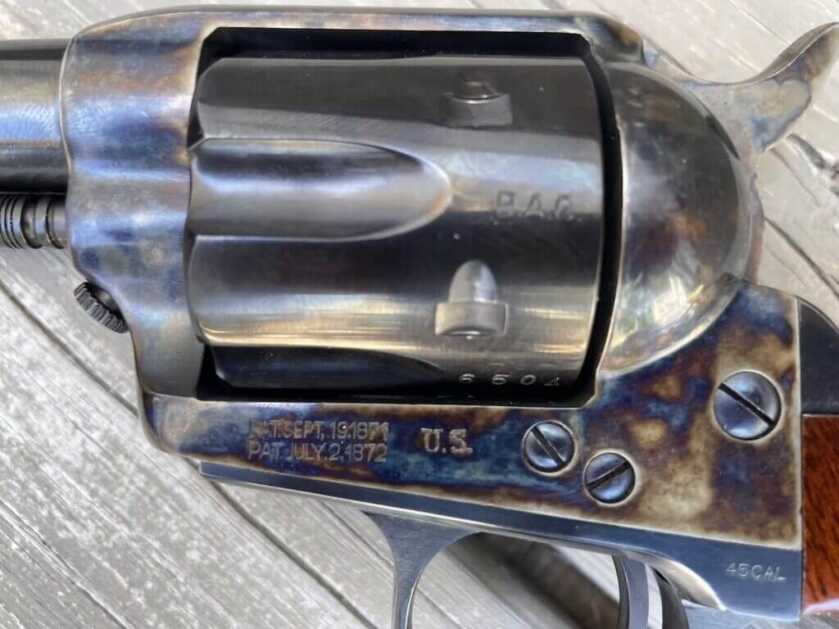
Cimarron makes a dead ringer for the Colt Artillery, well, maybe not, all the serial numbers match on the Cimarron Artillery Colts. It is called the U.S.V. Artillery with a 5.5-inch barrel and chambered in .45 Long Colt. Cimarron has stayed true to the Artillery Colt’s origin by using the early black powder style frame. This frame uses a screw to hold the cylinder pin in place in lieu of a button that was and is still used on later models.
The Artillery uses a cylinder pin bushing, which is in place to ease operation with black powder loads. Black powder loads can soot up a revolver’s cylinder and bind it. This gives another bearing surface, so the revolver’s cylinder is more likely to rotate after repeated firings.
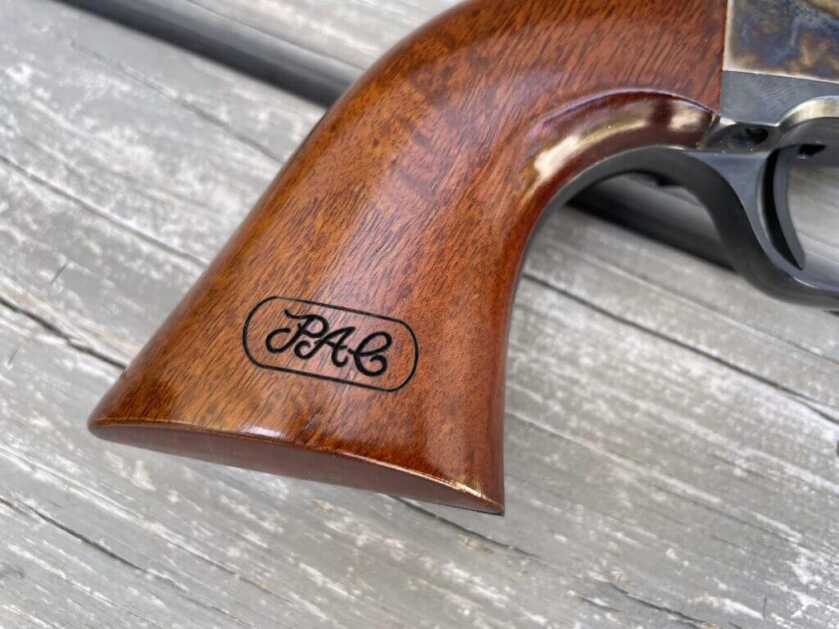
There is a beautiful frothy, blue case-hardened finish on the frame and hammer. The rest of the metal wears a deep blue. The smooth wood grip even has a reproduction cartouche, RAC, for the original government inspector Rinaldo A. Carr. The frame is also stamped “U.S.,” just as original government Colt SAA revolvers.
The Cimarron Artillery also has the bullseye style ejector rod head, another nod to the original models. Later versions had a smaller ejector rod head. Collectors call these ejector rod heads half moon or crescent ejector heads. The heft and balance of the Cimarron is very close to the original Colt SAAs.
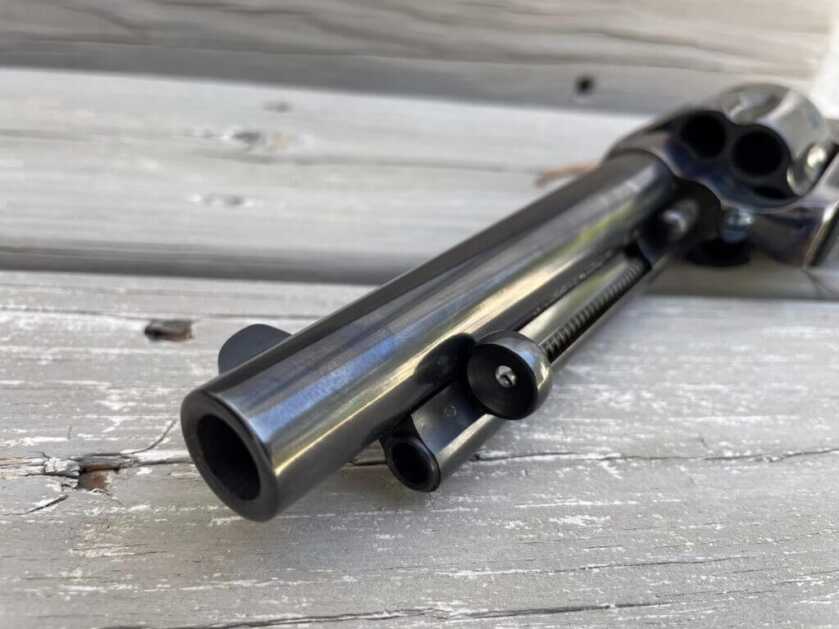
The U.S.V. Artillery is a natural pointer. The effort needed to cock the hammer was just right, not too difficult and not too easy. Easing the hammer down to half cock is the revolver’s only safety mechanism other than common sense. The Artillery, like other Colt SAA clones, should only be loaded with five cartridges. The hammer should rest on an empty chamber when it is carried.
The correct way to load these old six-shooters is by dropping the first cartridge into a chamber, then skipping the next chamber and filling the remaining chambers. This procedure allows you to leave the hammer resting on an empty chamber. It’s best practice.
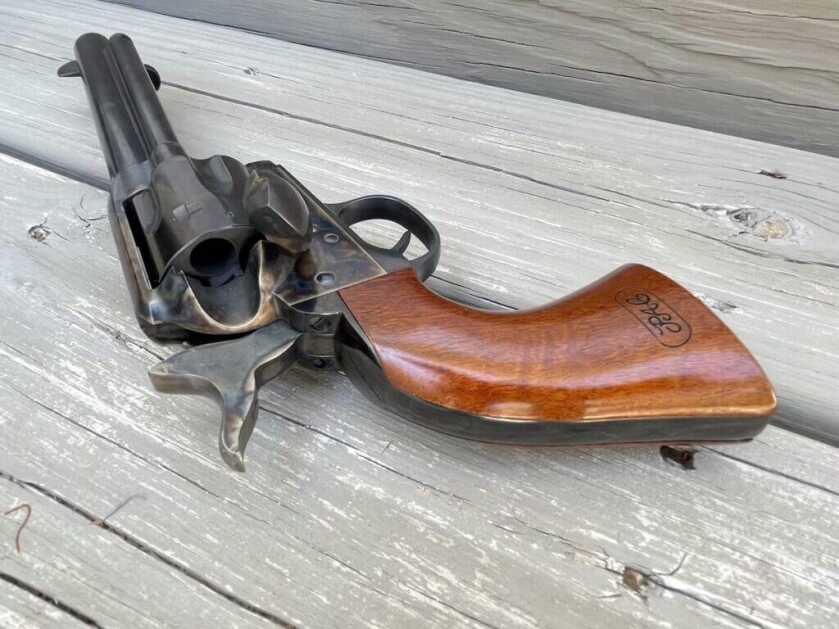
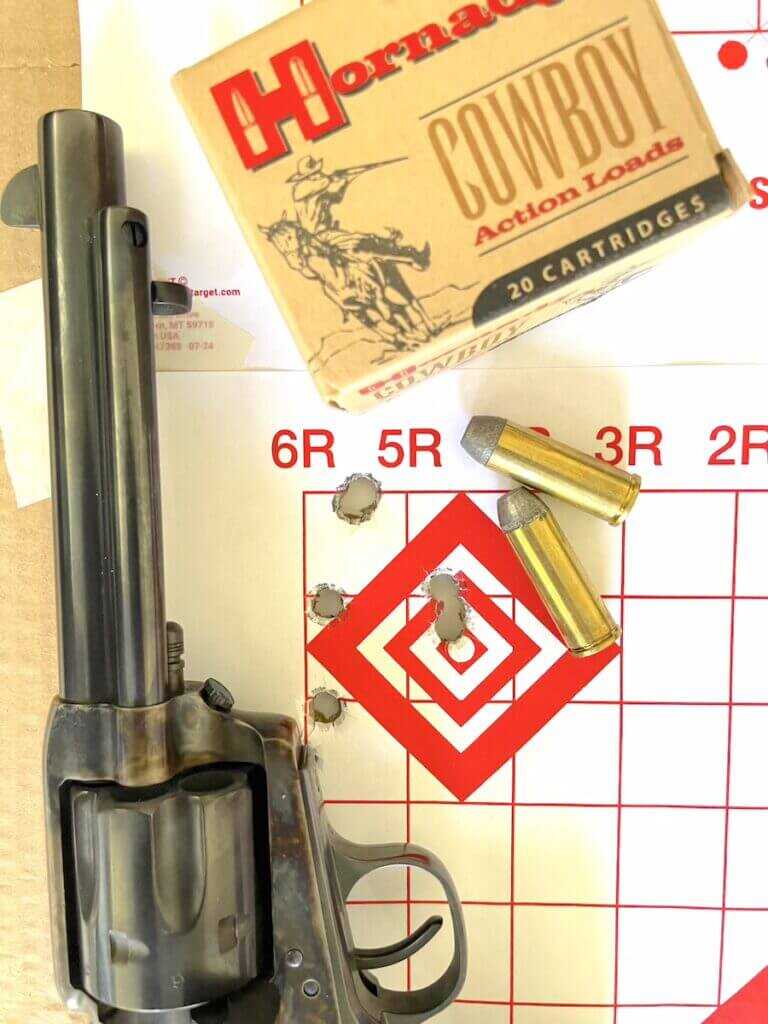
Two loads were used for live fire: Winchester Defender 225-grain bonded jacketed hollow points, and Hornady Cowboy loaded with a 255-grain RNFP. At a distance of 15 yards, the sights were properly regulated. No need to compensate with Kentucky windage or elevation. The rear sight is a “V”-shaped groove milled in the top of the frame, and the front sight is a thin, squared-off, rounded blade. They are not large blocky combat sights, but they work just fine. The trigger broke clean at two pounds eight ounces.
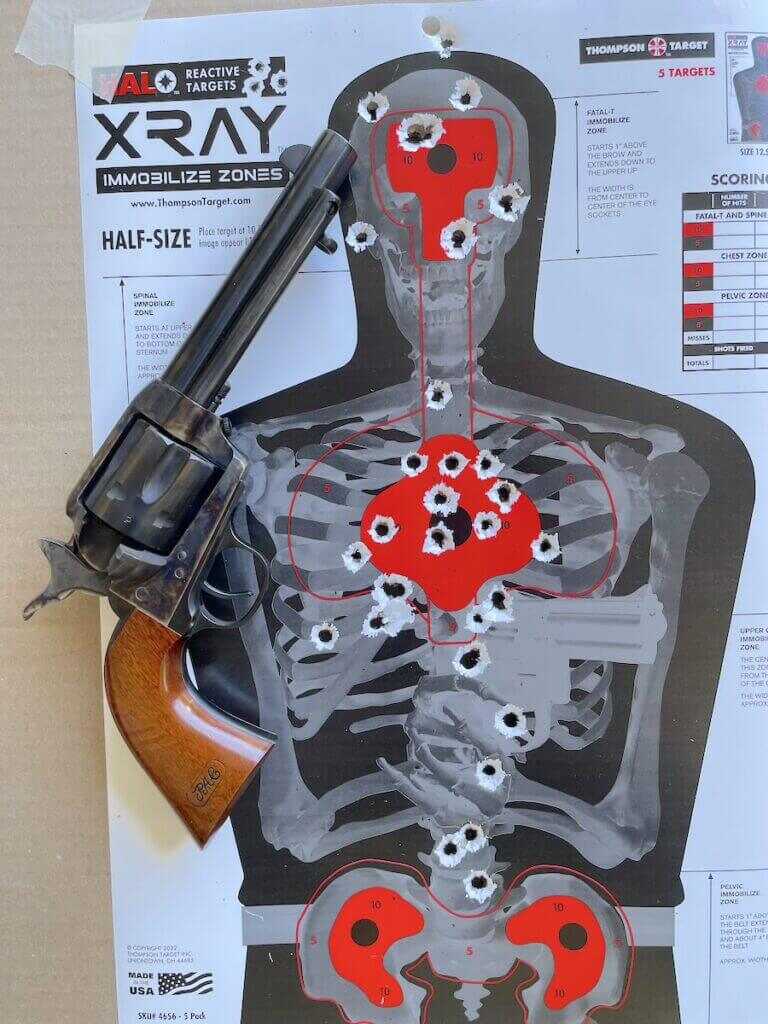
I started off at 7 yards using the Hornady Cowboy loads, which had mild recoil and were a hoot to shoot. Switching over to the Winchester defense ammo, I noticed the man-killer ammo had slightly more recoil, but it was easy to manage as the Cimarron, like most SAA revolvers, curls up in your hand during recoil.
I used a Thompson Target XRAY reactive target, and once I was finished with head and center of mass shots, I worked my way down the spine. Shooting two-handed and using my support hand to cock the Cimarron allowed me to fling lead down range with speed and accuracy.
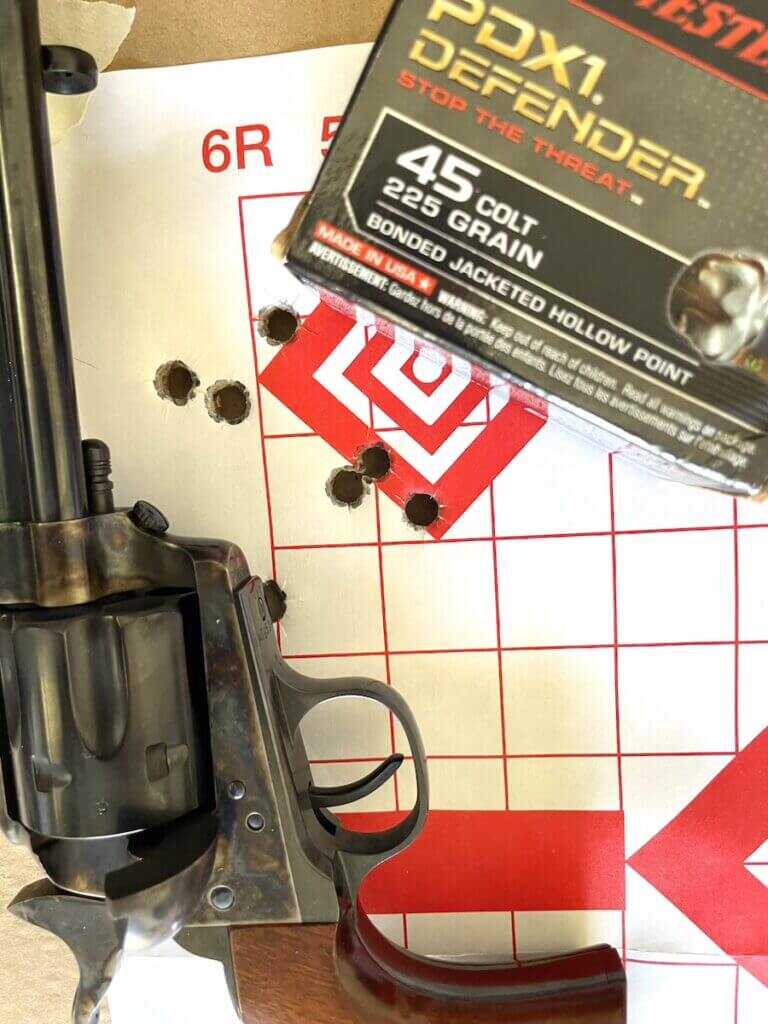
Move the target to 15 yards, and I used a rest to try to squeeze out accuracy. With the hot Winchester Defender loads, the Cimarron averaged slightly over 2.25 inches for 6-shot groups. The Hornady Cowboy had an average 6-shot group size of 2 inches.
Unloading an SAA can be a chore, but empties fell free from the U.S.V. Artillery’s cylinder chambers. I did need a nudge or two with the ejector rod on a few stuck cases.
| Model | Cimarron U.S.V. Artillery |
|---|---|
| Historic Pattern | Colt SAA Artillery |
| Caliber | .45 Long Colt |
| Barrel Length | 5.5-inch |
| Original Cavalry Barrel Length Referenced | 7.5-inch |
| Tested Barrel Lengths Referenced | Not provided in the original article |
| Frame Style | Early black powder style frame |
| Grip Detail | Reproduction RAC cartouche for Rinaldo A. Carr |
| Sight System | “V”-shaped groove rear sight and thin, squared-off rounded blade front sight |
| Trigger Pull | Two pounds eight ounces |
| Live Fire Distance | 7 yards and 15 yards |
| Winchester Defender Load | 225-grain bonded jacketed hollow points |
| Hornady Cowboy Load | 255-grain RNFP |
| Winchester Defender Group | Slightly over 2.25 inches for 6-shot groups |
| Hornady Cowboy Group | Average 6-shot group size of 2 inches |
| MSRP | Not provided in original article |
- Pros: The Cimarron U.S.V. Artillery is a natural pointer, carries the right Colt SAA Artillery look, uses the early black powder style frame, has strong historical details, and shoots mild Hornady Cowboy loads into about 2 inches.
- Pros: The 5.5-inch barrel balances well, the .45 Long Colt chambering delivers real authority, the trigger broke clean at two pounds eight ounces, and the revolver is easy on the eyes.
- Cons: Like other Colt SAA clones, it should only be loaded with five cartridges; unloading a SAA can be a chore, and a few stuck cases needed a nudge or two with the ejector rod.
The Cimarron U.S.V. Artillery recreates a unique version of the fabled SAA revolver. It is a shooting iron that is easy on the eyes and easy to shoot with power to end a bad situation. It also carries the kind of history that makes a sixgun more than steel, wood, and old-school mechanics. This Cimarron brings back the Colt SAA Artillery in a way that feels honest, shootable, and just plain fun.
- More Colt Single Action Army Reviews and History
- More Cimarron Revolver Reviews
- More .45 Long Colt Revolver Coverage

