

[[{“value”:”
Thank you for reading this post, don't forget to follow and signup for notifications!
In the United States, the 5.56 NATO and AR-15 have become synonymous with freedom. The round has become increasingly popular — in fact, it’s now the most popular centerfire rifle cartridge in the country.
The 5.56x45mm NATO is classified as an intermediate rifle caliber, meaning it falls between a handgun cartridge and a full-size rifle round. Given its popularity, it’s no surprise there’s a large variety of ammo options across a wide range of manufacturers that offer unique performance.
Background on the 5.56 NATO
The 5.56 NATO was developed in 1957 by Remington and ArmaLite for use in the AR-15 rifle. After it was officially adopted by the U.S. military in 1964, Remington released an adapted version for the commercial market designated the .223 Remington. Similarly, the North Atlantic Treaty Organization (NATO) followed a few years later and standardized the round, creating the 5.56x45mm NATO we know today.
The intent was to create a lighter round with less recoil than the 7.62 NATO that was currently in use with the M14 rifle. This allowed soldiers to carry more ammunition with less weight and engage targets more quickly. Additionally, the rifles could be more maneuverable while still being capable out to 500 yards.
The U.S. military initially adopted the round for use in the M16 rifle. Later, it continued use with the following M4 variants. Commercial AR-15 rifles have mirrored this acceptance, with the 5.56 NATO being by far the most common chambering. The U.S. military later used the round with the FN M249 SAW light machine gun.
.223 vs. 5.56
You’ll also find plenty of AR-15 rifles chambered in .223 Remington, but what is the difference? Isn’t it just the same round with a different name? In fact, no, the 5.56 NATO and .223 Remington are incredibly similar rounds based on the same design, with a few key differences that are important to highlight.

The 5.56 NATO has a longer leade, or throat (the distance from the mouth of the cartridge to where the barrel’s rifling touches the bullet), and more powder, resulting in higher chamber pressures than the .223 Remington. This is why a rifle chambered in 5.56 NATO can safely fire both cartridges, but not the other way around.
However, the .223 typically produces a slightly higher velocity, around 75 fps, leading to greater penetration. Originally, the 5.56 was intended to tumble and fragment on impact, creating a larger wound channel, but resulting in less penetration.
Both utilize a .224-caliber projectile (approximately 0.224 inches in diameter) and are often used in target shooting, competition, hunting, and personal protection applications to this day.
5.56 Tip Colors Explained
One of the main indicators that identify different types of 5.56 ammo is different tip colors. This allows shooters to quickly identify what type of ammunition is loaded into a magazine. This originally stemmed from when the military adopted the SS109 round, which was renamed the M855, as a replacement for the M193. To avoid confusion, the new round’s tips were painted green so soldiers could identify the new ammunition from the old.
Green tip M855 ammunition features a hardened steel penetrator tip, which aids in LIGHT barrier penetration. Many often believe these are armor-piercing rounds, but neither the military nor the ATF considers this to be the case. They merely penetrate a bit better than standard lead rounds.

True armor-piercing rounds are not available for civilians and feature a black tip. These rounds replaced the M855 and were designated the M855A1. The M995 is another black tip option. They utilize a hardened steel or tungsten core for true armor-piercing and hard barrier penetration capabilities. At 500 yards, they can zip through the engine block of a truck.
Another restricted option is blue tip 5.56 ammo. This is used to denote incendiary rounds. These are designed to ignite the target for further damage. They are typically used on fuel tanks to create a burst of flames. During WWI and WWII, they were incredibly effective against aircraft. However, there’s another blue tip that is far more common for us regular guys, and that is frangible training ammo. These rounds are designed to shatter on impact for safely shooting steel targets with minimal splashback or ricochet.
Silver tip ammo is a combination of armor-piercing and incendiary capability. Penetration is improved from the standard blue tip for the best of both worlds.
An orange or red tip is used for tracer rounds, which utilize a pyrotechnic charge that produces a bright light, allowing the shooter to see where the bullets travel. This allows for aiming correction for the individual or target identification for a team. You could also insert a single tracer round near the bottom of the magazine to give a clear indication of when you’re almost out of ammo.
Now take everything we just covered and put it to the side, because polymer-tipped ammo is available in numerous color options depending on the manufacturer and load, including blue, red, purple, and more, and is not the same as a painted tip. These are typically hollow point rounds with an added tip to improve aerodynamics and flight trajectory for increased accuracy. Additionally, upon impact, the polymer tip is driven into the hollow point cavity of the bullet, causing it to expand more, which produces a wide wound channel.
| Green Tip | Black Tip | Blue Tip | Silver Tip | Red Tip | Polymer Tip |
| Steel penetrator tip, light penetration. | True armor piercing, steel or tungsten core. | Incendiary military rounds, or frangible training ammo. | Armor-piercing and incendiary rounds. | Tracer rounds. | Multiple colors, hollow point ammo. |
Ballistic Performance
Bullet Weight
5.56 NATO bullets can range in weight as low as 35 grains in specialized, high-velocity loads, all the way up to near 80 grains for heavier, match-grade rounds designed for improved long-range performance. Most commonly, 5.56 is found in 55-grain and 62-grain options. The best grain for 5.56 NATO will depend on what you’re shooting.
55-grain is commonly available as inexpensive target shooting and plinking ammo. This allows you to shoot more for less, while still providing good accuracy. 55-grain and lower is also a good choice for varmint hunting. They travel fast and are plenty effective on smaller game.
62-grain ammo is more effective for self-defense purposes. These rounds hit harder and offer increased terminal performance. This is why the 62-grain is used in the NATO-standard M855. Hollow point options provide reliable expansion and ample penetration.
While 5.56 is not the most effective caliber for these purposes, 68-grain ammo is your best bet for medium game hunting. It is a good option for deer (where allowed) if used within around 200 yards. With proper shot placement, it offers enough penetration for a clean kill on a whitetail.

Bullet weights of 75 grains and above are primarily used for precision shooting. The heavier bullet is less susceptible to wind drift for more predictable long-range performance. It’s also a great choice for suppressed shooting because of the decreased muzzle velocity. Although it still surpasses the speed of sound, it will perform a bit better than lighter loads.
Velocity, Energy, Trajectory
Ultra-light 5.56 rounds can reach around 4,000 fps. More standard 55-grain and 62-grain loads hit roughly 3,300 and 3,050 fps, respectively. Heavier 75-grain bullets top out at a little under 2,900 fps typically. This results in between 1,300 and 1,400 ft/lbs of energy at the muzzle, with a drop between 30 and 55 inches at 500 yards. At 600 yards, the drop almost doubles to between 55 and 100 inches.
Accuracy and Effective Range
The 5.56 NATO is designed to be effective out to 600 yards, although trained shooters with the proper rifle setup and load selection can accurately group rounds at 1,000 yards. Here’s where twist rate comes into play. Faster twist rates, such as 1:7, are ideal for heavier bullets from 69 to 77 grains. A 1:8 twist is often considered the gold standard for its ability to stabilize 55 and 62-grain loads, as well as enough spin for accuracy with heavier match bullets.
A 1:9 twist may squeeze a bit more accuracy out of the 55 and 62-grain loads if you’re not concerned with anything heavier. For extremely light rounds for varmint hunting, a 1:12 twist is a good choice, though you will be limited in bullet options.
Recoil and Shootability

From a standard 7-pound rifle (the average weight of a typical AR-15), the 5.56 NATO exhibits about 5 pounds of recoil. This very mild recoil impulse is often described as a gentle push, rather than a sharp kick. This makes for an incredibly controllable round, allowing for fast follow-up shots. This is a good option for beginning shooters to practice recoil control and marksmanship fundamentals.
Penetration and Expansion
Penetration of 5.56 depends on the type of ammunition being used. Soft point and hollow point rounds tend to penetrate less than 15 inches in ballistic gel and soft targets. Standard ball ammo will increase this depth to between 15 and 20 inches. It can also pass through several layers of wood and drywall. M855 penetrator ammunition can travel through up to 3mm of mild steel, but is still stopped by hardened steel and ceramic plates.
Many 5.56 rounds are designed to rely on tumbling and fragmentation, rather than expansion, to improve their ballistic effectiveness. Soft point and hollow point rounds can expand to twice their original diameter. There are even bonded soft point rounds engineered to maintain their structural integrity when traveling through barriers, and then expand once they hit soft tissue.
| Cartridge | Bullet Weights (Grain) | Velocity Range (FPS) | Energy (Ft/lbs) |
|---|---|---|---|
| 5.56 NATO | 35-90 | 2,400-4,000 | 1,100-1,400 |
| .300 Blackout | 110-220 | 1,000-2,400 | 500-1,400 |
| 7.62x39mm | 120-154 | 2,100-2,450 | 1,450-1,600 |
| .308 Winchester | 125-200 | 2,500-3,100 | 2,400-2,800 |
Target and Competition Shooting
As touched upon above, lightweight 55-grain ammo is a common choice for plinking and target shooting due to its affordability and performance across a range of rifles. Full metal jacket loads prevent lead buildup in the barrel, and a boat-tail design offers excellent aerodynamics. 62-grain ammo is another good option, especially for those who want to train with a round similar to what they use for defense.
However, it should be noted that some ranges will not allow you to shoot green tip ammo due to concerns with excess damage to their barriers and equipment, as well as the possibility of the steel tip causing sparks that start a fire.
Top Loads
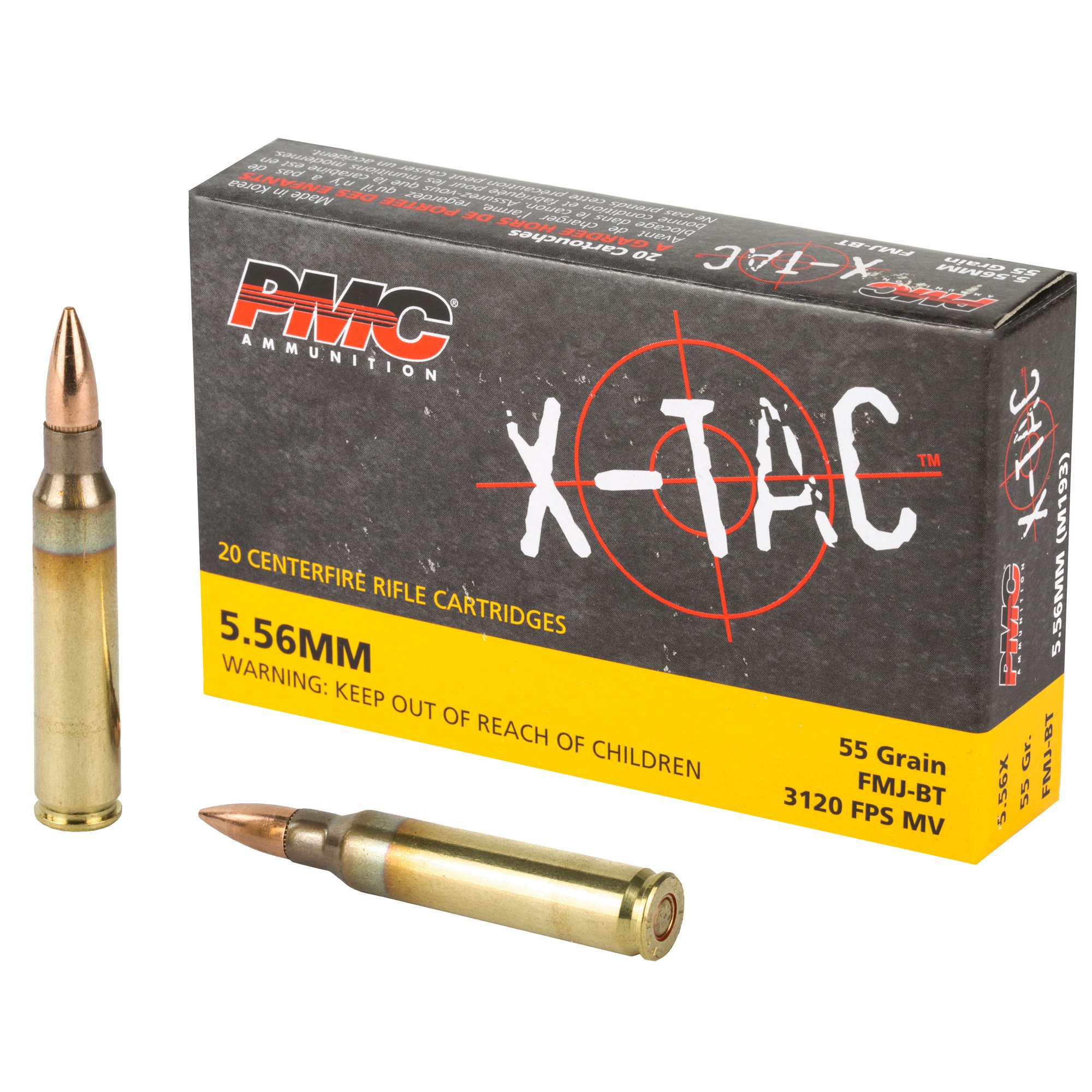
1. PMC X-Tac 55-grain FMJBT
For casual target shooting, PMC X-Tac 55-grain offers dependable service. This bulk 5.56 ammo features brass casings loaded with quality boat-tail FMJ bullets, clean-burning powders, and premium primers and components for consistent accuracy at a budget-friendly price.
| Distance (Yards) | Velocity (FPS) | Energy (Ft/lbs) | Trajectory (Inches) |
|---|---|---|---|
| Muzzle | 3,270 | 1,306 | -1.5 |
| 100 | 2,898 | 1,026 | 0 |
| 200 | 2,555 | 797 | -2.6 |
| 300 | 2,237 | 611 | -10.6 |
| 400 | 1,943 | 461 | -25.6 |
| 500 | 1,674 | 342 | -49.9 |
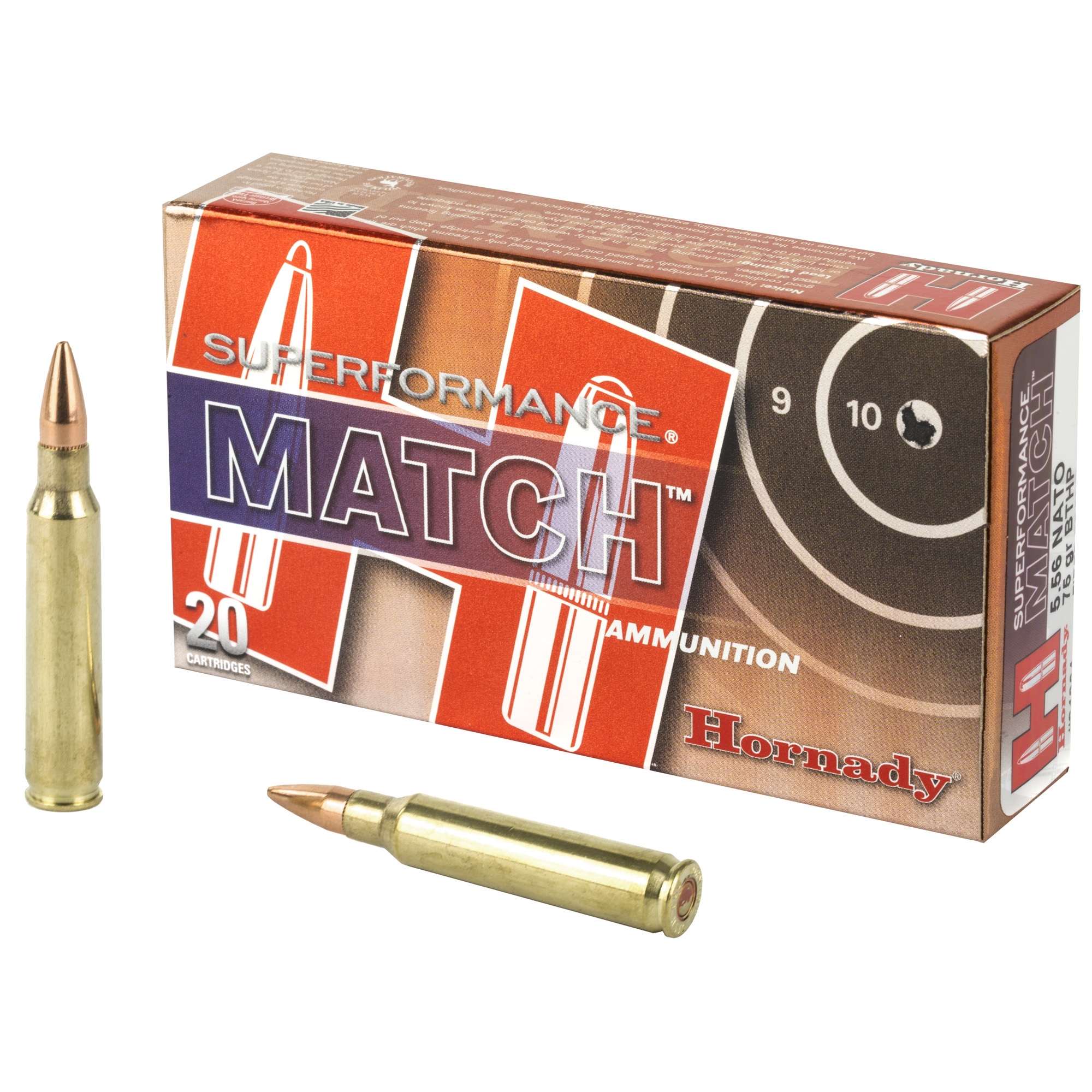
2. Hornady Superformance Match 75-grain BTHP
For more serious precision work, Hornady’s Superformance Match 75-grain ammo provides excellent accuracy, even at extended ranges. It is optimized for use in rifles with a 20-inch barrel or longer, and the heavy 75-grain bullet resists wind drift for consistent travel.
| Distance (Yards) | Velocity (FPS) | Energy (Ft/lbs) | Trajectory (Inches) |
|---|---|---|---|
| Muzzle | 2,910 | 1,410 | -2.4 |
| 100 | 2,676 | 1,192 | 1.2 |
| 200 | 2,453 | 1,002 | 0 |
| 300 | 2,242 | 837 | -7 |
| 400 | 2,041 | 693 | -21 |
| 500 | 1,851 | 570 | -43.3 |
Hornady Superformance Match 5.56 NATO Ammo 75gr BTHP 20 Rounds
(10)
Hunting
Most hunting loads for this caliber will be .223 Remington cartridges. However, there are a few solid options for hunting with 5.56 NATO. The round is popular for varmint hunters, where fast follow-up shots are useful. It’s also a great round to get kids into the practice, as the recoil and muzzle blast are minimal.
The 5.56 can even take medium-sized game such as deer within 200 yards, making it a fairly versatile cartridge. Importantly, for anything more than varmint hunting, be sure to check your local laws regarding the legality of hunting with the caliber.
Top Loads
1. Hornady Superformance 55-grain CX
Hornady’s Superformance also makes a great hunting load. For this section, I went with the 55-grain CX, which they tout as a medium game load for anything from 50 to 300 pounds. The CX (Copper alloy eXpanding) bullet design provides superior stopping power, and high velocities lead to consistent expansion.
| Distance (Yards) | Velocity (FPS) | Energy (Ft/lbs) | Trajectory (Inches) |
|---|---|---|---|
| Muzzle | 3,175 | 1,231 | -1.5 |
| 100 | 2,781 | 944 | 0 |
| 200 | 2,420 | 715 | -3 |
| 300 | 2,086 | 531 | -12.1 |
| 400 | 1,781 | 388 | -29.1 |
| 500 | 1,511 | 279 | -57.3 |

2. Barnes VOR-TX 70-grain TSX BT
Featuring a solid copper bullet, Barnes VOR-TX TSX provides maximum weight retention for improved stopping power, while precision-cut rings in the bullet shank act as relief valves, allowing the bullet to expand into the grooves for consistent double-diameter expansion and optimal energy transfer.
| Distance (Yards) | Velocity (FPS) | Energy (Ft/lbs) | Trajectory (Inches) |
|---|---|---|---|
| Muzzle | 2,850 | 1,263 | Unavailable |
| 100 | 2,568 | 1,026 | 1.4 |
| 200 | 2,303 | 825 | 0 |
| 300 | 2,054 | 656 | -8 |
| 400 | 1,822 | 516 | -24.2 |
| 500 | 1,609 | 402 | -51 |

Self-Defense
Due to restrictions in ammunition selection, the military relies on tumbling and fragmentation to create a larger wound channel for effective stopping power with 5.56. As civilians, hollow points are an option. 5.56 NATO hollow points expand to around twice their original size, and this slows their momentum. They will help prevent overpenetration, but this is still a high-velocity rifle round, and some forethought should be placed on your environment and what’s beyond it.
Those living in an apartment complex or residential housing with others in surrounding rooms may wish to turn elsewhere for a defensive caliber. However, if you’re defending a large property, or practice proper shot placement and ammo selection, the 5.56 NATO is a good choice for personal protection and home defense. A heavier 62-grain+ load can help limit the velocity while packing a bit more of a punch.
Top Loads
1. Hornady Frontier 68-grain BTHP
Designed for excellent all-around performance in self-defense, varmint hunting, and match settings, Hornady Frontier is a good round to stock up on. Manufactured to tight tolerances, this 5.56 ammo delivers reliable ignition, consistent velocities, and superior function in most semi-auto or bolt-action rifles.
| Distance (Yards) | Velocity (FPS) | Energy (Ft/lbs) | Trajectory (Inches) |
|---|---|---|---|
| Muzzle | 2,960 | 1,323 | -1.5 |
| 100 | 2,697 | 1,098 | 1.7 |
| 200 | 2,449 | 906 | 0 |
| 300 | 2,215 | 741 | -7.5 |
| 400 | 1,993 | 600 | -22 |
| 500 | 1,786 | 482 | -45.4 |
Hornady Frontier Cartridge 5.56 NATO Ammo 68gr BTHP Match 20 Rounds

(17)
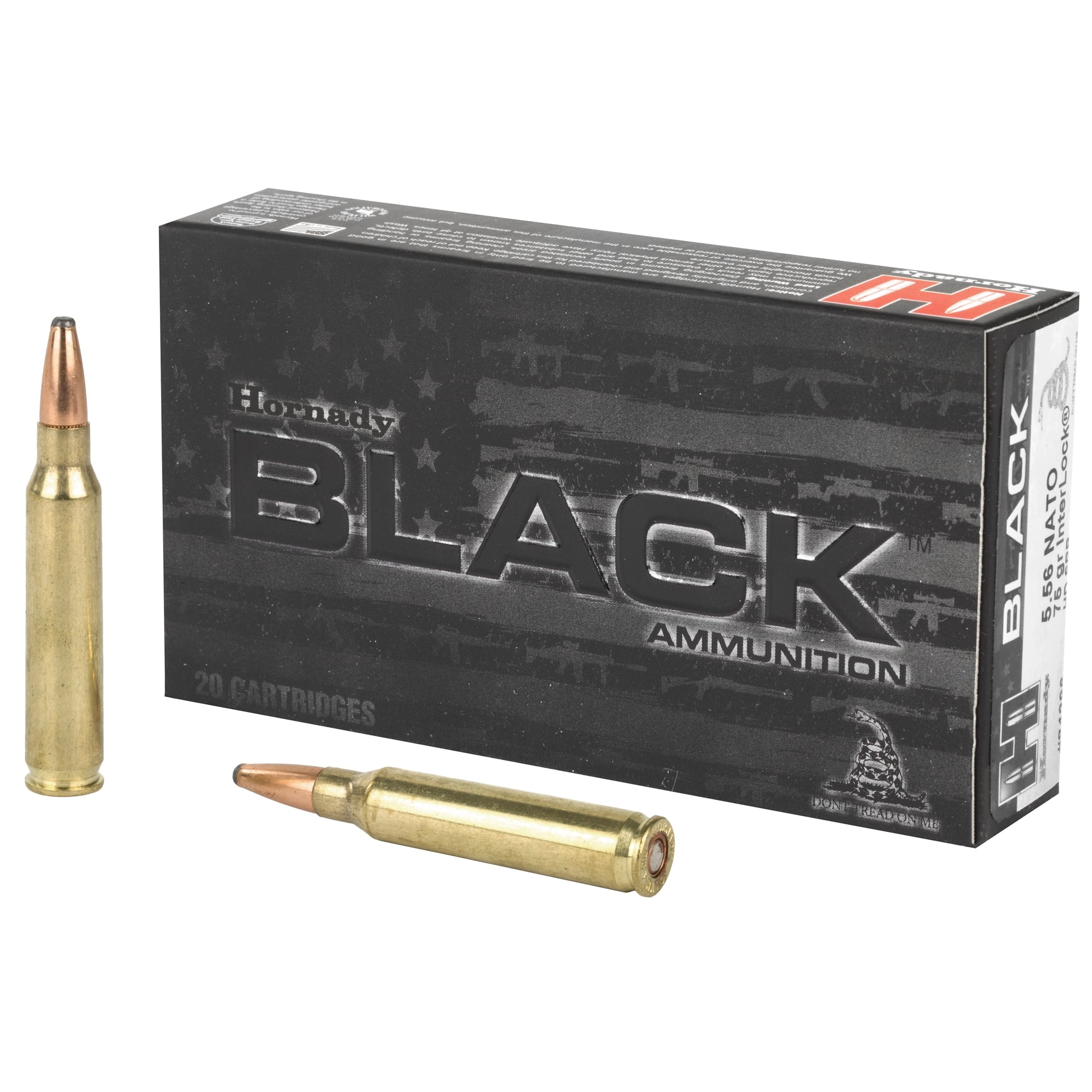
2. Hornady Black 75-grain InterLock HD
Designed for improved performance with short-barreled rifles (SBRs) and AR pistols, Hornady Black utilizes a proprietary propellant to achieve full powder burn. Additionally, the Critical Duty FlexLock bullets are equipped with a heavy-duty jacket-to-core InterLock band to eliminate clogging and mitigate bullet and core separation for maximum weight retention, excellent expansion, and consistent penetration.
| Distance (Yards) | Velocity (FPS) | Energy (Ft/lbs) | Trajectory (Inches) |
|---|---|---|---|
| Muzzle | 2,321 | 897 | -2.5 |
| 100 | 1,974 | 649 | 3.3 |
| 200 | 1,662 | 460 | 0 |
| 300 | 1,393 | 323 | -16 |
| 400 | 1,184 | 233 | -50 |
| 500 | 1,046 | 182 | -108.8 |

Final Thoughts
It’s clear to see why the 5.56 NATO is a fan favorite, especially when paired with the renowned AR-15. From target and competition shooting to hunting and self-defense, the 5.56 is a reliable performer in a relatively compact package. There’s a ton of ammo options with unique characteristics for customized performance in different applications. Whether you’re looking for your first centerfire rifle or just want to add another to the stable, the 5.56x45mm has a place in any collection.
What do you think of the 5.56 NATO? What are some of your favorite 5.56 loads? Share your thoughts in the comments.
“}]]

