

[[{“value”:”
Thank you for reading this post, don't forget to follow and signup for notifications!
Editor’s note: This article is part of Police1’s Firearms Week, which examines whether officers are equipped for the threats they may face today and tomorrow — from capacity and deployment speed to distance, accessibility and real-world firearm limitations. Thanks to our Firearms Week sponsor, KelTec.
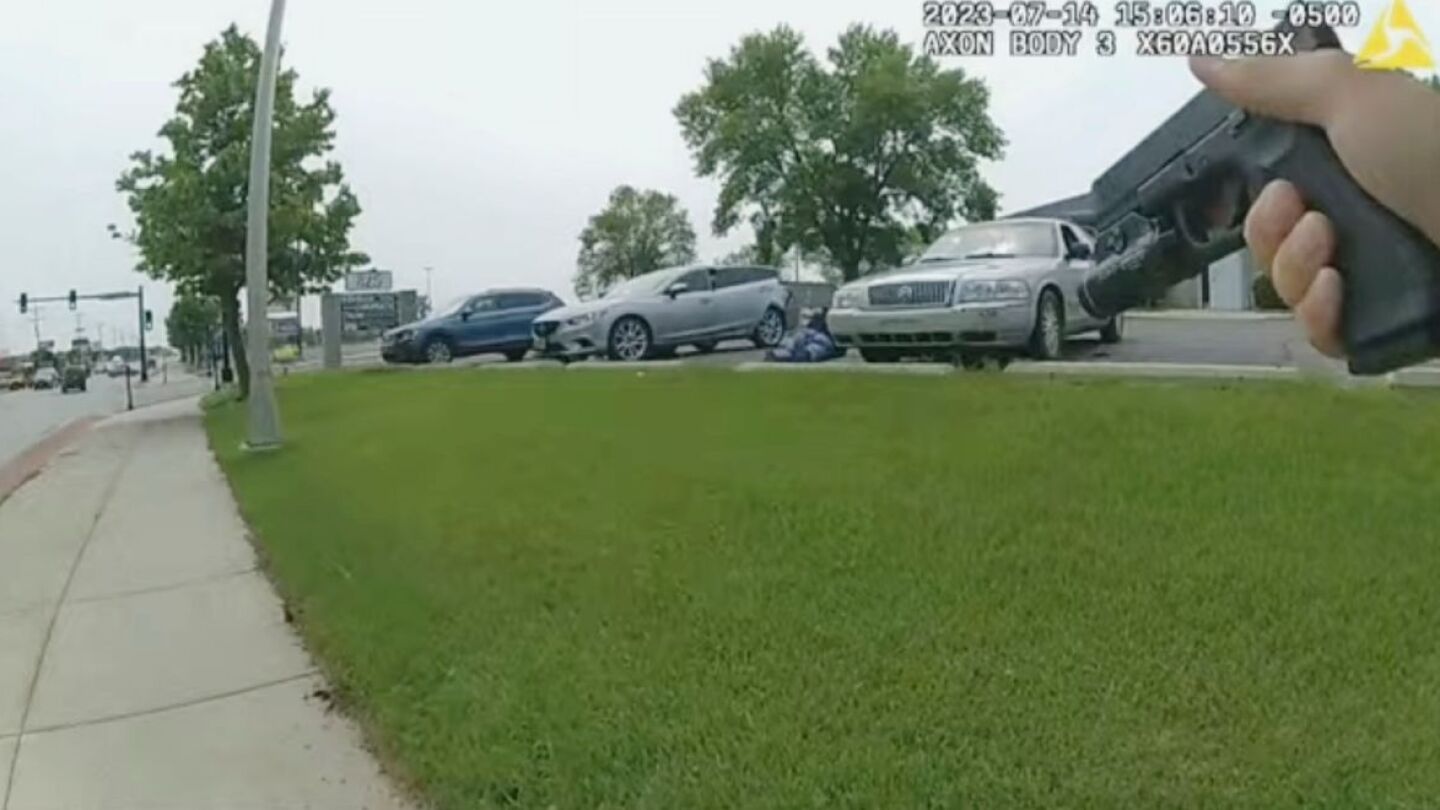
On July 14, 2023, Officer Zach Robinson of the Fargo (North Dakota) Police Department saved countless lives by defending himself, his colleagues and his community from a deadly attack. Nearly three years later, the incident remains a powerful reminder that firearm proficiency is built long before a critical incident unfolds.
Officer Robinson did outstanding lifesaving work under tremendous pressure; he was tactically sound and extremely proficient in gun handling. His response serves as a reminder that the fundamentals matter. Critical incidents continue to show officers struggling with some of the most basic elements of handgun use — maintaining a functional grip, identifying the need to reload and doing so expeditiously, clearing malfunctions and more. These skills don’t happen by accident or through luck. Effective training is the key to building shooters who can perform under pressure when it matters most.
| RELATED: Why reload efficiency matters when your handgun runs dry
Closed skills vs. open skills
As a starting point, let’s look at some definitions. Skills can fall into two broad categories, closed and open.
Closed skills are the type of things that occur in a controlled manner. Some sporting examples of a closed skill would be hitting baseballs in a batting cage, striking a punch bag in a gym or a football player running laps of the field. All these examples are physical skills being used in a very controlled manner. Variables are accounted for and there is not much if anything changing in the environment.
Skill is certainly required to complete these tasks, but there is not much in the way of ongoing adaptation required. The policing examples of this would be shooting a static range drill, driving around a closed track or hitting a dummy with a baton in a gym.
Open skills have a great deal of variability in their application. The environment in which they are undertaken is less controlled and is subject to frequent change. The user of the skill must adapt to their changing circumstances and the skill being used must be functional at a much higher level.
Sporting examples would be a baseball player in a live game, an MMA fighter opposed in an octagon and a football player pushing through the opposing team’s defense to score. Law enforcement examples would be exchanging gunfire in a fight for your life, driving to a call for assistance from an officer or striking a subject with a baton while fighting to control them.
There is a time and a place for training in a closed-skill environment, but we mustn’t be fooled into thinking that is the end game.
All physical skills trained in law enforcement are for the express purpose of operational use — and that use is typically under pressure. With that in mind, all training needs to be orientated toward that goal at every level.
| RELATED: Skill without thrill: The most efficient firearms training you’re not doing
Foundations of reality in training
The closer training can come to reality, the better served our people will be. The more chances they get to flex their open skill sets the more naturally they will flow. This is why sports teams play practice games — they do not just run isolated drills once or twice a year and then jump into intense competition.
An example of a highly useful training event may be a full-on scenario that includes being dispatched to a call, driving to the scene, completion of the paperwork and assessment of every interaction and decision along the way.
Few people have the time, the funding or the venues to offer something so in-depth. What we can do is work within the boundaries of our environment. We can still focus every element of our closed skill training toward its intended operational use. Everything we train should be with the end users’ job in mind. If the training “why” is to check boxes or pass tests and there is no loftier goal, we are not going to produce Officer Robinson-level performers. Operational excellence is the result of hundreds of small skills strung together following thousands of quality repetitions.
| RELATED: Reality-based training rewires how police officers think and act
Reloading at the speed of life
Any isolated skill in gun handling can be broken into elements. For the purpose of this article, the reload will be the topic.
Breaking a skill down like this can be broadly applied to anything you teach on or off the range. Speed is a non-negotiable necessity for reloading. If a gun has been shot empty, things are not going well. The gun needs to be full and functional immediately. Anyone who uses the word “slow” to describe how to reload is wrong. There is never going to be an operational need to reload an empty gun slowly. There must never be a suggestion that slow is the goal. Slow is not a solution. “Slow down” doesn’t qualify as feedback.
Each person should be working at their maximum efficiency every time.
A recruit will be hovering somewhere around four to five seconds for a handgun reload. A skilled officer will complete the task in less than two seconds. Wherever your people are on the speed scale, they need to be working to their maximum capability every time. Their speed limit is determined by their ability to succeed at the task; but the time taken to achieve success should be getting shorter week after week, month after month, year after year.
Once the need to reload has been identified, there are only three elements to returning the gun to operational readiness:
- Empty magazine out
- New magazine in
- Chamber a round
Each of these steps can be honed to minimal movement and maximum result. There isn’t enough room in this article to explore each nuance of efficiency associated with these elements. But as you watch people reload, ask yourself which of the three steps looks the least efficient. What can be done to reduce wasted time and movement on that step? The answers to those questions become your guidance for coaching and improvement. Video is a great tool for analysis and feedback for skills like these.
| RELATED: How the ‘selfie’ approach to self-assessment benefits students and trainers
Top three reloading dos and don’ts
If you want to build officers who can reload quickly and efficiently under pressure, here are my top three dos and don’ts:
Don’ts:
- Don’t allow people to exchange magazines in holstered pistols. Every time they do this, they are losing a rep of a real reload. Changing magazines in holstered pistols is lazy, potentially dangerous (yes, people have fired guns doing it), and it has zero operational value. It is a garbage rep of a valueless skill for no return.
- Don’t retain empty magazines — let it hit the ground, it has zero value. The most valuable thing for an empty gun in a fight for life is more ammunition. Discard the empty magazine as fast as possible and make way for more ammunition as the priority.
- Don’t allow people to run out of ammunition in training. If you design or run drills that allow people to shoot all their ammunition, leaving them with an empty gun and nothing to put in it, then you’re doing it wrong. No officer should ever be trained to accept an empty gun as normal. There is only one solution to the question of “What should I do with an empty gun,” and the answer is to reload it — right now! Design training programs that always allow people to have magazines available to reload any time they have an empty gun. Never let them holster after shooting to empty.
Dos:
- Do encourage reloading at the speed of life. If the gun is empty, there is only one speed for the reload and that is maximum speed. All too often in training, people will try to assess their work — or feedback starts from coaches while the shooter is still holding an empty gun. Reload as if your life depends on it — every single time.
- Do design drills to include random reloads. Avoid setting the gun up with a prescribed number of rounds that require a countdown to the reload. That type of training encourages people to shoot the drill and not really pay attention to the gun. When the gun goes empty unexpectedly, the shooter will start to associate the appearance and the feeling of a need to reload. The more they experience that circumstance, the more anchored it will become as a stimulus for them — and the quicker they will be able to recognize it and fix their problem.
- Do encourage movement to improve position. Notice this doesn’t say always move. If you happen to have substantial cover, a good tactical position and no better option, then staying still might be the answer. However, if you are out in the open — as Officer Robinson was — and your gun is empty, moving whilst reloading the gun would likely be the beneficial approach. Moving your feet and reloading your gun sounds simple, but like all things it must be practiced. Create opportunities in training for people to move while they reload. Even if it is just a lateral step or two, that is better than nothing at all. If there is space in your training realm to do more substantial movement, then take advantage of it as often as possible.
| RELATED: The story of the fatal Fargo ambush from the only officer left standing to eliminate the gunman
How to introduce some elements of stress to any live fire shooting skill
Life-threatening fear and the physical response that comes with it are difficult, if not impossible, to recreate in range training.
There are, however, simple and low-cost ways to expose officers to elements of stress. These may seem like small changes, but if you’ve never tried them, the results may surprise you. Officers who appear capable in routine drills can struggle when pressure is added to their performance.
These concepts can be applied to an isolated closed skill, such as standing still and drawing from a holster. They can also be used in more complex skill development, such as competition-style moving and shooting stages run in relays for a larger group.
- Introduce a timer. Simply telling officers their performance will be timed can change how they perform. Having them set a baseline time and then work to beat it may be enough to add meaningful pressure.
- The next level is turning timed tasks into group competitions. Competing against peers pushes people to work hard, raises emotion and arousal, and often brings some fun into the training environment.
- Peer observation is another quick and easy way to change an officer’s emotional state. If your training includes movement and relays, the officers waiting their turn should be watching those who are shooting. Observers can learn a great deal from intentional observation of their peers, making it a valuable use of their time.
- For the officers being watched, there is a high likelihood of increased emotional arousal and stress. Few people enjoy being watched while performing a skill, and even fewer want a group of officers watching them shoot. The combination of competition and an audience can create manageable levels of stress exposure. Once again, watch out for the danger of joy and the risk of fun while learning.
There is no timer in a fight for your life, but there is a substantial penalty for coming second.
Operational use of a firearm will always come with an unforgiving time constraint — get used to it in training. Get accustomed to people watching you work — using force is rarely a private event. Start using these stress-inducing concepts in live fire training and watch your people start to get comfortable being uncomfortable.
NEXT: In this video, Todd Fletcher walks through the clock drill, a simple way to introduce stress, target identification and decision-making into firearms training.
This article, originally published on August 29, 2023, has been updated with additional resources.
“}]]

