

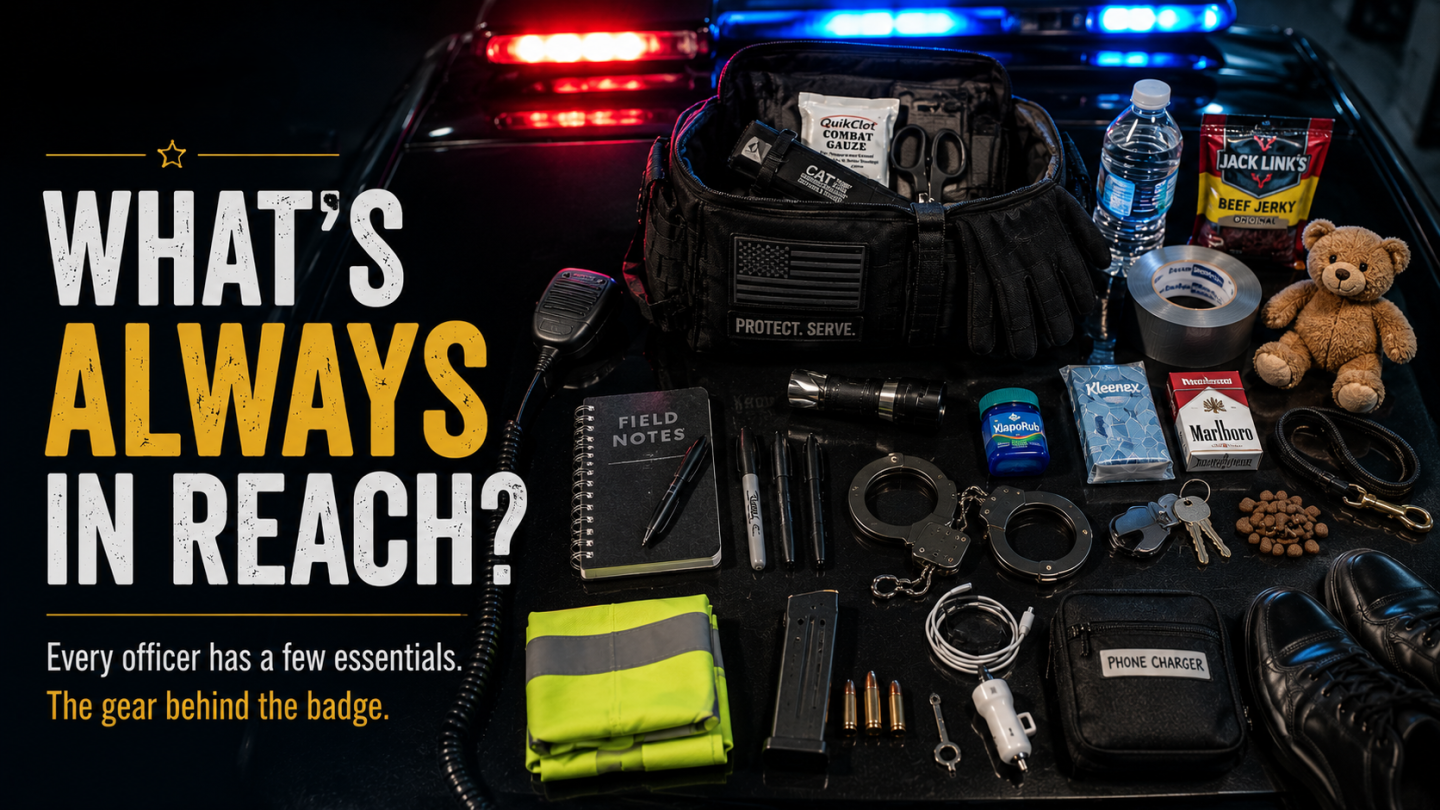
Most of us begin our careers loading our cars with equipment for report writing, maybe a spare flashlight, and a reference book of local laws or department policies. Each officer then curates his own collection of gear (“war bag”) that he or she has found or hopes to find useful while on patrol.
Thank you for reading this post, don't forget to follow and signup for notifications!
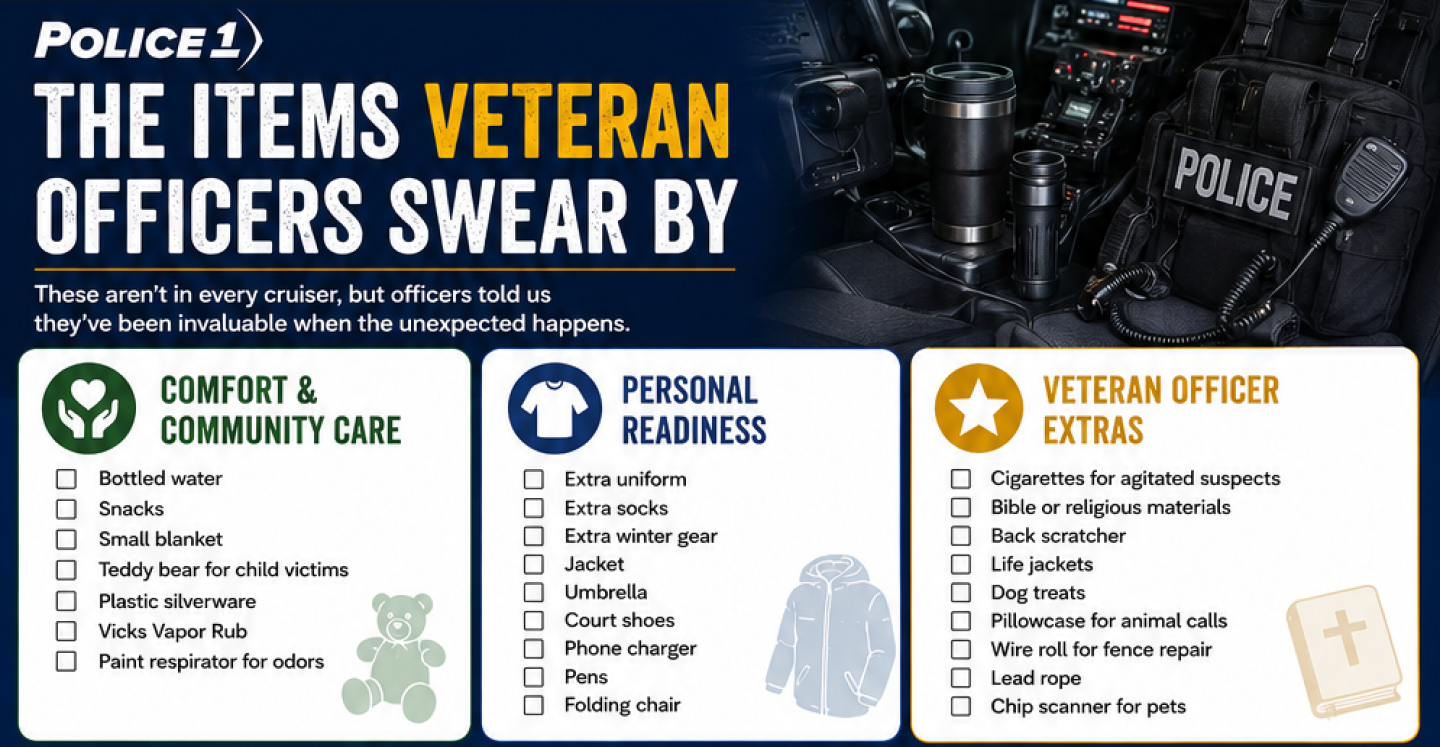
No patrol bag starts fully stocked. Officers build them one call at a time — after a fatal crash, a stranded motorist, a diabetic emergency, a long perimeter or a miserable night stuck at a crime scene without food, water or dry clothes. Police1 recently asked readers on Facebook for examples of items they carried in the field. Here are a few of the things they mentioned, with some embellishments and suggestions.
The tools officers wind up needing sooner or later
Batteries: Carry replacement batteries for everything you have that takes batteries, plus some of the standard types (AA, AAA, nine volt, 2032 coin cells — the most common type for key fobs) whether you use that type or not. Even if you don’t need those yourself, you’ll make the Christmas card list of any officer or a citizen whose gadgets have gone dead. Check out Storacell for a secure way of carrying these. Batteries leak or otherwise go bad, so check them from time to time.
Extra pens: Buy whatever quality pen you prefer for your use (I’m a fan of Pilot G2s), but have a supply of cheap-but-serviceable pens to give to people for writing statements and such. Once you have experienced the level of personal hygiene that some citizens find acceptable, you’ll be glad to let them keep the pen.
Tape measure: Accident investigations often require measuring wheelbases, car frame elevations, or skid marks. A measuring wheel is the best tool for the skid marks or other distances of more than a few feet, but if you don’t have one, a tape measure will do in a pinch. You can also use this as a size/scale reference when you’re taking crime scene photos, but a six-inch ruler is even better for that.
Flex cuffs: The day will come when you will have more bad guys than handcuffs. A small supply of flex cuffs will get you through that difficult time. Don’t forget to also have a pair of snips capable of cutting the flex cuffs off, as they’re often one-use items.
Pry tool: Shop a bit and you can find tools that are for prying, smashing and digging, all in one. These are heavy and a little bulky, but you might save the day by having one on the scene of an accident or a search warrant service.
Window punch: It seems to be common practice of obstinate motorists to roll up their windows and refuse to communicate with the police. They have clearly never watched any of the many YouTube videos of people doing this all the way to the end, as they all wind up the same way. Cops use their collapsible batons to break windows, but it seems to take them multiple strikes to break through. A spring-loaded window punch makes short work of safety glass. These are not expensive and take up little room.
Zip-Loc bags: I’ve mentioned Zip-Loc (or any good quality resealable plastic bag) bags several times because they are so useful. You can keep various items separate, and write on the outside of the bag relevant info such as contents and dates. Having a supply of unused bags simplifies temporary packaging of some evidence (note that paper containers are preferred for extended use, as the plastic can promote condensation and mold growth) and even prisoners’ property.
I once arrested a man who had just won big at a craps table, and had over $40,000 in cash in his pockets. A sergeant and I counted the money, put it in a Zip-Loc bag, double-sealed the bag with fingerprint lift tape (which looked suspiciously like office supply store packing tape), and signed our names across the seal. This was given to the intake deputy at the sheriff’s office, who is probably still cursing my name, but I know the money got there intact. Keep several sizes of bags on hand.

The gear that gets officers through long shifts
Snacks: Energy bars, mini-bags of chips or pretzels, licorice (“Red Vines”) or whatever you prefer will be a lifesaver if you get stuck at a crime scene and can’t leave. Hard candy (not sugar free) might resolve a diabetic crisis, and you never know when a suspect you want to make your friend will be hungry. Where appropriate, write the date you bought the snack on the wrapper. Just make sure your choices will survive the temperature extremes your equipment experiences, and that they’re sealed in a Zip-Loc bag or plastic container.
Bottled water: Staying hydrated can be critical. At crime and accident scenes, people can suddenly realize they’re parched from stress. Having a cop hand them a bottle of water can make you their friend for life. It’s also handy when something needs to be rinsed off, such as in a first aid situation. Get a case (less than $5) of the store brand from a warehouse store and keep it in your garage for a source of resupply.
Wet wipes and hand sanitizer: Washing your hands frequently is the single best way for cops to guard against getting sick, but sometimes there is no soap and water around. Disinfectant wipes and hand sanitizer are your fallback measures. Use the wipes on your handcuffs and even on the interior of the prisoner cage when you’re done with a transport. If you share cars, consider wiping down the steering wheel, shift lever and radio mic at the start and end of watch.
Bug spray: If you work in a humid environment, you will endure gnats, flies and mosquitoes. The latter, if you didn’t know, are the most dangerous animals on earth, responsible for the spread of deadly diseases to millions every year. You may need to experiment to find which brand or formulation works best with your personal chemistry. Put the bottle in a Zip-Loc bag to guard against leakage.
Toilet paper: This is a good substitute for tissues when you have a runny nose, but its original intended purpose may come into play, too. This is especially true if you work in a rural environment where sanitary facilities aren’t always available. You’ll appreciate the utility the day that gas station burrito does its magic on your guts and things become desperate. Don’t think it will never happen to you.
Spare uniform and/or coverall: I always followed the minimum Rule of Three on uniforms: one on my back, one in my locker, one at the dry cleaners. Now that many cops are wearing wash-and-wear Class B uniforms, it’s easier to keep one in a hanging bag or rolled up for immediate use. A coverall or jumpsuit can save you some grief at nasty crime scenes or other places where you need to crawl under a house or go someplace similarly filthy.
The items officers carry for others
Stuffed animal: Having one of these to give a frightened child might shape that kid’s notion of cops for the rest of their life. Check around the community. There is probably a resource that will supply all the teddy bears you need.
Dog treats: These can be a great distraction if you need to get past the family pooch, or just to make friends. Get top quality treats, as some dogs will just spit out the cheap stuff.
Lead rope and dog leash: If you work in an area where you have to deal with wandering livestock now and then, a lead rope can make life easier. Everyone encounters stray dogs occasionally, and a leash that can be looped into a sort of noose you can drape over the dog’s head and neck can help you corral and control Fido. If you get one in a bright color, you’ll be more likely to get it back. Write your name on it, anyway.
Cigarettes and matches: Tactical instructors will tell you to never allow a prisoner to smoke or have matches or a lighter, but there can be a time and place. When you have the situation pacified and the prisoner restrained, he or she might be willing to tell you just about anything for a cigarette. Carry wooden matches instead of a lighter (the lighters dry out), light the cigarette for them, and supervise them closely while they smoke.
The dirty-job essentials
Vicks VapoRub: Veterans say you stop noticing the odor of decomposition after an hour or so, but if you can’t wait that long, keep a jar of Vicks or some other mentholated ointment to smear on your upper lip. This is a preferable alternative to carrying around a cheap (the cheaper the better) lit cigar while you’re at a nasty crime scene, which was the practice in my day.
Work gloves: You probably have leather gloves that are good to protect against most hazards, but leather work gloves are useful when you have to deal with broken glass, need to traverse a barbed wire fence, or have to handle hot metal. You can get a pack of half a dozen pairs at a discount hardware store, and if they get ruined, pitch ’em and put a new pair in the bag.
Car vacuum, microfiber cloth, window cleaner: How badly you need these things varies indirectly with your tolerance for grubbiness. I never left the motor pool with a dirty windshield or dirty headlights, as my eyes fatigued more quickly if they had to constantly shift focus from the windshield dirt to the road. The vacuum will come in handy if the cop who had the car before you has a sunflower seed jones and spits the empties onto the floor. Yes, there are cops who do this.
No two patrol bags are alike because no two officers experience the job the same way. Over time, though, most officers discover the same thing: the items that matter most usually come from the calls that caught them unprepared once before.
What’s the one item you never hit the road without? Share below.

