


[[{“value”:”
Thank you for reading this post, don't forget to follow and signup for notifications!
Date: Thursday, July 16
Time: 2 p.m. ET | 1 p.m. CT | 11 a.m. PT
Register now using the “Register for this Police1 Webinar” box on this page!
* Can’t make the date? Register anyway and we’ll send you a recording after the event.
Artificial intelligence is rapidly making its way into law enforcement investigations. But not all AI is built the same, and the differences matter when it comes to case integrity and courtroom defensibility. This webinar cuts through the hype to give investigators, commanders and technology decision-makers questions and considerations when evaluating AI tools designed for investigations.
We’ll explore how AI-assisted investigations can dramatically reduce the time officers spend on research and documentation, while also examining the serious risks posed by consumer-grade AI tools that were never designed for public safety environments. From data sourcing and privacy exposure to policy compliance and evidentiary standards, this session will equip attendees with the right questions to ask before any AI product enters their agency.
By attending this webinar, you will learn:
- Why the trusted content an AI is trained on determines how trustworthy its outputs are and what “closed data” means for law enforcement.
- Why using consumer AI tools like ChatGPT creates real security, privacy and defensibility risks for agencies and cases.
- How cited, traceable AI outputs differ from hallucinated results and why that distinction could make or break a case.
- Ways that AI can compress hours of manual research and summarization into minutes, freeing investigators for additional field follow up and investigation.
- How summarization tools with sourced citations can streamline report writing while maintaining evidentiary integrity.
By joining this webinar, you will learn why these five points are critical for AI adoption and implementation. We will also show how a solution like Thomson Reuters CLEAR Investigate meets these critical needs, decreasing investigative research time by 47% using transparent and trusted content.
WHO SHOULD ATTEND:
Detectives / Criminal Investigators
Police chiefs / Sheriffs
Crime / Intelligence analysts
Narcotics investigators
Digital forensics investigators
Cybercrime investigators
* Please note the Q and A portion of the webinar will only be available for live event attendees.
MEET THE SPEAKERS:
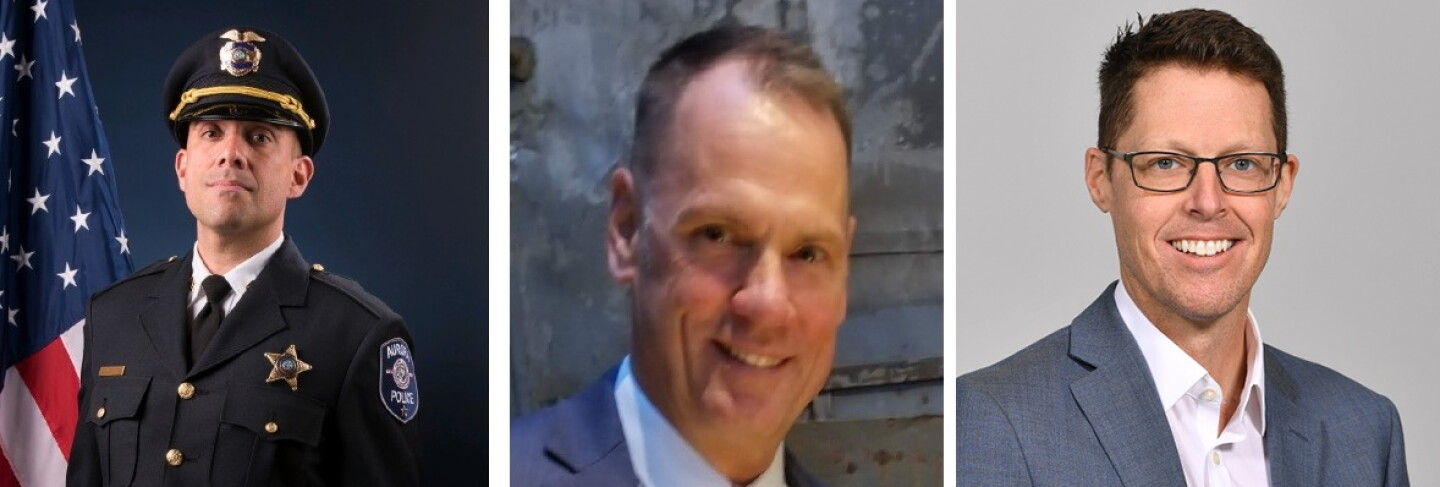
Edgar Gallardo is a Client Executive at Thomson Reuters, bringing more than two decades of distinguished law enforcement experience to his role. Before joining Thomson Reuters, Edgar served 22 years across two suburban Chicagoland police departments, building an exceptional record in both investigative and supervisory capacities. Early in his career Edgar spent nearly five years at his first department, where he earned certification as a State of Illinois Traffic Crash Reconstructionist. He then went on to serve over 17 years at his second department, advancing through the ranks as a patrol officer, detective and sergeant. He concluded his law enforcement career overseeing the department’s real-time crime center, where he led the integration of technology and data intelligence into frontline policing operations.
Michael Murphy is a Product Specialist with Thomson Reuters where he serves as an advisor and trainer on law enforcement products. Michael retired from the Maryland-National Capital Park Police after 23 years of service. Michael began his career in law enforcement as a patrol officer and rose through the ranks retiring as an Assistant Chief of Police. During his tenure in law enforcement he held various positions including patrol officer, tactical officer, patrol sergeant, detective sergeant, patrol commander, commander of investigations, commander of special operations, commander of management and technology, assistant chief of investigative branch and assistant chief of the operations branch.
Andrew Pellington is the Senior Director of Product Marketing for Thomson Reuters Risk and Fraud portfolio of solutions. His team is responsible for representing the voice of the customer and market at large, bringing valuable risk and fraud insights back into the organization. Andrew joined Thomson Reuters in 2011 with his first several years spent in the corporate strategy department. He received a B.S. degree in industrial engineering from Northwestern University and a M.B.A. from the University of Minnesota.
Access to these tools is limited to authorized, vetted professionals. Thomson Reuters is not a consumer reporting agency and none of its services or the data contained therein constitute a “consumer report” as such term is defined in the Federal Fair Credit Reporting Act (FCRA), 15 U.S.C. sec. 1681 et seq. The data provided to you may not be used as a factor in consumer debt collection decisioning; establishing a consumer’s eligibility for credit, insurance, employment, government benefits, or housing; or for any other purpose authorized under the FCRA. By accessing one of our services, you agree not to use the service or data for any purpose authorized under the FCRA or in relation to taking an adverse action relating to a consumer application.
“}]]

