

[[{“value”:”
Thank you for reading this post, don't forget to follow and signup for notifications!
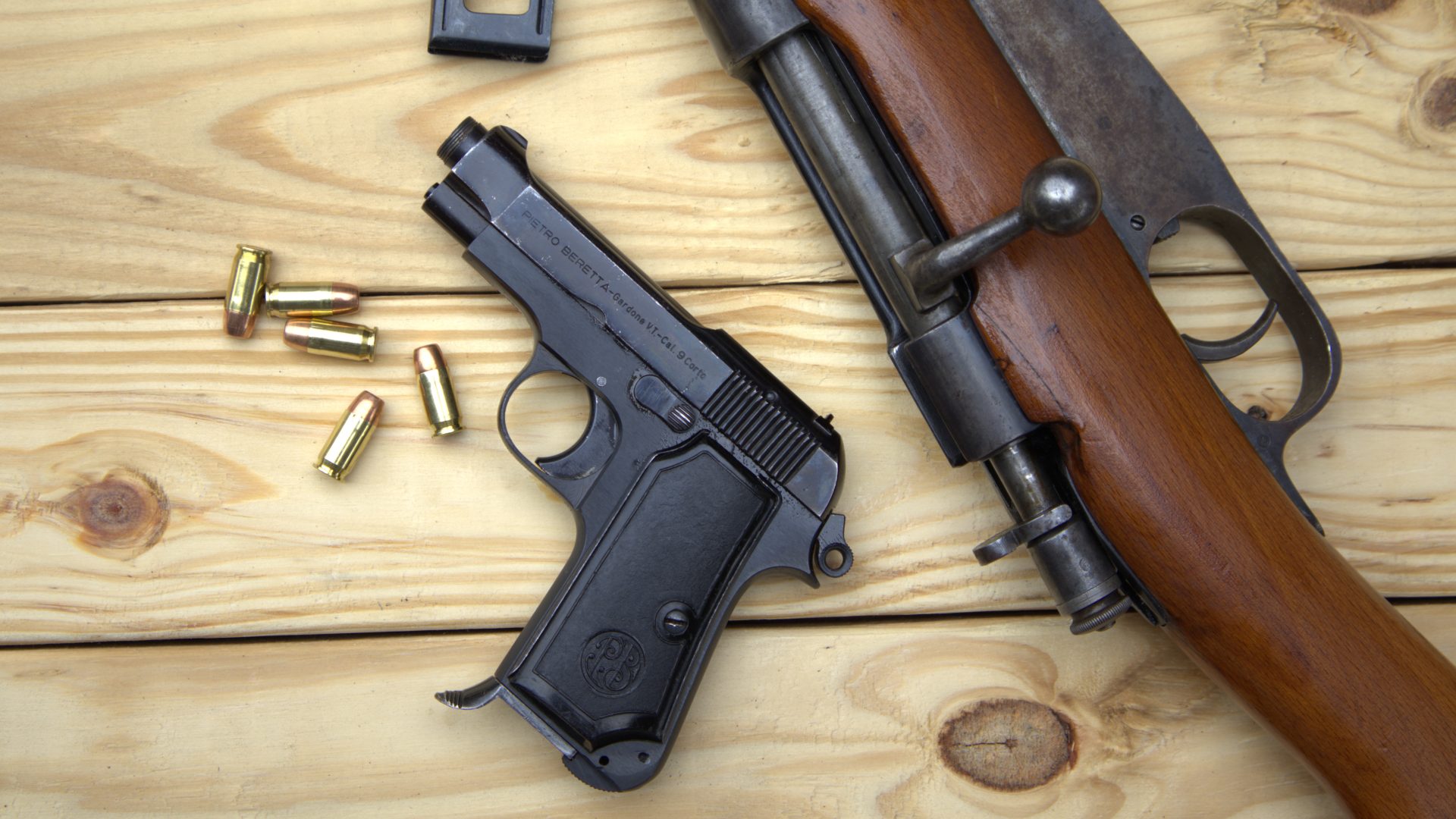
Many companies live and die by the quarter, but it’s only a select few that stand the test of time. Italian gunmaker Beretta is one of those few (and by a pretty damn good margin). At 500 years old (yup, five centuries), Beretta is the world’s oldest gunmaker. But its first firearm to achieve true international acclaim is a relatively recent one (though that’s partly because Beretta was primarily building gun barrels for its first few hundred years). We are, of course, talking about the Beretta M1934, or as it’s called in its home country, the Beretta Modello 1934. The Beretta 1934 is a humble but long-lived service pistol chambered in .380 ACP (9mm Corto) that would become the definitive Italian military sidearm of World War II.
Love or hate the little pistol’s descendant, the Beretta 92, the Pistola Automatica Beretta modello 1934 deserves some respect – and it’s still fun to shoot. Mad Duo
Beretta was founded in the Gardone Val Trompia in Italy all the way back in 1526. For most of its history, Beretta was a barrel maker. It was not until Italy joined the First World War in 1915 that Beretta waded into the realm of complete firearms and the start of what Beretta would become today.
The Kingdom of Italy relied on a hodgepodge of handguns ranging from the aging Model 1889 Bodeo revolver to the mechanically challenged Glisenti automatic pistol. Beretta kept the 9mm Glisenti cartridge and designed a no-compromise handgun around it in their Model 1915. This was followed up by the Model 1915/17, chambered in the internationally accepted .32 ACP cartridge.
These models, due to their simple design and characteristic open-top slide, were a hit with the Italian Army and Police. This track record led to improved versions through the 1920s with the Model 1934 being the final culmination of the design.
- Model: Beretta M1934 (Modello 1934)
- Manufacturer: Fabbrica d’Armi Pietro Beretta
- Designer: Tullio Marengoni
- Caliber: .380 ACP (9mm Corto / 9×17mm)
- Action: Blowback, Single-Action
- Production Era: 1934-1991 (mass production ended in 1980)
- Users: La Pubblica Sicurezza (adopted 1935), Regio Esercito (adopted 1936), Finland, Germany, Romania, et al
The Model 1934 was a combination of familiarity, simplicity, and power. It borrowed the distinctive open top slide and fixed barrel as the Model 1915/17. Also carried forward is the monolithic pinned trigger and a manual safety that doubles as a slide lock. A lanyard ring on the left side of the grip frame and a heel-style magazine release are also carried over. Notable differences include a more pronounced beavertail and a steeper grip angle. It is also one of the first handguns to come from the factory with plastic Bakelite grips instead of wood.
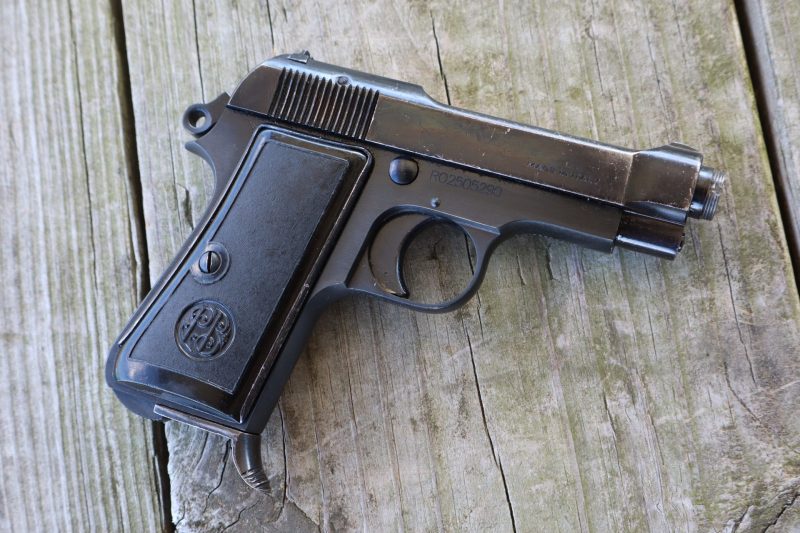
The 1934 is a straight blowback that is both reliable and inexpensive to produce over locked breech designs. The mechanism is ideally suited for compact handguns in smaller calibers. For a service pistol, the Model 1934 is on the small size and wears a short 3 ¾ inch barrel. It uses single-stack seven round magazines and chambers the .380 ACP, known in Italy as the 9mm Corto cartridge.
The decision to go with .380 was made easy as it was the largest caliber readily used in blowback pistols like the Walther PPK. Unlike the PPK, the Model 1934 is a single-action handgun with a small Commander-style hammer. The pistol had a half-cock safety and could be carried cocked with the safety engaged. But the safety requires a 180-degree turn to activate and deactivate. This ergonomic hangover from the old Model 1915/17 caused the Italian Army to ask Beretta to fit their pistol with a decocker, like a PPK. But the expense did not justify the concern, and the stock Model 1934 was adopted in 1935.
- Caliber: .380 ACP (9x17mm Browning Short)
- Capacity: Typically 7 rounds, detachable box magazine with heel release
- Action: Straight blowback, single-action
- Weight (Empty): ~24.6 ounces
- OAL: Overall length of 6 in.
- Barrel Length: 3.5 – 3.7 in. (varies by year of manufacture and import modifications)
- Height: ~ 4.5 in.
- Width: ~1.2 in. at the widest point
- Sights: Fixed front blade sight and rear notch sight
- Muzzle Velocity: ~ varies
The Beretta M1934 is a deceptively simple handgun, and that is shown by its easy field strip process. With the magazine removed, the safety is moved to the rear and pushed forward with the thumb as the slide is drawn rearward to lock back. From that position, the barrel can be tapped from the muzzle and plucked from the slide. With the barrel removed, the safety is pushed to the forward position, and both the slide and recoil spring assembly will come off the frame.
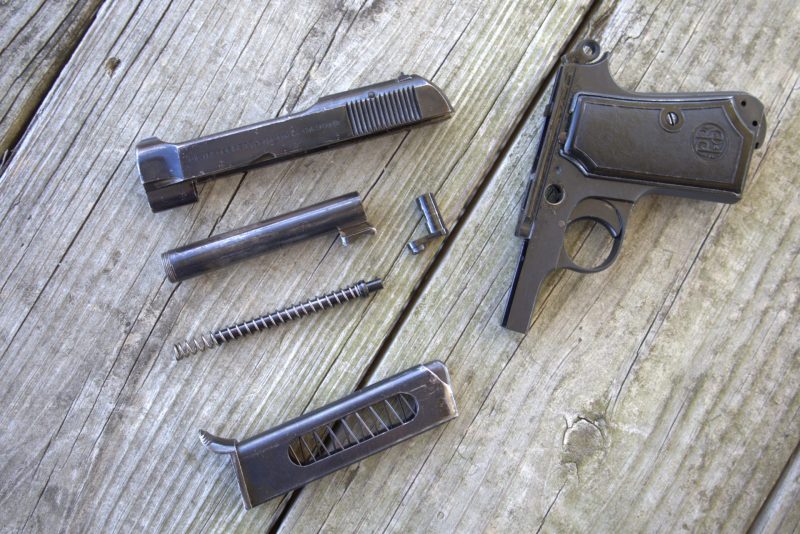
When disassembled, it becomes a little more obvious why the Italians stuck with their homegrown design. This simple design is easy to make in quantity and easy to keep in shape. A comparable Walther PPK fixed barrel is pinned to the frame and not readily removed for servicing. Likewise, the smaller recoil spring on the Beretta is better protected from damage compared to the large over-the-barrel spring of its rival.
The Beretta Model 1934 had some dated features but it was a reliable design that could be produced and maintained in quantity. Indeed, the Model 1934 made its way to other nations as war aid. In addition to serving Italy through World War II, the M1934 was exported to Finland during that country’s dash for arms during the Winter War. Allied Romania outright adopted the Beretta in 1940. When Italy left the war, German troops occupied the Beretta plant and kept the pistol in production.
Although it is best known as Italy’s standard sidearm during World War II, its post-war service life is often overlooked. Despite some attempts to replace the M1934 in both Army service and in Beretta’s catalog, the M1934 would only be discontinued in 1991 with over one million units produced. The following year, the M1934 was finally replaced in Italian Army service by the Beretta 92, which would go on to be Beretta’s most iconic handgun.
What’s in a name?
In the 90 years of its history, the M1934 and its preferred caliber has gone by a variety of designations and names. That’s maybe not too suprprising since more than a half a million of them were produced before Mussolini wound up hanging upside down (and dead) from the canopy of a gas station. They were not only manufactured for several countries, they were prized by Allied soldiers both for use in the field and as war trophies.
- “Modello 1934 calibro 9 corto” was its name when adopted by the Regio Esercito, Marina, and Aeronautica (Royal Italian Army, Navy, and Air Force, respectively).
- “9mm Scurt” was what the Romanian military called it (translates to 9mm Short).
- “9M34” is a logistical reference used by contemporary Italian units for the pistol and its cartridge.
- “M/1934” or “900 PIST 34 BERETTA” is what it was variously referred to by the FInns during WWII; these were marked “SA” for Suomen Armeja (Finnish Army).
- “Pistole 671(i)” was how the Wermacht (German Army) designated the models they acquired during the war.
- “Beretta Cougar” is what we called post-war commercial variants of the pistol brought to the USA by the former J.L. Galef Company.
- “P.B. 1966” was the name of certain post-war models (PB for Pietro Beretta)
As the M1934 has trickled out of military and police service, it has become available on the US commercial market as surplus. Recently, stashes of them have been found in Ethiopia and imported by Inter Ordnance via Switzerland. Many of these have 1/4×20-inch threaded barrels for attaching take suppressors, allowing them to be imported. These suppressors are then cut off after import. My particular Beretta M1934 is part of that shipment and came to me via Palmetto State Armory.
In terms of looks, the old M1934 looks like an M9 service pistol that was left in the dryer.
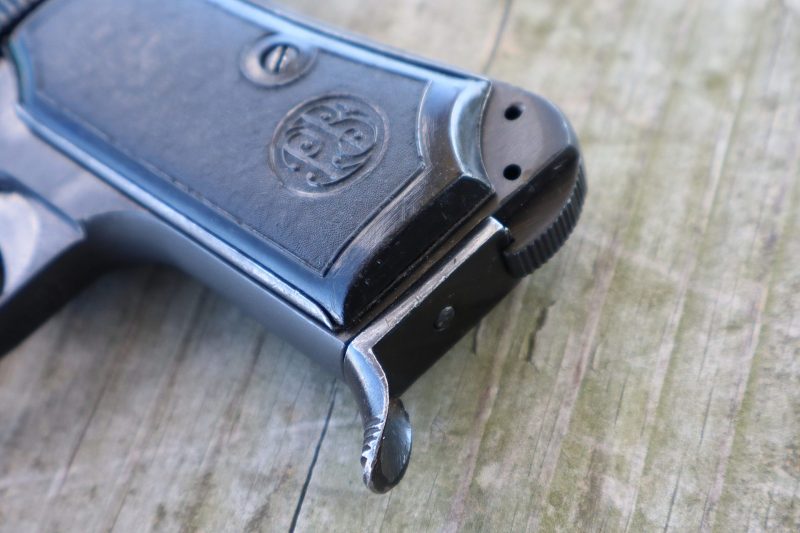
This Beretta M1934 is a functional example but is not pristine. The chamber on this model has some corrosion and the threads at the muzzle are crudely cut off. The slide is mismatched to the frame. The lanyard loop at the bottom of the grip is missing. Thankfully, parts, barrels, and even aftermarket springs are available for the old M1934 and I intend to work on that in the future. But how does it shoot?
In addition to various MilSurp retailers, gun shows, and the like, you can often find an M1934 being sold online by one of the primary sites many of us tend to visit. Heads up: it’ll probably be easier to find an M1935 than its predecessor.
- Check for availability and compare pricing on Gun.Deals
- Look at the current listings on Guns.com.
- Check out Guns International.
The Beretta M1934 pistol is a grab bag of modern Beretta and dollar-short ergonomics of previous conventions.
In terms of looks, the old M1934 looks like an M9 service pistol that was left in the dryer. The pistol is all-steel, dense, yet compact. The beavertail is abbreviated and lacks a sharp sweep for an extremely high grip, but the rounded hammer, rounded dustcover, and open-top slide are utterly familiar.
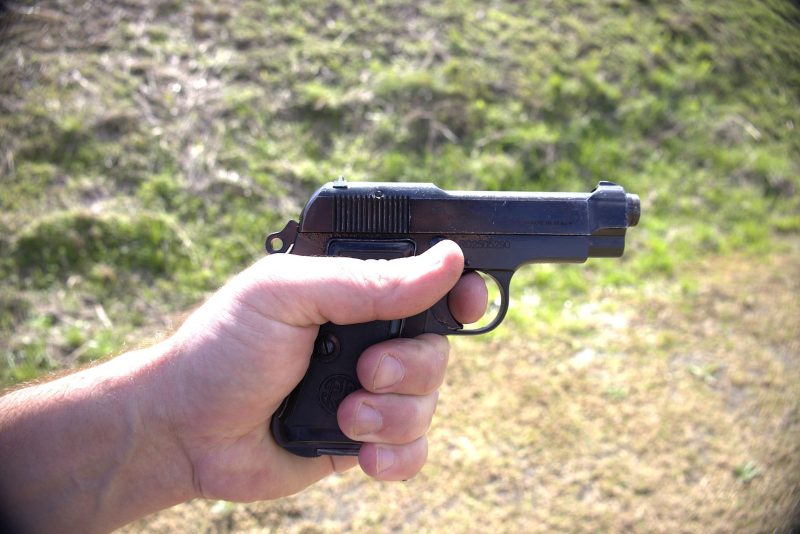
With the benefit of 2020 hindsight, we can see where Beretta went right and wrong in the overall shaping department. The same is true with the controls.
The seven-round magazine has an extended steel toeplate to anchor the pinky while shooting. It is odd to find this pocket pistol feature on a service pistol. The open magazine window from the old M1917 carries over to the M1934, but we are probably more familiar with it via the later Russian Makarov. The magazine is easy to load and is sealed well in the handgun. To load, push back the heel magazine release with the magazine body for easy insertion, then thumb the release and rip the magazine out by the toeplate.
This Euro-style release is faster than it looks and keeps the user from accidentally losing the magazine while shooting and carrying.
The Achilles’ Heel of the Beretta M1934, by modern sensibilities, is the manual thumb safety. With a round chambered, the safety is activated with a 180-degree counter-clockwise turn to the rear. Deactivating the safety requires very long thumbs or a change in grip to sweep it in the other direction toward the muzzle in order to fire.
On the firing line, the M1934 is easier to present by leaving the hammer in half-cock, cocking it, then shooting. Even faster is carrying the pistol with an empty chamber, then racking the slide before going into action. Running the M1934 at speed makes me wonder what would have happened if Italy had adopted the double-action Walther PPK instead, since that pistol could be carried fully loaded safely.
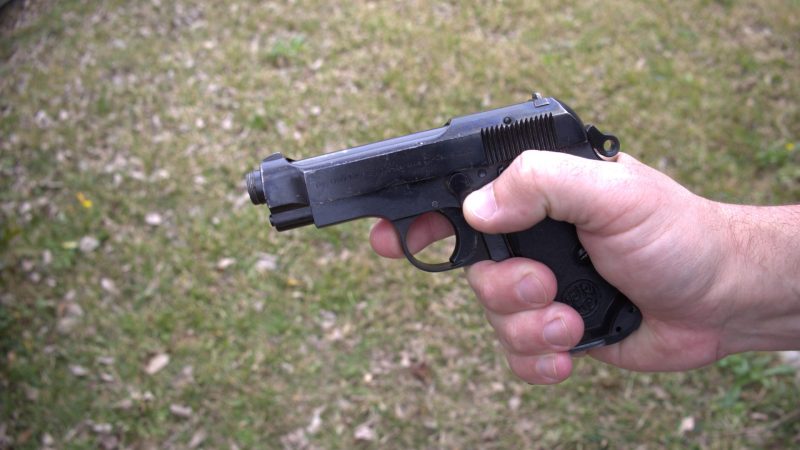
Despite the odd manual of arms, the Beretta M1934 is still a shooter. In hand, the ’34 is a compact pistol in the most pre-polymer-era sense. Its short, stocky grip is offset by the magazine toeplate that gives ample room for the pinky. The backstrap allows for a surprisingly high handhold and, in spite of its smaller size, hammer bite and slide bite are no issue.
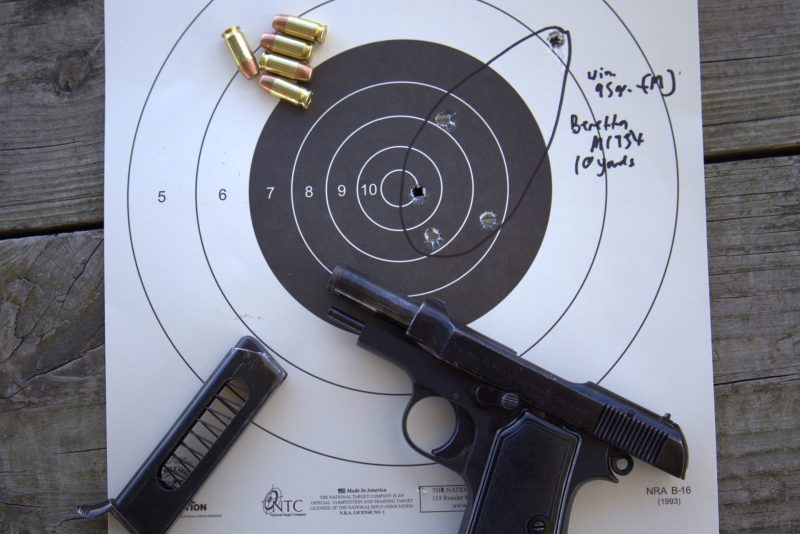
The iron sights are coarse, and the trigger is surprisingly heavy for a single-action handgun. On my Lyman trigger scale, the trigger breaks at just under 7 lbs. Yet the trigger breaks cleanly with very little take-up. That helped translate to some good shooting out to twenty-five yards. At ten yards, the sights and trigger are less of an issue, and the little ’34 is an effective point shooter.
From that distance, I could reliably put five rounds inside a four-inch cluster by simply indexing the front sight on target and pressing the trigger.
When the magazine is empty, the follower locks the slide back. But removing the magazine causes the slide to go home, requiring a rack to get back into action with a new loaded magazine. I later found that the extractor spring on this particular Beretta is on the weak side, but I had no issues with extraction or ejection as the blowback design expels the empty brass without input from the extractor. As an aside, blowback guns like the Walther PPK and Bersa Thunder are known for their more pronounced recoil, but the Beretta is a tame shooter that is easy on the hand.
The Beretta M1934 was a surprisingly forward thinking design, given what the Italians had to work with and given how pistols were treated tactically at its inception. Although the ergonomics come in a frustrating mix of shades of the future and the distant past, the M1934 persisted thanks to its simplicity and reliability. With over one million units produced, the pistol that brought Beretta to the international scene won’t be going away anytime soon.
Additional M1934 Resources
- “Italy’s Walther PPK” (Guns.com)
- This Old Gun: Beretta M1934 on American Rifleman
- Beretta M1934 page on Wikipedia
More of Jim’s Gems:
TH – Beretta M1934
“}]]

