

Editor’s Note: This article is part of a series examining how television has portrayed policing over the decades. From cultural upheaval to procedural realism, each installment will explore how TV crime dramas reflected — and shaped — their times.
Thank you for reading this post, don't forget to follow and signup for notifications!
The 1980s opened with Ronald Reagan taking office and a country eager to turn the page. Within hours of his inauguration, the American hostages held in Iran were released, giving the new decade an immediate sense of reset. Reaganomics promised prosperity and economic growth, while the Cold War that had shaped generations finally began to crumble with the fall of the Berlin Wall. The decade also brought larger-than-life pop culture, from neon and big hair to blockbuster movies and the rise of cable television. But for many Americans, the defining memory remains the Challenger explosion — a tragedy watched live by millions of people, including schoolchildren gathered around classroom televisions.
| PREVIOUS: 1960s cop shows: How TV policing evolved in a decade of upheaval
Key shows of the decade
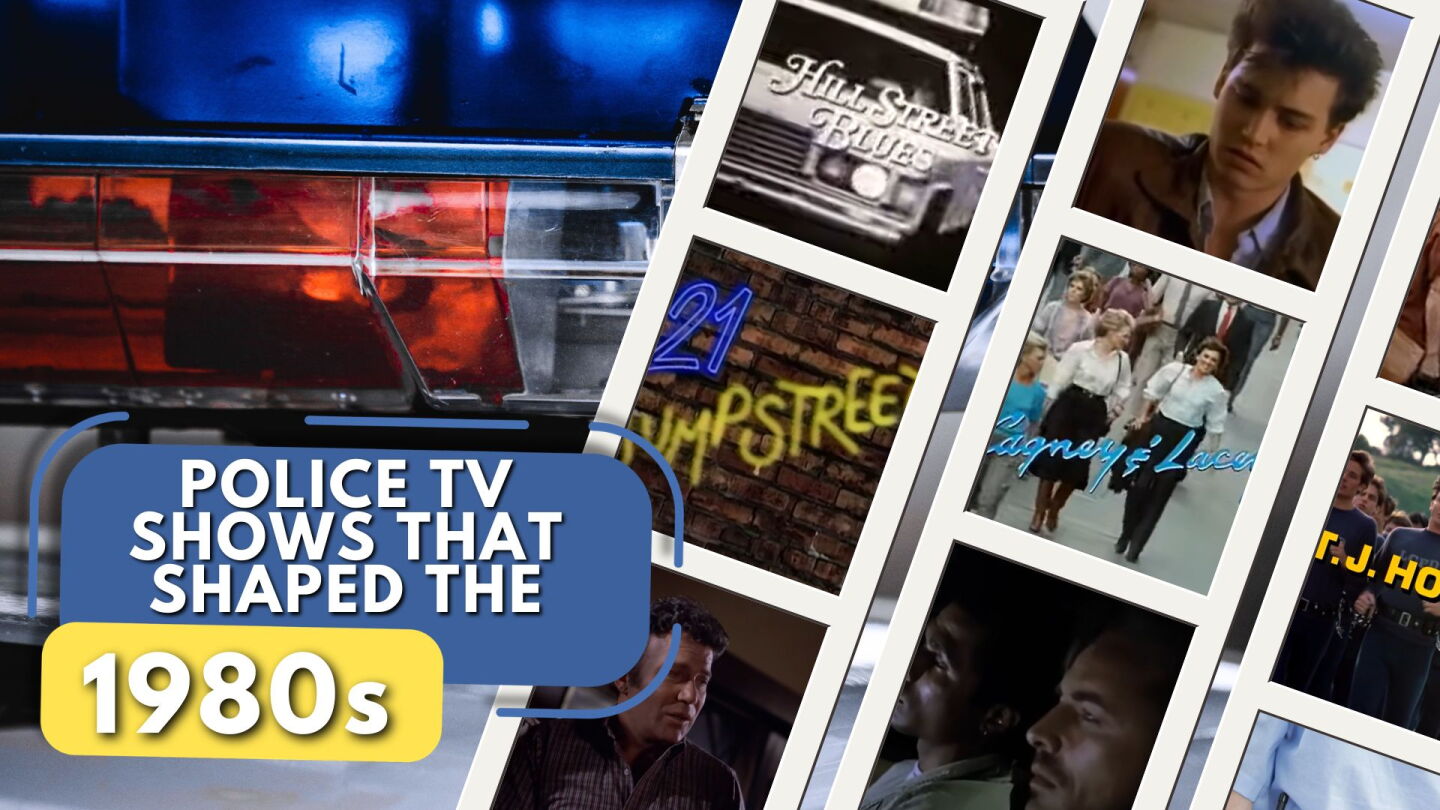
21 Jump Street — 1987-1991
- Basic premise: Youthful-looking rookie officers are recruited into a specialized undercover unit where they pose as teenagers to investigate crimes involving young people.
- What made it distinctive: The series helped launch the career of a then-unknown Johnny Depp, though much of the rest of the cast faded from public view after the show ended. Its stories focused on troubled teenagers and the young officers assigned to infiltrate their worlds. To solve cases, the officers often had to gain the trust of vulnerable kids, only to betray that trust once the investigation was complete. That built-in conflict gave the show much of its emotional weight and helped separate it from more traditional police dramas.
- How it portrayed policing: The Jump Street unit operated almost independently, with little connection to the larger police department around it. The focus remained tightly centered on undercover work and the personal relationships formed during investigations.
- What it got wrong: Many viewers came away believing most police agencies had some version of a Jump Street-style unit. While the concept was loosely inspired by an actual LAPD program, few departments were large enough to support that kind of operation. For young officers hoping for glamorous undercover assignments, the reality was usually far less exciting than television suggested.
- Why it mattered: The series combined strong performances with stories that often explored difficult subjects involving teenagers, including addiction, abuse and peer pressure. At a time when few police dramas paid much attention to the lives and struggles of young people, 21 Jump Street carved out a distinct identity and connected with a younger audience.
Cagney & Lacey — 1981-1988
- Basic premise: Two female NYPD detectives navigate the demands of the job while supporting each other through the pressures of their personal lives.
- What made it distinctive: At the time, it was uncommon for a police drama to center on a female lead, let alone two. The series stood out by showing the constant pressure women faced to prove they belonged in a profession still dominated by men.
- How it portrayed policing: The workplace sexism was blunt, but not unrealistic for the era. Women who reached roles such as detective were often treated as tokens or viewed with suspicion. One telling detail was the sheet hung to separate the women’s lockers from the men’s because there was only one locker room.
- What it got wrong: Like many TV police dramas, the detectives were involved in more shootings than would be realistic. Even so, the series offered a fairly grounded portrayal of female detectives working in an agency that had not fully accepted them.
- Why it mattered: The show inspired many women to consider careers in law enforcement. Its lead characters gave viewers strong, capable female role models at a time when television rarely showed women in those roles.
Hill Street Blues — 1981-1987
- Basic premise: The officers of Hill Street Station, part of a large police department in a struggling city, deal with crime, public disorder and the personal problems that follow them home. They are known as “the blues” because of their blue uniforms.
- What made it distinctive: This was Steven Bochco’s first major ensemble police drama, built around a large cast of regular characters with their own storylines, flaws and private struggles. The captain was a recovering alcoholic. One patrol officer had a gambling problem. A female officer, later promoted to sergeant, worked with a partner who was loyal and capable but often crossed personal boundaries. Episodes often opened with a chaotic morning briefing and ended late at night, sometimes with the precinct captain and the public defender with whom he had a complicated relationship.
- How it portrayed policing: The show felt realistic to many officers. Its characters, conflicts and workplace frustrations reflected the kinds of people and problems cops recognized from their own agencies. The officers were flawed, funny, difficult and human, which made the department feel lived-in rather than staged.
- What it got wrong: Not much. The show regularly explored the role of politics inside a police department, something real officers could easily recognize. Officers from better-funded agencies may not have seen their own departments in Hill Street’s worn-out facilities and unreliable equipment, but those from under-resourced cities likely did. Fittingly, in the series finale, Hill Street Station burns down.
- Why it mattered: Hill Street Blues is often regarded as one of the best police dramas ever made. Not everyone would rank it at the top, but few 1980s cops ignored it. The characters were memorable because they were imperfect, burdened and believable, and few police shows since have matched its depth.
Miami Vice — 1984-1989
- Basic premise: Undercover narcotics detectives Crockett and Tubbs work to disrupt Miami’s drug trade.
- What made it distinctive: With its designer clothes, exotic cars and heavy use of licensed rock and pop music, Miami Vice became “MTV Cops.” The show’s style was a major part of its identity, and its production budget far exceeded anything a real vice unit would have had.
- How it portrayed policing: The show leaned more toward fantasy than realism. Crockett and Tubbs often seemed to operate outside normal rules and procedures, and many scenes had a dreamlike, highly stylized quality.
- What it got wrong: Procedurally, quite a bit. The detectives were constantly involved in major narcotics cases, which would have quickly made them too recognizable to work undercover. Shootings often carried little consequence, and some weapons and tactics made little practical sense. One memorable error came when Crockett referred to the “Miranda Act,” though Miranda came from a U.S. Supreme Court decision, not legislation.
- Why it mattered: Miami Vice was visually and musically unlike anything else on television at the time. It captured the style and energy of the MTV era, even when its police work stretched far beyond reality. It was often wrong on procedure, but it was hard to look away.
T.J. Hooker — 1982-1986
- Basic premise: A veteran police sergeant serves as the field training officer for a young rookie officer.
- What made it distinctive: T.J. Hooker marked William Shatner’s first major television role after Star Trek. The show also leaned heavily into its young supporting cast, featuring then-unknown Heather Locklear and Adrian Zmed as much for their screen presence as their police work.
- How it portrayed policing: The series favored action and spectacle over realism. T.J. Hooker routinely found himself hanging onto speeding vehicles, chasing suspects through elaborate stunts and surviving explosions that seemed to happen every other episode. The show treated patrol work more like an action movie than everyday policing.
- What it got wrong: Quite a bit. T.J. Hooker was portrayed as a longtime sergeant who somehow ran academy training, supervised recruits and handled nearly every type of police assignment imaginable. The police academy itself operated more like a military boarding school, complete with barracks-style housing. Weapons handling was often poor, undercover operations were highly exaggerated and Locklear’s character was repeatedly placed in implausible undercover roles that usually ended with her being taken hostage. Even by 1980s television standards, the show often stretched credibility.
- Why it mattered: Despite its flaws, T.J. Hooker became a memorable part of 1980s television, driven largely by Shatner’s popularity and the show’s over-the-top action. Few police dramas embraced spectacle quite as enthusiastically, for better or worse.
Key figure of the decade
In television drama, Steven Bochco became one of the defining producers of the era through ensemble series such as Hill Street Blues, L.A. Law, NYPD Blue and Brooklyn South. His shows typically unfolded over the course of a single day, beginning in the early morning and ending late that night. Rather than focusing on one central character, Bochco built large casts in which different characters moved to the forefront depending on the week’s story. His characters were rarely perfect heroes; they were flawed, complicated people whose personal struggles often carried across multiple seasons. Just as important, viewers spent as much time watching their lives outside of work as they did following their professional responsibilities.
| PREVIOUS: 1970s cop shows: Vietnam is behind us, but what is ahead?
How these shows shaped public perception
These shows also helped shape public perceptions of policing, for better and worse. Many viewers came away with unrealistic expectations about police work, especially when it came to violence. Television detectives and patrol officers were routinely involved in shootings and major crimes at a rate far removed from reality. At the same time, some series made a genuine effort to portray officers as ordinary people dealing with stress, family problems and emotional struggles, though this occasionally created the impression that all cops were deeply troubled or emotionally damaged. The influence of these programs can still be seen in modern police dramas, particularly the ensemble format popularized by shows like Hill Street Blues, where large casts, overlapping storylines and episodes unfolding over a single day became a lasting television formula.
Closing
Hill Street Blues was a standout, but many other 1980s police shows leaned more on spectacle than realism. They were entertaining, often wildly so, but they should be watched as television drama, not as a reliable guide to police work.
NEXT: Listen to our podcast discussion on the best cop shows in TV history

