

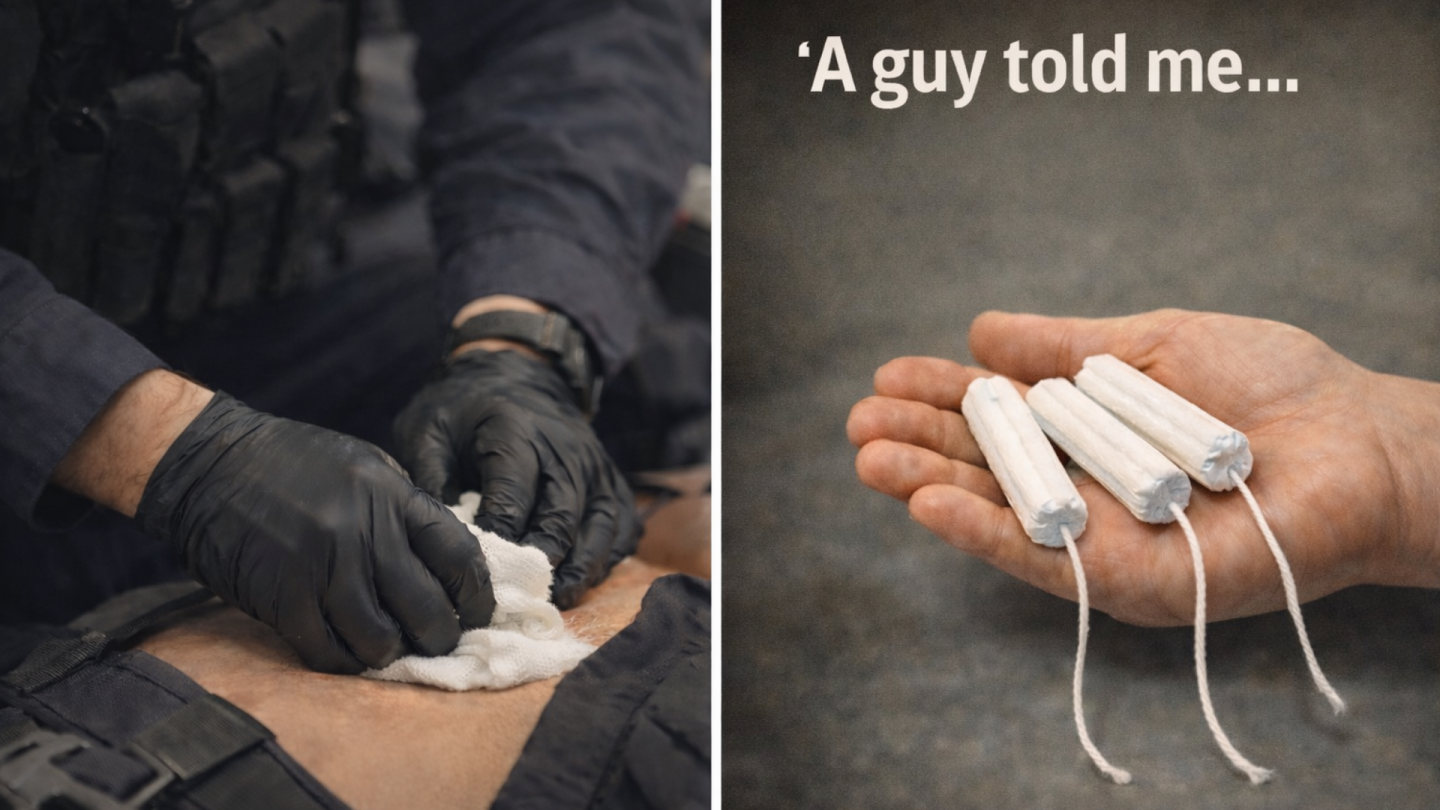
Some bad ideas just refuse to die.
Thank you for reading this post, don't forget to follow and signup for notifications!
One of them is the belief that tampons can be used to treat gunshot wounds. On the surface, it makes sense — tampons absorb blood — and when something gets repeated often enough, especially from multiple sources, it starts to feel true.
Officers are inundated with information, much of it backed by vague stories of success that no one can really verify. Even when an outcome is positive, it’s hard to tell whether it happened because of the technique or in spite of it.
That’s how this idea has stuck around and still shows up in training conversations in 2026. I can’t believe we’re still having this discussion, but here we are.
When the myth shows up again
I recently participated in a discussion about what items a person should carry in a medical kit. An individual suggested carrying tampons to use for packing a gunshot wound.
This idea has been around long before me, and it’s one I have worked hard to dispel over the years, yet it continues to return. Very quickly, the group became divided between those insisting this was not a recommended practice and those convinced that using feminine products was a sound idea.
I have had these conversations before, and usually once I explain how bleeding control actually works, people quickly see that shoving a tampon into a wound may not be the best medical idea. In this case, one of the people advocating for the use of tampons as an effective method of bleeding control was, in fact, a medical doctor.
When credentials cloud judgment
Certainly, a doctor is giving sound medical advice backed by science and experience, right?
His long and detailed explanation was filled with complicated medical jargon and sounded extremely articulate. For many, this was validation of their belief that tampons were an effective tool to control bleeding. When a person speaks with a title or with confidence, we have a natural tendency to assign greater credibility to what they are saying, even when faced with evidence to the contrary. This is known as the illusion of knowledge.
Despite my counter that the sole function of a tampon is to absorb blood — which does nothing to manage the source of bleeding — what we need is to apply pressure onto the vessel. That’s why wound packing with gauze and hemostatic agents works. His stance didn’t change. In fact, when challenged, he dug in even deeper.
The problem with “a guy” stories
When faced with solid facts that counter a held opinion, people will often fall back on anecdotal evidence, and this was no exception. He knew “a guy” who had successfully used a tampon to treat a gunshot wound.
I love “a guy” stories. When pressed for specific details, no one actually knows “a guy.” I have certainly never met him, but I really want to because “a guy” has done a lot of really impressive things.
Typically, I dismiss “a guy” stories immediately as fiction, rumor, or so watered down that the details are meaningless. Even if the story were true, it is impossible to determine whether the outcome had anything to do with the subject’s actions. It may have been a non-critical injury where survival had nothing to do with the treatment.
Plenty of patients survive medical malpractice. They survive despite the care, not because of it.
As instructors, we must be careful how much weight we assign to stories and ensure they are supported by evidence.
What the evidence actually shows
Since I was obviously not making much headway against a medical doctor’s opinion, I took a day and researched my next arguments. Searching medical literature and journals, I was unable to find even a single instance of a tampon being used to stop bleeding from trauma.
All the medical literature supported my position that tampons do not provide the pressure needed to control bleeding. In fact, multiple medical sources indicate that tampons may cause more harm because they are designed to absorb blood, which can interfere with the body’s ability to clot.
The American College of Surgeons specifically addressed this argument, stating that even if you run out of medical supplies, using a piece of clothing to pack the wound would be more effective than a tampon. Despite being presented with guidance from a leading medical authority that shoving a sock into a bullet wound is a better idea, the doctor’s stance remained unchanged.
The illusion of knowledge often extends to us as well. We may believe that once we are bestowed a title such as “instructor,” that means our information is correct. Whether it is ourselves or others we look to for training, a title or degree does not necessarily indicate a level of proficiency on a particular topic.
What instructors need to take from this
There are two takeaways here.
First, stop teaching or repeating the tampon myth. It is not an effective method for treating gunshot wounds. Officers should be carrying and training with proven tools — tourniquets, wound-packing gauze, hemostatic agents and pressure dressings — and understanding how to use them correctly.
Second, this is a reminder of how easily bad information spreads, even among experienced professionals. As instructors, we have a responsibility to ensure what we teach is grounded in current, evidence-based practice.
Stories are not enough. Titles are not enough. Confidence is not enough.
Information needs to be vetted, current and relevant to the operational environment. And when we encounter resistance — especially from someone with perceived authority — we need to recognize that not every argument can be won.
Sometimes the best use of time is focusing on the people willing to learn, not spending hours trying to convince someone who isn’t. Otherwise, you may find yourself doing what I did — digging through medical journals just to argue with a stranger on the internet.
How do you challenge misinformation in your agency when it comes from a perceived authority? Share below.
| WATCH: Tactical emergency care for law enforcement: Wound packing

