


[[“value”:”
Thank you for reading this post, don't forget to follow and signup for notifications!

Kat Ainsworth Stevens
Between $0 tax stamps and the Texas Suppressor Freedom Act, there’s a lot for gun owners to be happy about in the Lone Star State. Texas has long been proactive in enhancing firearms rights at the state level, and the Act is a significant part of that effort. Here’s everything you need to know about Texas suppressor laws.
Disclaimer: This is for informational purposes only and not legal advice.

What Is the Texas Suppressor Freedom Act?
In May 2021, Texas passed House Bill 957, known as the Texas Suppressor Freedom Act, which took effect on September 1, 2021. This law allows suppressors made in Texas to be legally possessed and owned without a federal tax stamp, provided they remain within the state’s borders.
Since the Act passed, legal challenges and lawsuits have taken place regarding its validity. In both 2023 and 2024, federal courts affirmed that federal law supersedes state law on suppressor regulation. As a result, the Act remains in place in Texas, meaning state and local funds are prohibited from being used to enforce federal suppressor laws on suppressors made within the state.
Everything’s bigger in Texas, including firearms freedoms. However, the legal battle over suppressors continues in 2026, and federal laws remain in place.
What Suppressors Are Covered?
The Act was written to permit only suppressors made in Texas to be owned and possessed without the owner obtaining a federal tax stamp. According to the applicable government code — which you can view here — a suppressor must be made in Texas “from basic materials” and cannot include any parts imported from another state, except for “generic or insignificant” parts. Specifics regarding which parts might be considered generic enough for importation aren’t included.
These Texas-made suppressors must also be stamped with “Made in Texas.”
What this doesn’t do is grandfather in all the suppressors Texans already owned. Suppressors that don’t meet the specific verbiage of the Texas Suppressor Freedom Act aren’t included. Only compliant Texas-made suppressors obtained on or after the Act went into effect in 2021 are covered (and remember, there’s still federal law to consider).
Can These Suppressors Be Used With Any Gun?
Yes, the Act specifies that Texas-made suppressors can be used with any firearm, regardless of whether the firearm was imported from another state, as long as the suppressor meets the manufacturing guidelines. The suppressor itself can’t leave the state; compliant suppressors are only protected by the law within the state’s borders.
Federal Law on Suppressors
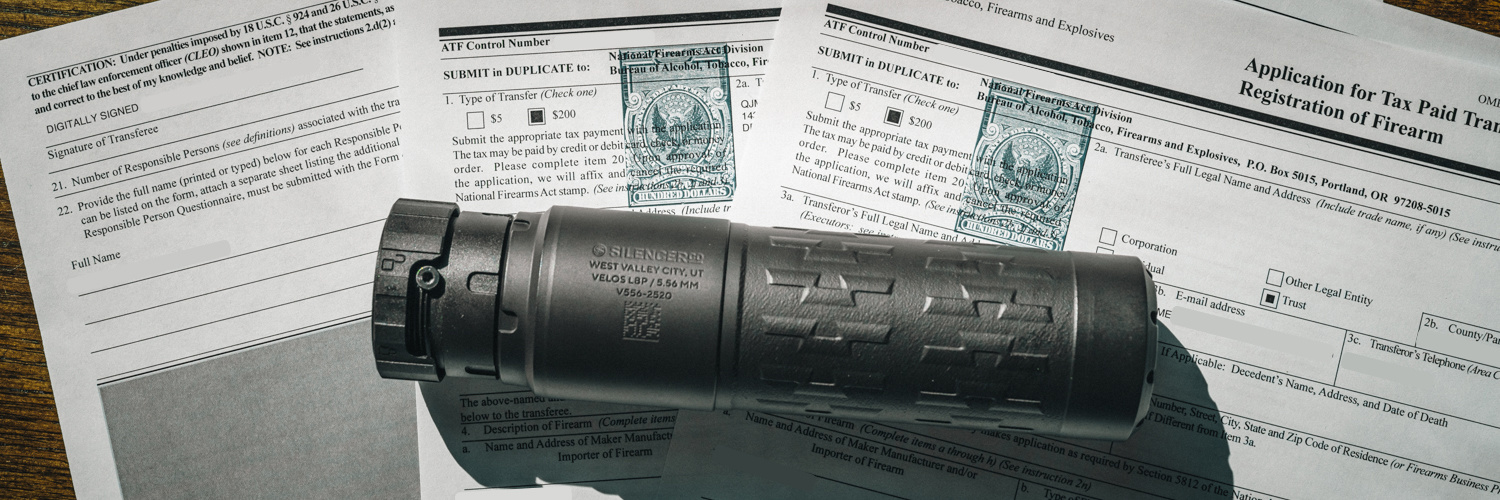
The National Firearms Act (NFA) of 1934 restricts the ownership and possession of suppressors and other items unless the owner goes through extensive background checks and paperwork. If those checks are passed and the tax stamp is approved, the fee is $0. That is thanks to the Big Beautiful Bill passing on July 4, 2025. The tax stamp-related language in the bill removed the decades-long $200 tax stamp fee and changed it to a $0 fee as of January 1, 2026.
This federal law continues to apply today, making it illegal to own a suppressor without completing the required federal process.
The NFA, 26 U.S.C. Chapter 53, can be viewed in its entirety here. It’s important to be familiar with these laws because claiming ignorance of the law is not a valid legal defense. It’s quite literally your responsibility to know and follow the law.
What Does Texas Say About the NFA?
The Texas Suppressor Freedom Act states that suppressors made and kept within Texas are not subject to federal laws or regulations.
Specifically, it says in part, “a firearm suppressor that is manuactured in this state and remains in this state is not subject to federal law or federal regulation, including registration, under the authority of the United States Congress to regulate interstate commerce.”
There’s also a clause protecting basic materials to be used for suppressors from federal regulation. The question is, can Texas do that?
Can Texas State Law Override Federal Law?

Legally, federal law always supersedes state law, but there’s more to it than that. The key concept here is the Supremacy Clause, found in Article VI, Paragraph 2 of the United States Constitution. It declares that federal laws and the Constitution are “the supreme Law of the Land,” and binds judges in every state to this principle.
The Supremacy Clause was created to address issues that arose under the Articles of Confederation, adopted in 1777. These Articles established the United States government but lacked clarity on the binding nature of federal laws on states. This ambiguity led to conflicts between federal and state governments until the Constitution was ratified in 1788. The Supremacy Clause resolved these conflicts by ensuring federal laws took precedence over state laws.
Despite the clarity provided by the Supremacy Clause, conflicts between federal and state laws persist, as seen with the Texas Suppressor Freedom Act. This is where the concept of nullification comes into play.
Nullification Theory
Nullification is the idea that states can invalidate federal laws. While this theory has never been upheld in court, it remains a contentious point. The Kentucky and Virginia Resolutions, penned by Thomas Jefferson and James Madison, argued that states could judge the constitutionality of federal actions.
Jefferson wrote that the Constitution was considered a “compact” with the states and that each state — Kentucky, in this case — had “an equal right to judge for itself” if the compact was violated in some way. He wrote “…where powers are assumed which have not been delegated, a nullification of the act is the rightful remedy.”
So, does nullification theory mean Texas’ attempt to legalize suppressors made within the state’s border could work? Yes, but also no. The powers of the state versus the federal government remain an issue.
What Happened to the Texas Suppressor Freedom Act?
After the Texas Suppressor Freedom Act was enacted, a legal battle quickly ensued. The Texas Office of the Attorney General filed a lawsuit challenging federal suppressor regulations. However, in 2023, federal judge Mark Pittman dismissed the lawsuit due to “lack of standing,” indicating that the suit had no grounds to be filed.
Texas appealed the decision, but in June 2024, the U.S. Court of Appeals for the 5th Circuit upheld the dismissal. The court reaffirmed that federal laws, including the National Firearms Act (NFA), apply in Texas as they do in the other 49 states.
In the 14-page opinion issued by the 5th Circuit, Chief Judge Edith Brown wrote, “The declarations do not state any intention to engage in conduct proscribed by the law. The plaintiffs must show an invasion of a legally protected interest that is concrete, particularized, and actual or imminent, not conjectural or hypothetical.” This means Texas and the plaintiffs failed to prove an actual injury that justified suing the federal government.

Is Texas Going Back to Court Over Suppressors?
Texas continues the fight for suppressor freedom. It’s an ongoing legal battle, one that requires persistence and patience. There hasn’t yet been a test case, meaning no legal precedent has been set one way or another regarding the Act.
In the meantime, the Texas Suppressor Freedom Act is law in the Lone Star State. It’s simply important to remember that as of now, the federal government continues to have the final legal word on suppressors nationwide, and that means the NFA is in place.
Kat Ainsworth Stevens
The post Texas and Suppressor Laws appeared first on SilencerCo.
“]]

