


[[{“value”:”
Thank you for reading this post, don't forget to follow and signup for notifications!
Are you into collecting firearms?
There’s something precious in owning a piece of history in your hands.
For those who love to reminisce about the good old times, collecting historical weapons may feel like second nature.
But collectible firearms are more than nostalgic objects or display pieces.
Each one represents a specific moment in time, shaped by the technology, craftsmanship, and cultural context of its era.
When approached with the right knowledge, collecting becomes an educational journey, one rooted in responsibility, safety, and respect for history.
One you need to be ready for.
So, what exactly makes a firearm collectible?
How old it is certainly makes an impact, but just because something is ancient, it doesn’t mean it’s indeed a classic.
A collectible firearm is a mix of history, rarity, craftsmanship, and, more often than not, the story behind it also plays a huge role.
It’s the unique combination of these factors that turns an ordinary gun into a sought-after treasure for collectors.
Well, this one is kind of obvious.
Firearms that played a key role in significant events, like military battles, revolutions, or landmark moments in history, hold tremendous value. Weapons used, for example, during the Civil War or WWI could have shaped our current reality.
Owning one means owning a tangible connection to the past.
So are all the arms that have been used in the past worthy?
Not really
A firearm is often considered collectible if it’s rare, whether because it was part of a limited production run, was only produced for a short period, or has unique features.
Imagine stumbling upon a firearm that was only made in small numbers, or perhaps one that has never been fired. Those are the kinds of pieces that regular people only dream about.
The scarcer the item, the higher its value.
And speaking about scarcity…
Some firearms leave their mark in history because of the workmanship that went into creating them.
Vintage designs, intricate engravings, and high-quality materials make certain guns stand out from the rest.
Over the years, as firearm manufacturing techniques evolved, some older models simply can’t be replicated anymore, which makes them all the more precious.
Stories are part of what makes us human.
The story behind a firearm, such as the previous owner or where it has been, can turn an otherwise ordinary gun into a coveted item.
A firearm with a documented history or a connection to a famous individual or event holds more value, even beyond its physical condition.
Once you start understanding what makes a firearm collectible, the next natural step is recognizing the different types collectors are drawn to.
While the reasons for collecting may vary, most collectible firearms tend to fall into a few well-defined categories, each with its own appeal and responsibilities.
When someone mentions a collectible firearm, what’s the first thing that comes to mind?
Something historical?
Yeah, that’s probably one of the most common categories.
Typically manufactured before the turn of the 20th century, these pieces reflect the earliest days of firearm design and engineering.
Their value lies in their age, craftsmanship, and great historical context.
Not surprisingly, extra care is required when handling them.
Materials may be fragile, mechanisms worn, and many were designed for ammunition that is no longer produced or safe to use today.
Military-issued firearms give us glimpses of stories about patriotism and conflict.
From early bolt-action rifles to sidearms carried by soldiers, these pieces are often tied to specific wars or military units.
Collectors value originality here; matching serial numbers, unaltered parts, and documented service history can make a significant difference.
Preservation, rather than modification, is key when it comes to military collectibles.
You might believe otherwise, but not all collectible firearms come from the battlefield.
Many civilian firearms, especially early hunting rifles, revolvers, and shotguns, are prized for their design and craftsmanship.
These firearms often reflect a time when function and aesthetics went hand in hand. They also offer insight into how firearms were used in everyday life, from hunting to sport shooting.
Some firearms are collectible because they were never meant for mass use.
Limited-edition and commemorative models are produced in small batches to honor specific events, anniversaries, or figures.
While visually striking, their collectible value often depends on originality, condition, and whether they remain unmodified. Even with modern commemoratives, responsible storage and safe handling remain essential.
Owning a collectible firearm comes with a sense of pride, but also with responsibility.
No matter how old or historically significant a firearm may be, safety should always come first. These pieces weren’t built to modern standards, and time can change how they function.
For clarity, here are the fundamentals every collector should keep in mind:
- Always treat the firearm as if it were loaded
Age doesn’t make a firearm harmless. Even long-displayed or inherited pieces should be handled with the same caution as a modern firearm. - Be mindful of aging materials and mechanisms.
Springs, firing pins, and internal components can weaken or fail over time, sometimes without visible warning. - Avoid using modern ammunition unless verified safe.
Many collectible firearms were designed for cartridges that are no longer produced or that differ from modern equivalents. Using the wrong ammunition can cause serious damage. - Inspect before handling or displaying.
A basic safety check, preferably done by someone knowledgeable, can help identify potential risks before regular handling. - Do not fire a collectible firearm without professional guidance.
Some firearms are best preserved as historical artifacts. If firing is ever considered, a qualified gunsmith should inspect it first. - Handle with intention and respect.
Collectible firearms deserve careful, deliberate handling, whether they’re being examined, cleaned, or moved for display.
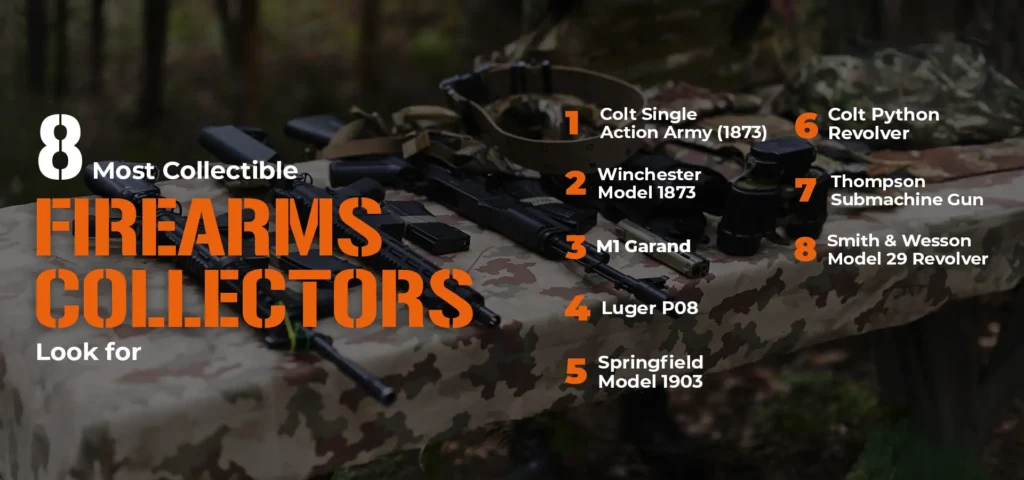
A symbol of the American West, this revolver is deeply tied to frontier history and early U.S. military use.
- Introduced in 1873 for the U.S. Army.
- Known for its durability and simple, reliable design.
- Highly valued in original, unmodified condition.
- Collector interest increases with documented military or early civilian use.
Often called “the gun that won the West,” this rifle reflects a pivotal era of American expansion.
- Popular lever-action rifle of the late 19th century.
- Widely used by settlers, ranchers, and law enforcement.
- Original finishes and matching components add significant value.
- Alterations or refinishing can reduce collectibility.
A cornerstone of 20th-century military history, the M1 Garand played a major role in World War II.
- Standard-issue U.S. infantry rifle during WWII.
- Known for its semi-automatic action and reliability.
- Collectors look for correct period parts and markings.
- Service documentation enhances historical and collectible value.
Distinctive and instantly recognizable, the Luger P08 is closely associated with early European military history.
- Features a unique toggle-lock mechanism.
- Issued in various forms during the early 1900s.
- Markings, dates, and manufacturer details matter greatly.
- Original condition is especially important for collectors.
This rifle represents the evolution of military firearms into the modern era.
- The bolt-action rifle was adopted by the U.S. military in the early 1900s.
- Renowned for accuracy and solid construction.
- Collectible examples retain original military configuration.
- Sporterized versions typically hold less value.
This model is probably one of the finest production revolvers ever made. The Colt Python is a gorgeous display of performance and exceptional craftsmanship.
- Introduced in the mid-20th century as a premium revolver.
- Known for its smooth trigger pull and high-polish finish.
- Early production models are especially sought after.
- Original condition and factory parts are critical to value.
Few firearms are as instantly recognizable or historically significant as the Thompson Submachine Gun. It represents a unique chapter in firearm history and gangster culture.
- Developed in the early 1900s and widely known for its use during the Prohibition era.
- Later adopted by the U.S. and Allied forces during World War II.
- Known for its distinctive profile and high rate of fire.
- Highly regulated today, with strict legal requirements for ownership.
The Smith & Wesson Model 29 holds a special place in American history. Its reputation was cemented in the mid-20th century, both on and off the screen.
- Introduced as one of the first revolvers chambered in .44 Magnum.
- Known for its strong frame and double-action performance.
- Famously associated with Clint Eastwood’s “Dirty Harry” films, which brought the Model 29 into popular culture.
- Early production models and original finishes are especially sought after.
Are collectible firearms safe to shoot?
Not always. Many collectible firearms were designed for older ammunition or have internal components that have weakened over time. Firing any collectible firearm should only be considered after inspection by a qualified gunsmith.
In many cases, these firearms are best preserved rather than used.
Do antique firearms require background checks?
This depends on local, state, and federal laws. In many jurisdictions, firearms manufactured before a certain year are classified differently from modern firearms.
However, regulations can vary, and collectors should always verify current legal requirements before buying, selling, or transferring any firearm.
What makes a firearm lose its collectible value?
Common factors include refinishing, replacing original parts, altering the firearm’s configuration, or lacking proper documentation.
How can I tell if a firearm is truly collectible?
Collectibility is usually determined by a combination of age, rarity, condition, originality, and historical significance.
Research, factory records, and professional appraisals can help confirm whether a firearm holds collectible value.
Should collectible firearms be stored differently from modern firearms?
Yes. Collectible firearms often require controlled humidity, careful handling, and secure storage that prevents corrosion or unauthorized access.
Proper storage protects both the firearm’s condition and the safety of those around it.
“}]]

