


One of the facts you have to accept when it comes to shooting shotguns is that the pellets spread. That’s both an enormous strength and a significant weakness. Shotgunners typically want to control their patterns and account for their pellets. Knowing how your shotgun patterns is critical to using your shotgun, but what affects those patterns?
Thank you for reading this post, don't forget to follow and signup for notifications!
- Choke
- Wad
- Barrel Harmonics
- Shot Plating
- Buffer
- Pellet Count
- Velocity
- Staying Tight
Today’s focus will be on buckshot. Birdshot has a lot in common with buckshot when it comes to pellet spread, but some individual factors can vary depending on your goal. We are going to discuss all the aspects I know that affect the spread of buckshot. Some are common sense, some have been taught to me, and others I’ve noticed along the way.
The main decider of your shotgun’s pellet spread will be your gun’s choke. A choke is either a removable or fixed device that implements a tapered constriction at the end of your shotgun’s muzzle. Most tactical shotguns are cylinder bore guns and have no choke restriction. The tighter the choke, the tighter the pattern.
Advertisement — Continue Reading Below
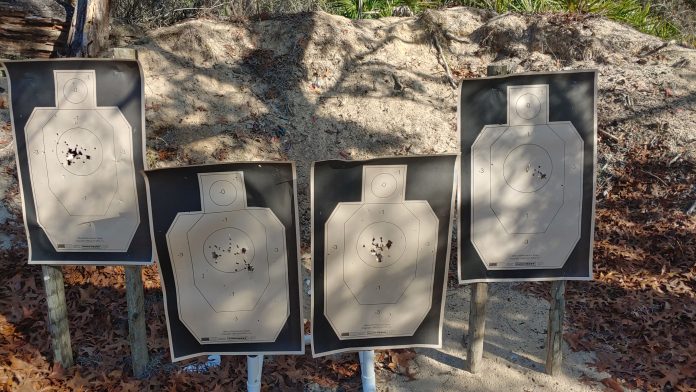
Some chokes are only made for birdshot and can cause issues with buckshot. When using specialized ammo, such as Flitecontrol, a choke can interact negatively with the specialized wad, resulting in a greater degree of spread than expected.
A shotgun wad sits inside the shotgun shell and separates the gun powder from the shot. When the gun powder is ignited, the wad is propelled and pushes the shot forward, working essentially as a piston. Wads help prevent deformation, and that can affect pellet spread.
Advertisement — Continue Reading Below
Modern wads feature a shot cup that serves as a wad and prevents the pellets from engaging the barrel. Modern wads, like the Flitecontrol wad and Versatite wad, can drastically improve how your pellets pattern and create the tightest patterns possible.
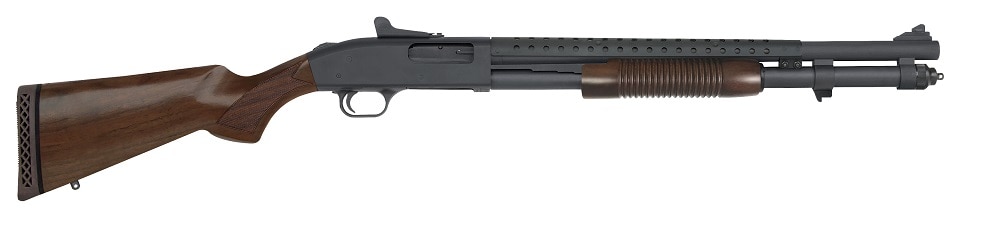
Steve Fisher of Sentinel Concepts was where I first heard a discussion about shot pattern and barrel harmonics. Mr. Fisher theorized that the heavy-walled barrel of the 590A1, mixed with the multiple mounting points consisting of the normal barrel band and then the additional band created by the bayonet loop, helps create a tighter patterning gun.
Advertisement — Continue Reading Below
I experimented with this myself and found an almost 50% improvement in pattern between a 590A1 and a Mossberg 500. Additionally, the barrel on my Compact Cruiser has a ridiculous taper to it, and that taper creates some really big patterns, bigger than average.
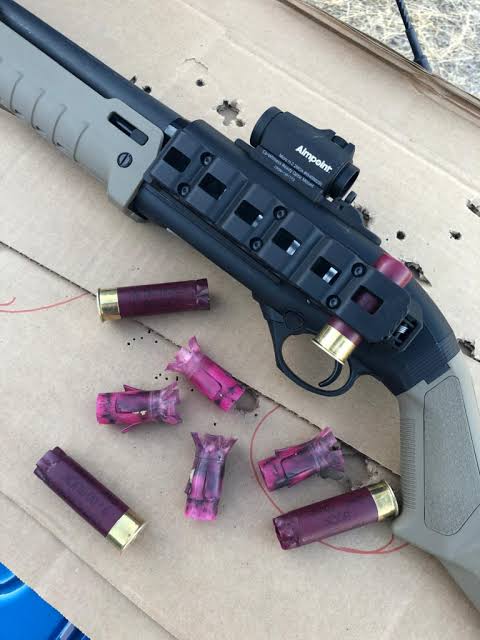
Plated shot, typically copper-plated, prevents deformation. Bare lead pellets often crash into one another and deform. Deformed pellets can create a looser pattern. They go from round to various shapes, causing them to fly erratically.
Advertisement — Continue Reading Below
Plated shot also moves through chokes with improved lubricity, helping create a tighter, more uniform pattern.
Buffer material is typically fine, granulated plastic, which we call grex. This material fills the space between the pellets and cushions the pellets while firing. The ultimate goal is to help prevent pellet deformation from pellets slamming into each other.
Pellet count can affect how your buckshot performs. For example, with 00 buckshot, the famed ninth-flyer pellet phenomenon is widespread. You’ll fire a load of 00 buckshot, and eight pellets will pattern perfectly, but one random pellet will fly somewhat randomly away from the pattern.
Advertisement — Continue Reading Below
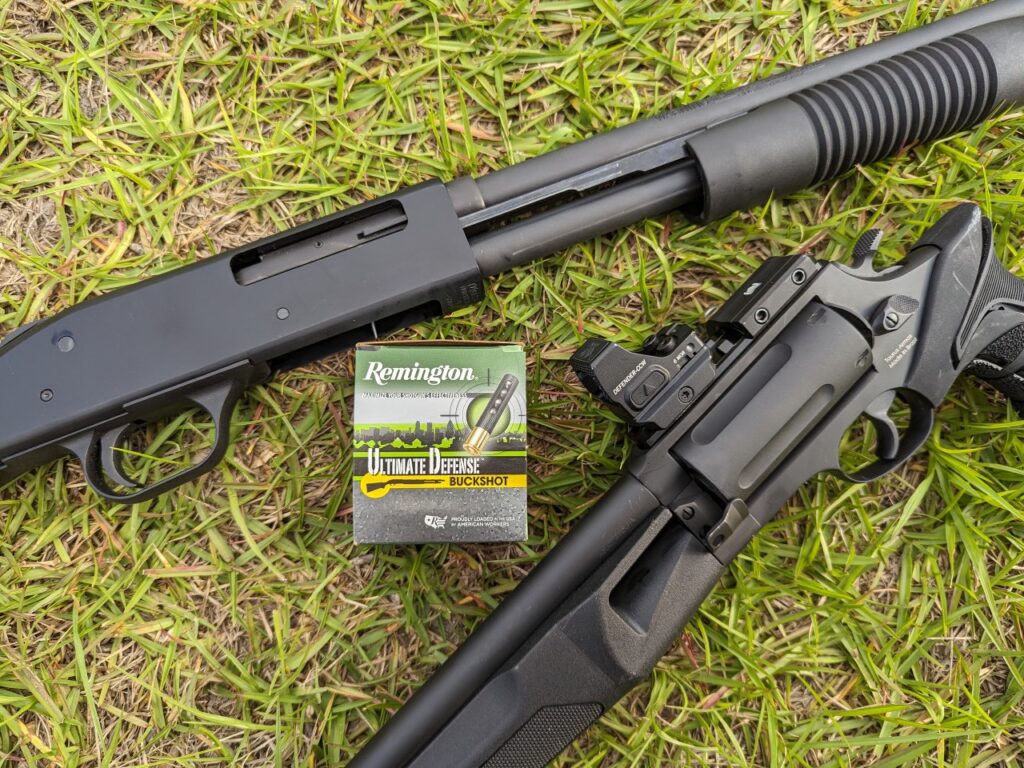
How the pellets are stacked within the shell can affect your pattern, and uniform stacking seems to be the most desirable way to ensure a tight spread. Uneven stacking creates destabilized patterns. You’ll often see less stable patterns from smaller shot due to the desire to stack as many pellets as possible in a shell.
Velocity plays a role in how your shot spreads. Higher velocities tend to create wider patterns. The increased velocity can create a crushing and deforming effect when the round is fired, and pellet deformation creates uneven patterns. The faster the shot is squeezed through a choke and a forcing cone, the greater the deformation can be.
Advertisement — Continue Reading Below

As the wad moves at high velocities, it departs with more force and causes separation from the shot column in a chaotic manner. This can disrupt shot even more.
For most defensive applications, a tighter pattern is desired. This allows more pellets to hit the threat, increasing the chance of stopping it. It also increases pellet accountability and helps prevent errant pellets from hurting others. In some scenarios, such as jungle warfare, a shotgun’s wider pattern can help score hits on targets.
Advertisement — Continue Reading Below
You have to match your buckshot to the role, then pattern it repeatedly to ensure it can accomplish that task. If you want a tight pattern, pay attention to the above factors when choosing a gun and shell.

