

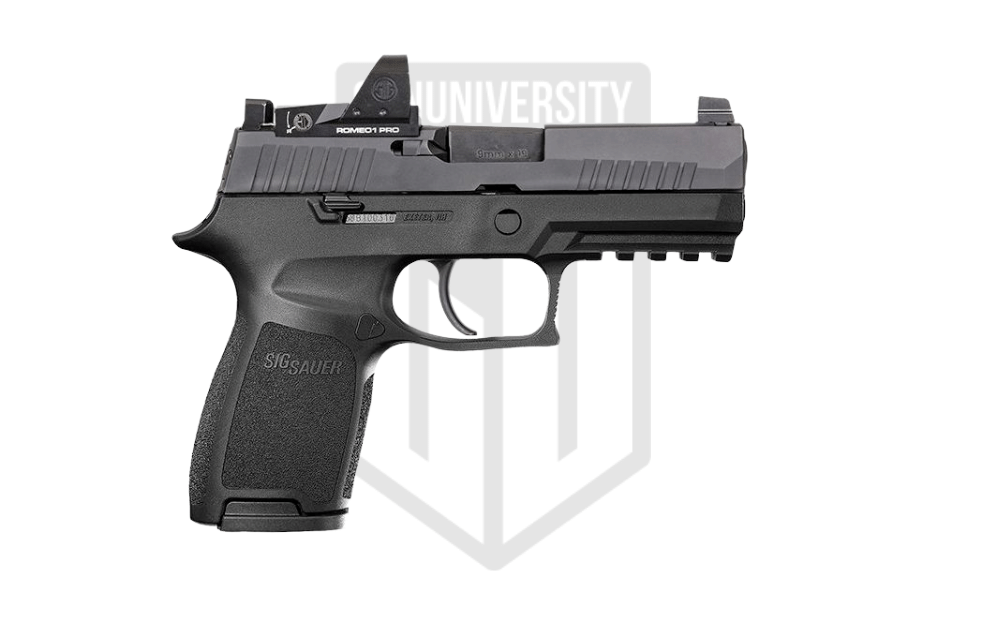
Although I used to recommend the Sig P320, and it was my primary range/training sidearm for a few years, I don’t recommend nor use it anymore because I no longer trust it to be a safe nor reliable firearm.
Thank you for reading this post, don't forget to follow and signup for notifications!
The P320 has been well-documented to have serious issues – we will explore those here.
There are three main issues I have with the P320 are: the drop-safe issue, the uncommanded discharge issue, and, after researching details on the first two issues, I have since discovered reliability issues identified by the Army in their testing.
I will walk through each below.
Sig p320 9mm Specs
- Overall Length 8 inches
- Barrel Length 4.7 inches
- Width 1.25 inches
- Weight 28.3 ounces
- Capacity 17 rounds
- Caliber 9mm
Sig P320 History
The Sig p320 has had more than its share of news and controversy.
I’m going to do my best to walk through the ups and downs for the pistol and the company, however, first it is probably best to start with a summary timeline of events to be able to follow everything.
Sig p320 Timeline
January 2014 – SIG Sauer announced the p320 pistol at the 2014 SHOT show, the firearm industry’s annual trade show. The p320 was a striker-fired adaptation of Sig’s p250, a double-action-only hammer-fired pistol.
September 2015 – The United States Army, joined by the Air Force and Marine Corps, requested proposals for The XM17 Modular Handgun System (MHS) competition as a search for a new military sidearm/service-pistol.
February 2016 – Deadline for submissions to the MHS competition – testing and evaluation of submitted pistols begins.
August 2016 – The Army “down-selected” two handguns as finalists in the competition, Glock’s and Sig’s submissions (variants of the Glock Model 19 and Sig model p320, respectively). This started phase two of the competition where, among other things, the pistols were supposed to undergo destructive testing up to 35,000 rounds.
According to a FY17 summary of Army Programs for the Office of the Secretary of Defense (OSD), the Army discovered some issues with the Sig pistols – the XM17 (full-size variant of the p320) and the XM18 (compact-size variant of the p320). The document identified a drop-safety issue, which Sig fixed during testing, and reliability issues related to “double-ejections” and not meeting the requirements for rounds fired before failures or stoppages. The document does not identify nor discuss any issues that may have been found with the Glock pistol.
A discussion on the findings can be found below this timeline.
January 2017 – Sig was announced the winner of the MHS competition for their submission – a compact and full-size variant of their p320 pistol platform. Glock protested this announcement as “premature,” among other issues, because phase two had not been completed per the competition rules and was instead stopped at 12,500 rounds – well short of the planned 35,000 rounds and only half of the contract’s required service life of 25,000 rounds.
June 2017 – The U.S. Government Accountability Office (GAO) released the results of an investigation wherein it wrote that “Sig Sauer’s full-sized handgun had a higher stoppage rate than Glock’s handgun, and there may have been other problems with the weapon’s accuracy.”
August 2017 – Omaha Outdoors, after seeing rumors starting to circulate online about the Sig p320 firing when dropped, conducted their own tests and published a video on August 7th on the matter where they confirmed that the p320 would fire when dropped at a certain angle.
On August 8th, one day after the Omaha Outdoors article and video, Sig announced a “voluntary upgrade” program for the Sig p320. (Archived version of Sig Press Release)
March 2018 – All military branches adopt the Sig MHS pistol (military variant of the p320)
2018 – 2025 – In addition to drop-safety claims, numerous reports of “uncommanded discharges” (where a pistol fires without the trigger being pulled) start to be made. This includes reports from the military of multiple instances of soldiers being injured by p320 discharges and news articles like a Washington Post article from 2023 that claims that “more than 100 people allege that their P320 pistols discharged when they did not pull the trigger.” (It is important to note that the Washington Post compiled this information along with The Trace, an anti-gun organization. This article was not included to make a claim about what may or may not have happened to 100 people but rather to illustrate growing claims and scrutiny of the p320.)
It has also resulted in numerous lawsuits against Sig and even some law enforcement agencies, such as Immigration and Customs Enforcement (ICE), and law enforcement groups, such as the Washington State Criminal Justice Training Commission, banning the use of the p320.
Sig has continued to defend the p320 and insists that it is safe, it is impossible for a p320 to fire without the trigger being pulled, and that it meets and exceeds all safety requirements. Sig has even fought back, not just in defending its lawsuits, but also by suing the Washington State Criminal Justice Training Commission (WSCJTC) for banning its pistol. The WSCJT released a report detailing an uncommanded discharge during their training and highlighting six other uncommanded discharges on military installations.
The results of the lawsuits have been mixed. Sig has won some of the lawsuits against them for the p320, they have settled a few lawsuits, and they have also been found liable and negligent by a jury.
August 2024 – After experiencing an uncommanded discharge with a Sig p320, the Michigan Sate Police ask the Federal Bureau of Investigation’s Ballistic research Facility to evaluate the pistol. The FBI’s report was not made public until July 2025.
March 2015 – Sig Sauer launches a website (p320truth.com) and social media campaign, with the caption “The P320. It ends today,” where they aggressively defend the p320 with statements like “The P320 cannot, under any circumstances, discharge without a trigger pull – that is a fact” and “The allegations against the P320 are nothing more than individuals seeking to profit or avoid personal responsibility.”
May 2025 – Sig seeks, and receives, legal immunity from the state of New Hampshire for lawsuits related to the Sig P320.
July 2025 – Airman Brayden Lovan was killed by a bullet fired by an alleged uncommanded discharge from his Sig M18 pistol. He allegedly removed his holster with the pistol secured inside, set the holster on his desk, and was killed after he was struck by a bullet from an ucommanded discharge (firing without a trigger pull) from the P320.
The Air Force immediately paused the p320 variant (M17 and M18) pistols from service.
Numerous training institutions, shooting ranges, police departments, and even the International Defense Pistol Association (IDPA), have now banned the Sig p320 pistol due to safety concerns.
Most recently, a federal jury determined that the p320 was “designed defectively” in a Cambridge police officer’s lawsuit.
August 2025 – Houston Police Department bans P320 after officer injured.
According to a FY17 summary of Army Programs for the Office of the Secretary of Defense (OSD), the issues with the Sig p320 variants during testing for the MHS program were described as:
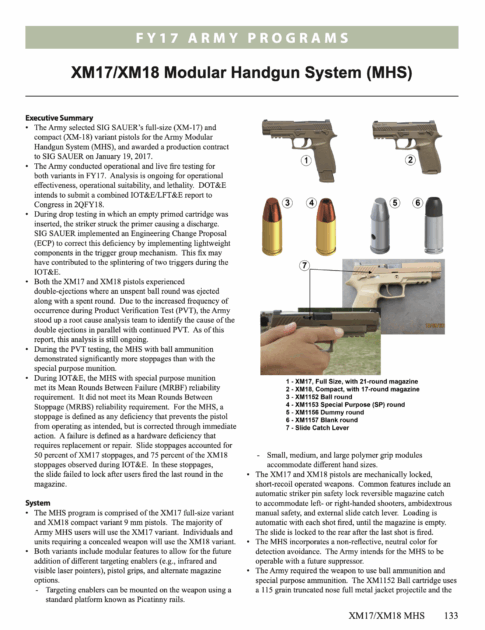
- “During drop testing in which an empty primed cartridge was inserted, the striker struck the primer causing a discharge.” In other words, the Sig p320 variant would fire when dropped at a particular angle and height.
- “Both the XM17 and XM18 pistols experienced double‑ejections where an unspent ball round was ejected along with a spent round.”
- With ball ammunition, neither the XM17 (full-sized p320 variant) nor the XM18 (compact-sized p320 variant) passed the requirement for Mean Rounds Between Stoppages (MRBS) and the XM18 also didn’t meet the requirement for Mean Rounds Between Failures (MRBF).
For the drop-safety issue, “The Army directed SIG SAUER to develop an ECP [‘Engineering Change Proposal’ – changes to a product’s design] to correct this deficiency. SIG SAUER modified the trigger mechanism to eliminate this deficiency. Subsequent testing validated that this ECP corrected the deficiency and the pistol no longer fired when dropped.”
For the failure to meet functional requirements, the MHS competition reliability requirements were for the pistols to shoot 5,000 Mean Rounds Between Failure (MRBF) (an average of 5,000 rounds of ammunition fired before a part breaks) and 2,000 Mean Rounds Between Stoppage (MRBS) (an average of 2,000 rounds fired before a stoppage defined as “any deficiency that prevents the pistol from operating as intended, but is corrected through immediate action.”)
The 5,000 MRBF and 2,000 MRBS requirements applied to both “special purpose ammunition” and “ball ammunition.” The XM17 and XM18 passed the requirements with “special purpose ammunition,” however, there were issues with standard ball ammunition.
With ball ammunition, the Sig XM17 passed the 5,000 MRBF requirement with 6,944 MRBF demonstrated but fell short of the 2,000 MRBS requirement with only 343 MRBS demonstrated. This means that, on average, the XM17 experienced a stoppage every 343 rounds.
With ball ammunition, the Sig XM18 fell short of both the 5,000 MRBF requirement with 3,906 MRBF demonstrated and also the 2,000 MRBS requirement with only 196 MRBS demonstrated. This means that, on average, the XM18 failed after 3,906 rounds and experienced a stoppage every 196 rounds.
The government summary explains that the majority of the stoppages were due to the slide not locking to the rear after the last round of a magazine was fired. The Army attributed this to a high-grip when firing by the soldiers and determined that the issue could be resolved with training.
Although the failure of the slide to lock back accounted for the majority of stoppages, if the slide locking issue were ignored/eliminated, the pistols still would have not met the 2,000 MRBS requirement. Removing the slide-lock issue would increase the results to only 708 MRBS for the XM17 and 950 MRBS for the XM18 – both at less than half of the requirement.
Glock alleges that the Army chose to go with the Sig pistol and end the testing early because of cost. The Congressional Research Service put the unit cost for each MHS pistol at $180. At that price, it would cost the military $85.2 million for all 473,216 pistols – this leaves questions about the contract’s ceiling price of $580 million. It is not clear what the remaining $494.8 million is for nor where any of the money may have went.
The first significant issue (or perceived issue) discovered by the public is the drop-safe issue.
Both the US Army and individuals in the civilian market have found that pistols based on the P320 platform can fire if dropped at a certain angle.
The issue exists when the pistol is dropped on the back of the slide and the trigger’s inertia carries the trigger rearward thereby firing the pistol. This issue with the P320 is due to the mass and spring tension of certain parts.
The Army brought this to Sig’s attention and Sig solved the issue by replacing certain parts with lighter-weight parts. Less mass in the newer replacement parts resulted in less inertial force.
Although Sig was aware of the problem and had a solution for the problem, Sig did not use these newer parts for the civilian commercial market until it became a public issue in August 2017 just after the Omaha Outdoors video. Until that video came out, they continued to use the older parts on civilian models of the pistol which would cause the p320 to fire when dropped at a certain angle.
After the Omaha Outdoors article and video, Sig stopped production of the p320 and stopped producing p320s with the older parts that would cause it to fire when dropped at a certain angle. Sig also started a voluntary upgrade program wherein anyone could send in their p320 to be upgraded so that it wouldn’t fire when dropped.
Sig insisted then, and continues to claim, that the P320 is the safest striker fired pistol on the market. However, if anyone was uncomfortable with their P320, Sig was happy to spend the time and money to upgrade the P320 free of charge.
One of Sig’s popular claims is that the P320 will not fire without the trigger being pulled. In this drop-safety issue, the claim is technically accurate because what caused the P320 to fire when dropped was the trigger moving to the rear under inertia.
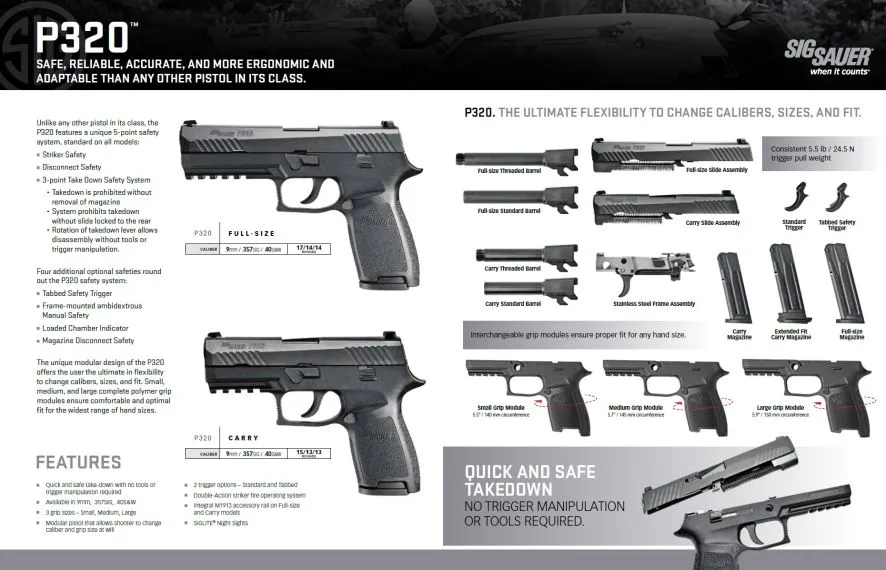
In addition to the new lighter parts, the issue could have been solved with a blade-style trigger safety that is common on almost every other striker fired pistol.
In fact, in an older brochure for the Sig P320, sig clearly contemplated a blade-style safety (see the top right trigger labeled “tabbed safety trigger” in this image below) but, for whatever reason, Sig chose not to use it.
At the time of this issue and the voluntary upgrade, Sig pointed out that the p320 passes every formal drop-safety test. Drop safety tests include certain heights and orientations and none of them called for passing a drop at a -30 degree angle.
In my opinion, once Sig was aware of this problem and they implemented a solution for the Army, they should have immediately fixed it in the civilian P320 as well.
After the voluntary upgrade and Sig started using the newer parts, the drop-safety issue stopped for all new and upgraded pistols (Of course, since it was not a recall, any of the 500,000 P320s since production started in 2014 that were not sent in for the voluntary upgrade still had the issue).
Even after the voluntary upgrade and the fixing of the drop-safety issue for new or upgrade P320s, the P320 was still being blamed for firing without the trigger being pulled.
This can be seen in the many lawsuits and claims about it over the years.
In many cases, it appears that a foreign object made it’s way into the trigger guard, pulled the trigger, and thereby discharged the firearm. In these cases the pistol’s design was blamed, however, it performed as designed – to fire when the trigger is pulled.
There have also been claims that the P320 is firing after being “jostled” or by having the slide manipulated without the trigger being pulled.
The issue here seems to be that the P320 is a striker-fired pistol that is fully-charged when it is at rest. The best example to explain this is a pinball machine ball launcher. In a Glock pistol, the launcher is pulled back as the trigger is pulled and then it is released. In a Sig P320, however, the “launcher” (striker) is pulled all the way to the rear as its normal state and it simply released upon the trigger’s pull.
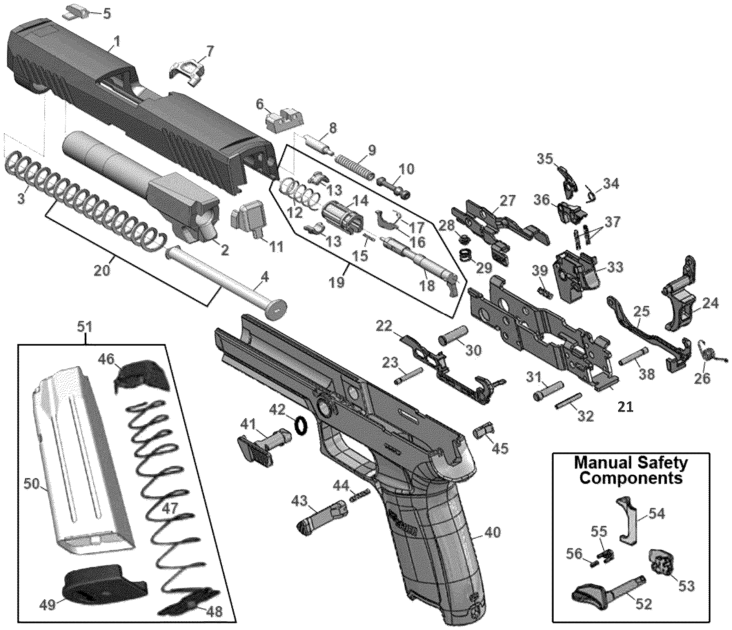
In the P320, the striker is held to the rear by a small notch in the sear (a component of the trigger assembly). When the trigger is pulled, the sear is lowered which releases the striker. If the striker is able to over-ride (or slip over) the small notch in the sear, then the striker can move forward on its own.
To prevent this from causing a discharge, the Sig P320, like most other modern pistols, has a safety mechanism in the slide that prevents the striker (or firing pin) from moving forward enough to strike a primer and fire a round. This safety mechanism is designed to move out of the way only when the trigger is pulled.
Although this should stop a round from firing if the striker slips off the sear, it is a mechanical device that can fail.
In some of the claims of uncommanded discharges, it appears as if the pistol’s slide can be manipulated enough to cause the striker to slip off the sear. If the safety mechanism in the slide is working, a round wont be fired. If it fails, a discharge will occur.
Upon seeing these issues, I grabbed one of my personal P320 pistols to investigate. I found that I could, occasionally, get the striker to release by simply manipulating my slide. I could get it to release more often if I moved the trigger approximately 1/8th of an inch to the rear (I’m estimating that the P320’s trigger has about 3/4th of an inch of pre-travel before it will fire) while also jostling the slide.
The most concerning condition I found, however, was during a “function check” of the pistol where I pulled the trigger to release the striker, held the trigger to the rear, and then re-charged the pistol by puling and releasing the slide. At this point, with the trigger still held to the rear, I can get the pistol to fire every time by simply moving the slide.
What I found is NOT the same as a P320 just “going off by itself in a holster.” However, it does show to me that there is an issue with the design wherein the tolerances allow a slide movement to release the firing mechanism.
This should not happen on any firearm.
It appears that it is at least possible for the P320 to fire after being jostled – especially if the internal safety mechanism in the slide is stuck or otherwise inoperable.
A former engineer for Sig has invented a fix for the P320’s firing mechanism. Brian McDonald has a patent for a replacement kit that proposes to fix the safety issues with the Sig P320. Currently, the design is owned by Angled Spade.
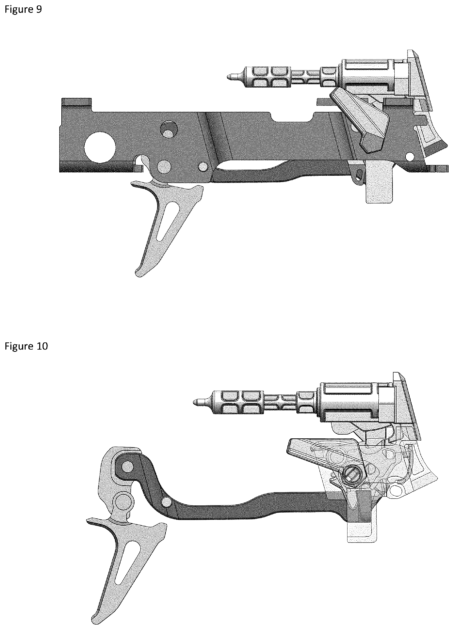
So far, Sig’s response has been to say that there’s nothing wrong with the P320. They continue to claim that it is 100% safe and it is the “most tested pistol in the world.”
Unfortunately, I have direct experience of the striker sliding over the sear for an uncommanded discharge condition, there are simply too many claims and injures attributed to the P320, and things like the Army’s MHS results draw serious concerns about bot only the P320 but also what Sig is telling us.
Sig has gone on the offensive and is suing organizations that have banned the P320 for safety concerns and recently sent out an email and statement asking people to report on ranges or training institutions that have banned the P320.
In my opinion, Sig needs to admit that the P320 is not safe, recall every single P320, and either fix the design or replace it with something else. If Sig does anything short of this, they risk more people being injured or killed, they risk long-term brand damage, they risk being sued by police departments and civilians, and they will lose our trust.

