


[[{“value”:”
Thank you for reading this post, don't forget to follow and signup for notifications!

Designate The Lodge at AmmoToGo.com as your preferred source on Google News
Whether you need a cartridge for prairie dog hunting, varmint control, or long-range, shoulder-friendly rifle shooting, the .22-250 Remington and the .204 Ruger are excellent choices. They are noticeably similar, so choosing one or the other can be difficult. But if you know what you want to do with the rifle, and if you understand […]
Whether you need a cartridge for prairie dog hunting, varmint control, or long-range, shoulder-friendly rifle shooting, the .22-250 Remington and the .204 Ruger are excellent choices. They are noticeably similar, so choosing one or the other can be difficult.
But if you know what you want to do with the rifle, and if you understand the cartridge options and capabilities of both rounds, you can easily choose between the classic .22-250 Remington and the relatively new .204 Ruger.
.22-250 Remington vs .204 Ruger: Specs
.22-250 Remington.204 Ruger
Released1965 (Used since 1936) 2004
Bullet Diameter0.224 inches0.204 inches
Neck Diameter0.26 inches0.2311 inches
Base Diameter0.445 inches0.3764 inches
Case Length2.205 inches1.85 inches
Overall Length2.68 inches2.2598 inches
Bullet Weights35 – 64 grains24 – 40 grains
Case Capacity0.2052 cubic inches0.1415 cubic inches
Typical FirearmBolt-action riflesBolt-action rifles
Physical Shape, Size, and Weight
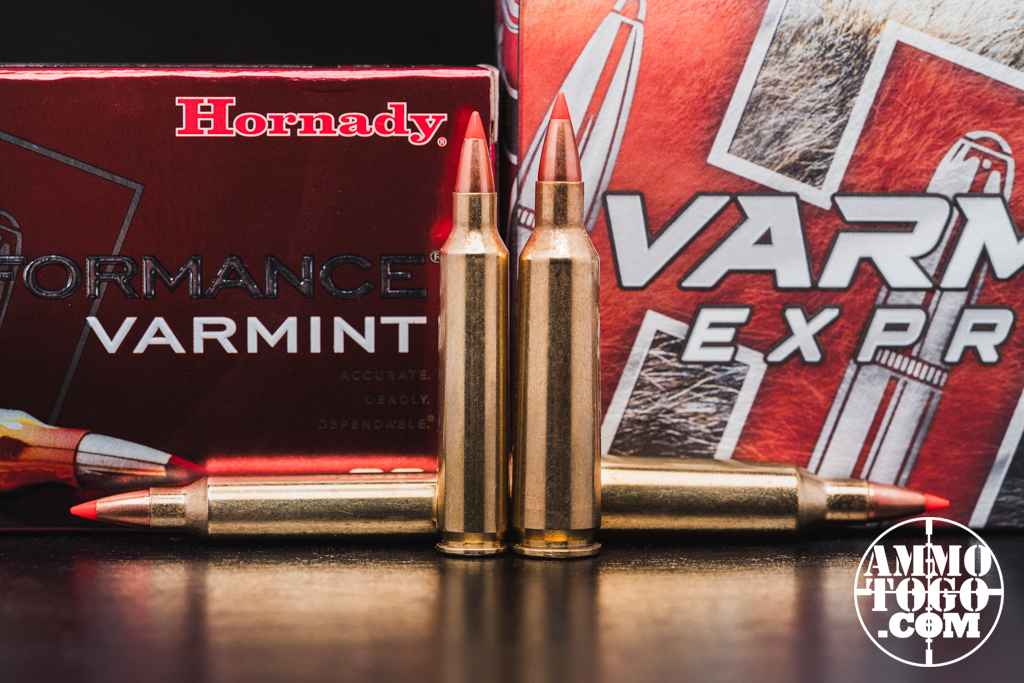
Physically, these two cartridges are highly similar. If you were to hold both in your hand, the differences would be hard, but not impossible, to spot. After closely examining you two, you’d see that the .22-250 is a bit larger than the .204 Ruger; the bullet is wider (obviously), and the case length and base diameters are larger as well.
Also, the .22-250 packs larger bullets. There is some overlap in the range of 35 to 40 grains, but the .22-250 can go as high as 64 grains while 204 Ruger ammo ranges from about 24 to 40 grains in bullet weight.
The Ammo Market
These bullets are not considered rare, but neither is extremely common. Gun owners will likely find the .22-250 is more readily available, but it doesn’t have the mass following of popular and prevalent rounds like the .223 Remington, .22 LR, or the .30-30 Winchester. That said, there are likely more .22-250 options on store shelves compared to the .204 Ruger.
You’ll find .22-250 ammo in greater variety. While the rounds share nearly identical purposes, the .22-250 can be used for whitetail deer and other game. There are even .22-250 products marketed directly to deer hunters. This is not the case with the smaller .204 Ruger.
For example, when this article was written there were five .204 Ruger options at Ammo To Go. At the same time, there were 12 .22-250 Remington products. For perspective, there were 117 .223 Remington/5.56 NATO rounds and 69 .30-06 Springfield options.
Ultimately, what matters to hunters, land owners, and hobby shooters is performance. Speed, power, accuracy. Regardless of size, market conditions, and price, these are the things that matter to gun owners…
22-250 vs 204 Ruger: Ballistics
Velocity
| Ammo | Muzzle Velocity (fps) | 100-Yards | 200-Yards | 300-Yards | 400-Yards |
|---|---|---|---|---|---|
| 22-250 – 35 Gr. Hornady Superformance | 4,450 | 3,736 | 3,128 | 2,598 | 2,125 |
| 22-250 – 40 Gr. Nosler Ballistic Tip | 3,950 | 3,420 | 2,950 | 2,527 | 2,141 |
| 22-250 – 50 Gr. Sierra Prairie Enemy | 3,800 | 3,367 | 2,976 | 2,618 | 2,260 |
| 22-250 – 60 Gr. Winchester Power Point | 3,500 | 3,086 | 2,708 | 2,360 | 2,038 |
| 22-250 Average | 3,925 | 3,402 | 2,941 | 2,526 | 2,141 |
| 204 Ruger – 24 Gr. Hornady Superformance | 4,400 | 3,667 | 3,046 | 2,504 | 2,023 |
| 204 Ruger – 32 Gr. Nosler Varmageddon | 4,000 | 3,433 | 2,934 | 2,487 | 2,081 |
| 204 Ruger – 36 Gr. Sierra Prairie Enemy | 3,840 | 3,397 | 2,971 | 2,570 | 2,203 |
| 204 Ruger – 40 Gr. Remington AccuTip | 3,900 | 3,482 | 3,103 | 2,755 | 2,433 |
| 204 Ruger Average | 4,035 | 3,495 | 3,014 | 2,579 | 2,185 |
Both rounds are among the fastest cartridges available on the market. Both offer blazing speed near or above 4,000 fps, with lighter options in both rounds reaching 4,400 fps. With similar bullet sizes, it appears the .22-250 may have a slight speed advantage thanks to the larger case, but it’s not a clear, runaway victory.
Energy
| Ammo | Muzzle Energy (ft-lbs) | 100-Yards | 200-Yards | 300-Yards | 400-Yards |
|---|---|---|---|---|---|
| 22-250 – 35 Gr. Hornady Superformance | 1,539 | 1,085 | 761 | 524 | 351 |
| 22-250 – 40 Gr. Nosler Ballistic Tip | 1,386 | 1,038 | 773 | 567 | 407 |
| 22-250 – 50 Gr. Sierra Prairie Enemy | 1,603 | 1,259 | 984 | 761 | 567 |
| 22-250 – 60 Gr. Winchester Power Point | 1,741 | 1,353 | 1,042 | 791 | 590 |
| 22-250 Average | 1,567 | 1,184 | 890 | 661 | 479 |
| 204 Ruger – 24 Gr. Hornady Superformance | 1,032 | 717 | 494 | 334 | 218 |
| 204 Ruger – 32 Gr. Nosler Varmageddon | 1,137 | 837 | 612 | 439 | 308 |
| 204 Ruger – 36 Gr. Sierra Prairie Enemy | 1,178 | 992 | 706 | 528 | 388 |
| 204 Ruger – 40 Gr. Remington AccuTip | 1,351 | 1,077 | 855 | 674 | 526 |
| 204 Ruger Average | 1,175 | 906 | 667 | 494 | 360 |
With the energy statistics, we begin to see a difference between the two: the larger .22-250 has a clear power advantage. In fact, the weakest .22-250 had a muzzle velocity that was more powerful than the strongest .204 Ruger.
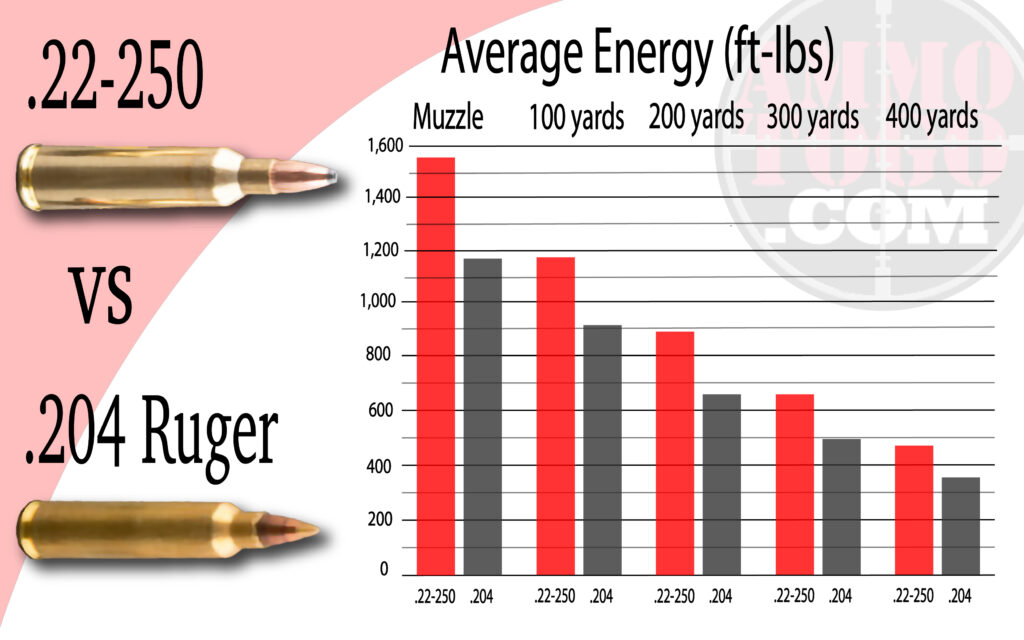
The difference is clear, but power concerns may not be as large of an issue compared to other rounds. These cartridges are used for clearing prairie dogs, removing varmints, and striking artificial targets. You don’t need a lot of power for any of these activities. So while the .22-250 excels in power, it may not matter to you.
Trajectory
| Ammo | Drop at 300 yards when zeroed to 200 (Inches) | Drop at 400 yards when zeroed to 200 (Inches) |
|---|---|---|
| 22-250 – 35 Gr. Hornady Superofrmance | 4.2 | 13.4 |
| 22-250 – 40 Gr. Nosler Ballistic Tip | 4.8 | 15.1 |
| 22-250 – 50 Gr. Sierra Prairie Enemy | 4.7 | 14.6 |
| 22-250 – 60 Gr. Winchester Power Point | 5.9 | 18 |
| Average 22-250 Drop | 4.9 | 15.3 |
| 204 Ruger – 24 Gr. Hornady Superformance | 4.3 | 14.3 |
| 204 Ruger – 32 Gr. Nosler Varmageddon | 4.8 | 15.3 |
| 204 Ruger – 36 Gr. Sierra Prairie Enemy | 4.7 | 14.8 |
| 204 Ruger – 40 Gr. Remington AccuTip | 4.3 | 13.2 |
| Average of 204 Ruger | 4.5 | 14.4 |
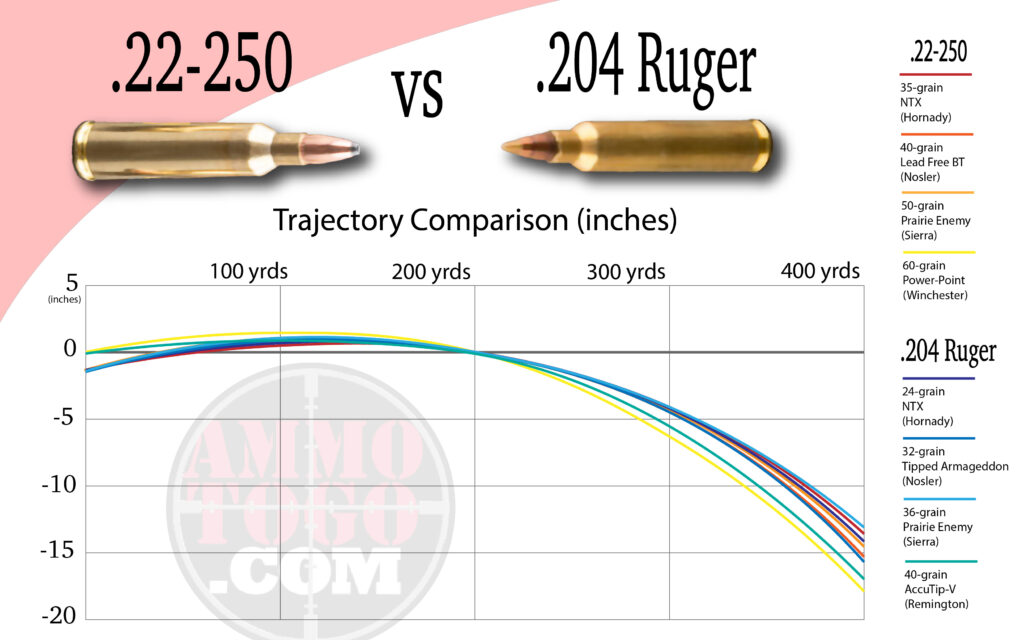
Again, we see strikingly similar statistics. The .204 Ruger appears to have straighter trajectories, but only by roughly a half in at 300 yards and less than an inch at 400 yards. Most shootings, with decent scope and plenty of practice, can handle the difference.
Recoil
Here is one area where the .204 Ruger has a slight advantage. The round was created to have similar stats (specifically velocity) as the .22-250 Remington. But it was meant to do so with a lower recoil. By most accounts, it has met this goal, as most agree it is easier on the shoulder than the .22-250.
Summary
These two rounds have a lot in common, so after learning about their statistics and performance capability, which should you choose? Here’s a summary…
Choose the .22-250 Remington if…
The .22-250 is a great choice if you want a little more power and greater versatility. The .22-250 can basically do everything as the .204 Ruger, but you’ll also have the potential to use it as a deer-hunting round. Also, with greater downrange energy, it may be a better option for long-distance coyote and hog hunting.
Choose the .204 Ruger if…
The .204 Ruger is a superior option if you want lighter recoil. New hunters and smaller individuals may appreciate the light performance of this round. (Although, to be fair, the .22-250 is not a shoulder-hammering round either.) Also, if you want to preserve small game pelts, such as rabbit or fox pelts, the smaller .204 Ruger will deliver the small yet effective wound you need.
From the field to the range, these rounds are excellent for many uses. When you need a box of .22-250 Remington or .204 Ruger ammunition, visit our shop at ammotogo.com!
“}]]

